A Beginner's Guide to Reformer Pilates
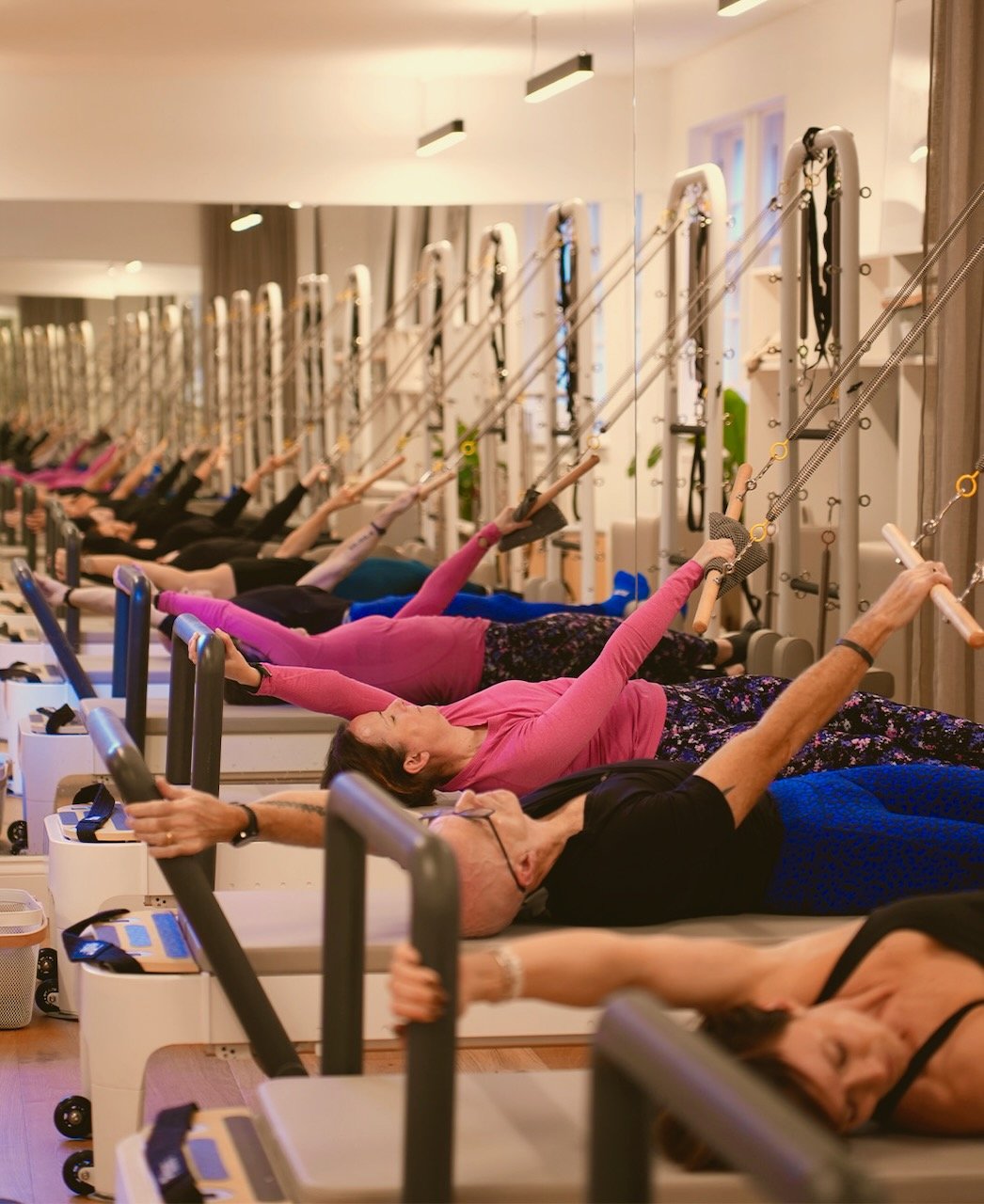
A Tower class in full flow at Luma Pilates, New Town Edinburgh
In a nutshell
Reformer Pilates is a form of Pilates performed on a spring-based machine called a Reformer. The carriage, springs, straps and footbar create adjustable resistance and support, allowing exercises to be adapted for complete beginners through to experienced practitioners. If you are new to Reformer Pilates, the first few classes are mainly about learning how the machine works, understanding the basic movement vocabulary and building confidence with the equipment.
In this guide
- What is Reformer Pilates?
- Who is Reformer Pilates for?
- What happens in your first class?
- How the class levels work at Luma
- What Reformer Pilates actually does
- How often should you do Reformer Pilates?
- Reformer Pilates vs other forms of exercise
- Pilates for specific goals and life stages
- Private vs group Reformer Pilates
- Is Reformer Pilates worth it?
- How much does Reformer Pilates cost in Edinburgh?
- Reformer Pilates classes in Edinburgh
What is Reformer Pilates?
Reformer Pilates is a full-body form of exercise performed on a spring-loaded machine called a Reformer. Unlike Mat-based Pilates, the Reformer uses a sliding carriage and adjustable resistance to challenge the body across a wide range of movements. That resistance can be increased or reduced, which is one reason the same machine can work for a complete beginner and an experienced practitioner.
The practice is rooted in the principles Joseph Pilates developed in the early twentieth century: control, precision, breathing, centring, and flow. The Reformer adds adjustable resistance and support, giving instructors considerable scope to change the load, range, and complexity of an exercise.
Who is Reformer Pilates for?
A very wide range of people.
At Luma Pilates, we teach clients from their twenties to their eighties: complete beginners who have never set foot on a Reformer, experienced runners and cyclists, people who spend most of their working lives at a desk, and clients in their fifties, sixties, seventies, and beyond who want to maintain strength and movement as they age.
Our lead instructor Lucia Poulter has spent 26 years teaching Pilates. One of the things that has kept her interested in the method for so long is how adaptable it is. The same principles can be taught very differently depending on the person in front of you.
You do not need to be flexible, particularly fit, or experienced before you begin. You do need to start at the right level and let the work build from there.
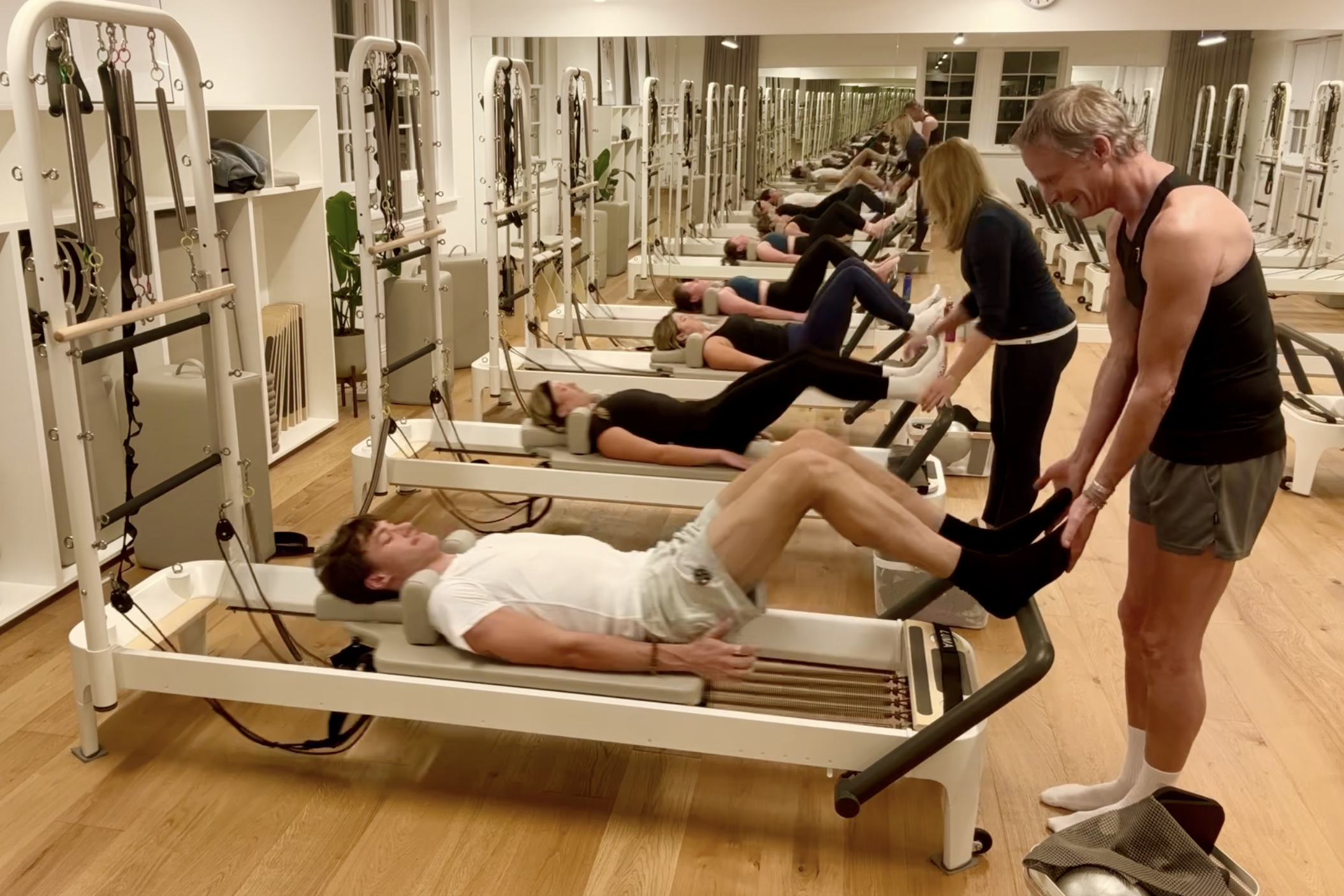
Lucia and Max cueing footwork in a Reformer Fundamentals class
What happens in your first class?
We've written a dedicated guide to your first class. For now, here's what to expect.
If you're new, we'd recommend starting with Reformer Fundamentals, our entry-level class designed specifically for people who are new to the Reformer. You'll learn how the machine works, the key movement principles, and the foundational exercises that underpin everything else. There's no pressure, no performance, and no prior experience required.
As your confidence builds, you can progress through Reformer Fundamentals Progressing and into Reformer Pilates 1, 2, and 3 as your practice develops.
How the class levels work at Luma
Luma's Reformer classes run from Reformer Fundamentals through to Reformer Pilates 3, with a deliberate progression between each level. The foundational work is not a simplified version of the real thing. It is the real thing, and it needs to be established properly before the practice can develop.
Your instructor will advise when you're ready to move up. Progression is guided by whether the foundational patterns are genuinely in place, not by how many classes you have attended. See the full Reformer Pilates levels at Luma for more detail on each class.
There is no fixed timetable for progressing. Some people become comfortable with the foundations quickly; others benefit from spending considerably longer at a particular level. What matters is not how fast you move through the system, but whether you have the control and understanding required for what comes next.
| Level | Suitable for | Typical timeframe |
|---|---|---|
| Reformer Fundamentals | Complete beginners, new to the machine | First 4 to 8 weeks |
| Reformer Fundamentals Progressing | Building confidence, foundations established | 1 to 3 months |
| Reformer Pilates 1 | Solid technique, ready for more challenge | 3 to 6 months |
| Reformer Pilates 2 | Strong practice, comfortable with complexity | 6 to 12 months |
| Reformer Pilates 3 | Experienced practitioners, fluent in the vocabulary | 12 months plus |
What Reformer Pilates actually does
The evidence base for Pilates is real, but it is more nuanced than some of the claims made about it. Research supports benefits across areas including strength, physical function, flexibility, and some pain-related outcomes, while also showing that Pilates is not uniquely superior to every other well-structured form of exercise.
What it offers is a particular way of working.
It builds strength and control. Pilates places particular emphasis on the trunk, hips, shoulders, and the coordination between them. Research supports improvements in trunk strength and endurance following Pilates training, although other well-designed forms of exercise can produce similar gains. What the Reformer adds is adjustable resistance and a precision-focused way of developing that strength.
It develops body awareness and postural control. Pilates teaches you to notice how you organise your body in different positions and gives you more control over how you move between them. That can change how you sit, stand, and carry yourself, but it is more useful to think in terms of awareness and adaptability than the idea that Pilates "fixes" one correct posture. Read more in our guide to why Pilates improves posture.
It can be adapted around injuries and physical limitations. The resistance, range, and starting position of an exercise can all be changed on the Reformer. That makes it a useful format for many people returning to movement after injury or managing ongoing symptoms, provided the exercise is appropriate to their situation. Pilates is not a substitute for physiotherapy or medical care, and individual assessment matters when an injury or condition is involved.
It develops movement through range. Pilates combines strength and mobility rather than treating them as separate qualities. Over time, clients often notice greater ease in movement and less stiffness. Read more in our guide to Pilates for flexibility.
It can complement other forms of exercise. Runners, cyclists, swimmers, dancers, and gym-goers often use Reformer Pilates alongside their main activity to develop strength, control, coordination, and movement quality. See our guide to Pilates for runners.
It demands concentration. A Pilates session asks you to coordinate movement, resistance, breath, and detailed cueing at the same time. Many clients value the fact that for fifty minutes there is very little room to think about anything else.
How often should you do Reformer Pilates?
There is no single frequency that everyone needs.
Two or three sessions a week gives you more opportunity to build strength, familiarity, and consistency with the practice. A regular weekly session can still be valuable, particularly if Pilates sits alongside other forms of movement or exercise.
More is not automatically better. What matters is a frequency that you can sustain and recover from, and that fits with what else you do.
See our full guide to how often you should do Pilates for a breakdown by goal and lifestyle.
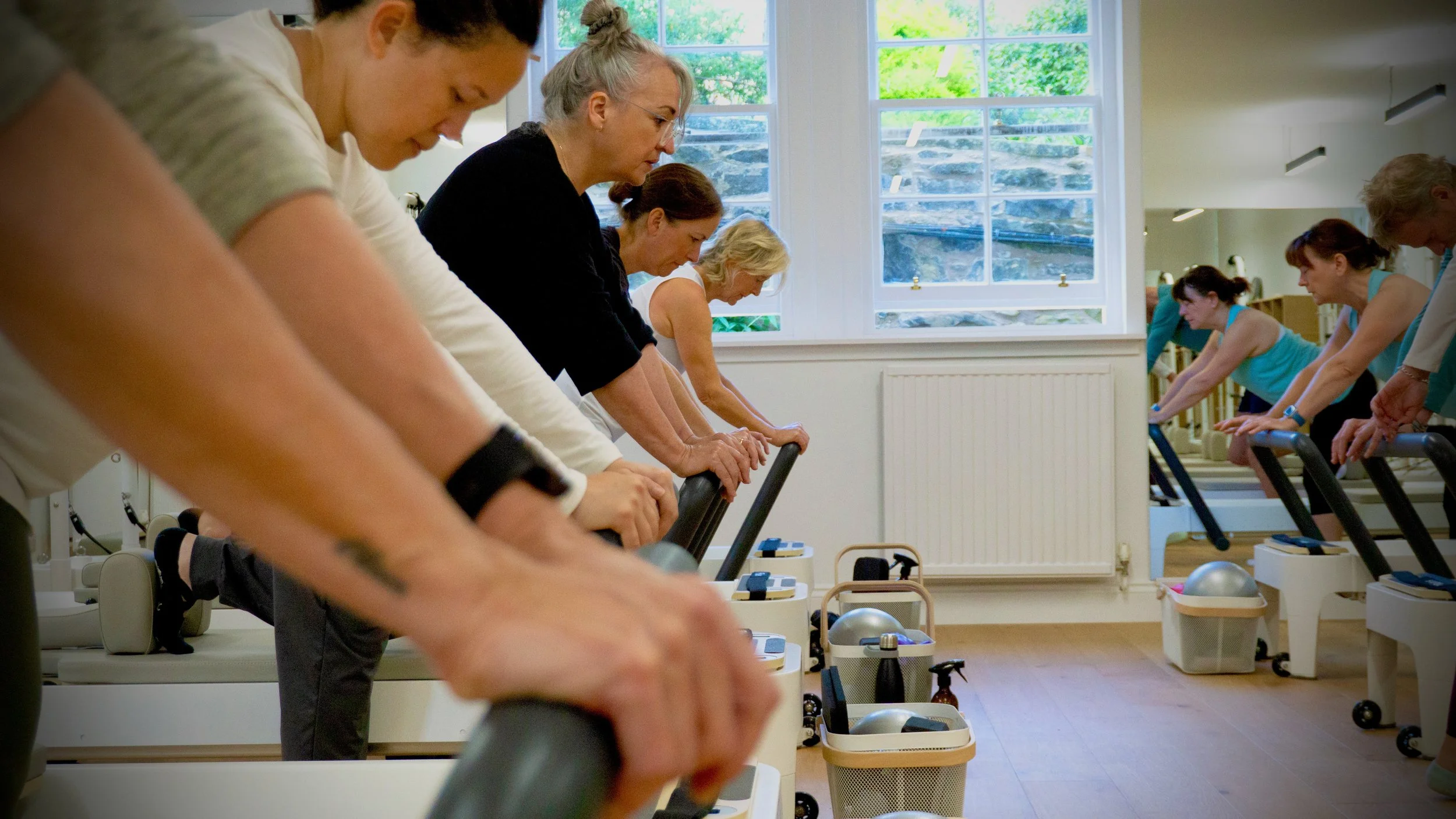
All levels, all ages – a Reformer class at Luma Pilates, Edinburgh
Reformer Pilates vs other forms of exercise
Reformer Pilates sits alongside other forms of exercise rather than replacing them. Here's a brief comparison of the most common questions. Each links to a dedicated guide for more detail.
Reformer Pilates vs the gym. Both build strength, but in different ways. The Reformer emphasises control, coordination and movement quality; the gym offers more options for heavy external loading. Many people do both. Read our full comparison of Reformer Pilates vs gym workouts.
Reformer Pilates vs Mat Pilates. Mat Pilates uses bodyweight and small props on the floor. The Reformer adds spring resistance and a moving carriage. Both use the same underlying Pilates principles. Read our guide to Reformer vs Mat Pilates.
Reformer Pilates vs physiotherapy. Physiotherapy is clinical assessment and treatment by a regulated healthcare professional. Pilates is exercise and movement instruction. They can work well alongside one another but one does not replace the other. Read our guide to Pilates vs physiotherapy.
Yoga vs Pilates. Both involve movement, body awareness and breath, but their methods and emphasis differ. Read our guide to Yoga vs Pilates for posture.
Pilates for specific goals and life stages
Reformer Pilates adapts well to different bodies, goals and life stages. The guides below go into detail for specific situations.
For beginners. You don’t need any previous Pilates experience to start. Read our guide to whether beginners can do Reformer Pilates.
For men. Pilates offers strength, control and mobility that many men find very different from their existing training. Co-founder Max Howarth came to the practice in his fifties and runs men-only Reformer classes on Tuesday evenings and Sunday lunchtimes. Read his guide to Pilates for men in Edinburgh or see our dedicated men's Reformer class page.
For runners. Read our guide to whether Pilates is good for runners.
For cyclists. Read our guide to Pilates for cyclists in Edinburgh.
For ballet dancers. Read our guide to Pilates for ballet dancers in Edinburgh.
For lower back pain. Pilates can be one useful form of exercise for some people with persistent lower back pain, particularly when the work is appropriately adapted. Read our guide to Pilates for lower back pain.
During menopause. Read our guide to Pilates and Yoga during menopause.
For injury recovery. The right starting point depends on the injury, stage of recovery and any guidance from a physiotherapist. Read our guide to Pilates for injury recovery.
Private vs group Reformer Pilates
Group classes offer consistency, community, and excellent value. Private sessions offer a different kind of attention: the whole session can be built around your body, history, and goals.
Most clients can begin in a group class. A private session is particularly useful when you have a significant injury history or medical consideration, are returning after surgery, want an instructor to understand something in detail before you enter a group setting, or have a specific aspect of your practice that you want to work on closely.
Read our full guide to private vs group Pilates classes.
At Luma, private 1:1 sessions are £90 and private 1:2 sessions are £135. View all pricing.
Is Reformer Pilates worth it?
For the right person, yes.
The value is not simply in using the machine. It is in good teaching, appropriate progression, and a practice that you can sustain long enough for it to become useful.
If you come regularly, want to build strength and movement quality, and value being taught in a small class where the instructor can actually see what you are doing, Reformer Pilates can be a worthwhile investment.
How you pay for it depends on how often you expect to come. If your schedule is unpredictable, a Class Pack may make more sense. If Pilates is already a regular part of your week, a Subscription can reduce the per-class cost.
For a full breakdown, see our guide to how to choose between Class Packs and Subscriptions at Luma. If you're leaning towards a Subscription, our guide to Luma membership benefits covers what is included.
How much does Reformer Pilates cost in Edinburgh?
At Luma, new clients can start with our introductory offer of three Reformer or Tower classes for £48. From there, Class Packs and Subscriptions are available at different frequencies and commitment levels, with the per-class rate reducing as you attend more regularly.
See our full Reformer Pilates prices and membership options for current rates.
Reformer Pilates classes in Edinburgh
Luma Pilates is a Reformer, Tower, Mat, Barre and Yoga studio at 15 Northumberland Street NE Lane in Edinburgh's New Town. Classes are kept deliberately small so instructors can see how you are moving and adjust accordingly.
If you’re new, start with Reformer Fundamentals. From there, the practice develops progressively as your confidence, control and understanding grow.
Explore Reformer Pilates classes in Edinburgh to see class levels, beginner information and how to get started.
Written by Lucia Poulter
Lucia is lead instructor and co-founder at Luma Pilates, with 26 years of teaching experience and Comprehensive BASI certification. She has introduced hundreds of clients to the Reformer, and this guide reflects the questions she answers most often in the studio.