Pilates Glossary: Terms Worth Knowing
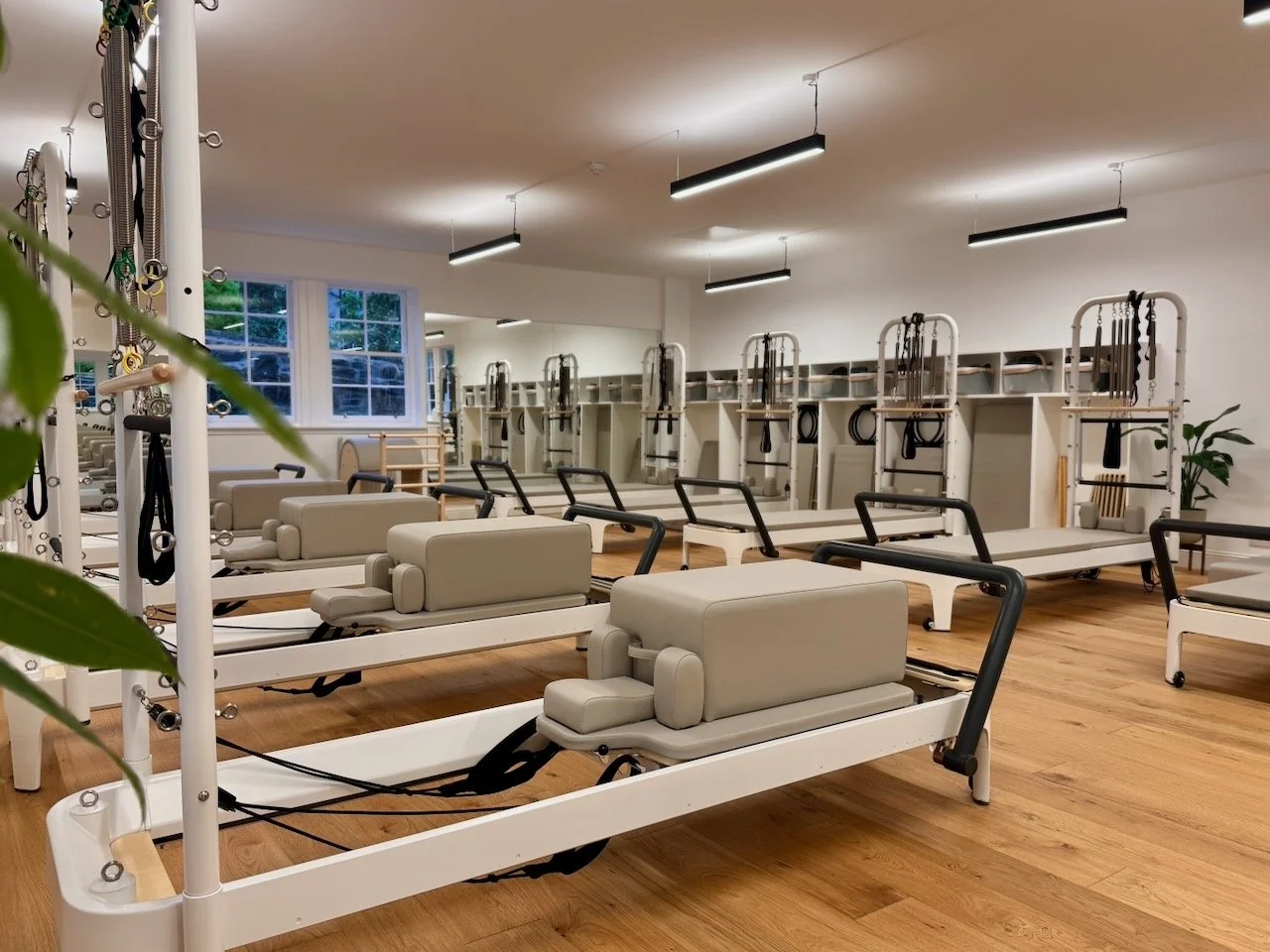
The Reformer and Towers at Luma Pilates. Carriage, footbar, shoulder blocks, straps, and Tower frame visible
In a nutshell
A plain-English Pilates glossary covering the terms that come up most in Reformer Pilates classes. Equipment, movement principles, anatomy, and Pilates-specific language, all explained the way a good instructor would explain them, without unnecessary jargon.
Pilates has its own vocabulary. Most of it is straightforward once someone explains it, but walking into your first class and hearing words like "posterior chain", "neutral spine", or "eccentric loading" without context is unnecessarily confusing.
This glossary covers the terms that come up most at Luma. It is not exhaustive, and it is not written for specialists. It is written for people who want to understand what their instructor is talking about so they can get more from every class.
In this guide
Jump to term
Equipment
Reformer: The spring-loaded machine at the centre of Reformer Pilates. It consists of a sliding carriage, a footbar, a set of springs, and adjustable straps. The carriage moves along rails in response to your movement, and the springs provide resistance or assistance depending on how they are configured. Because the load, support, and range can all be adjusted, the same machine can be used by complete beginners and experienced practitioners. See Reformer Pilates classes at Luma.
Carriage: The sliding platform you lie, sit, kneel, or stand on during a Reformer class. It moves along rails when you push or pull against the footbar or straps. The weight of the carriage and the spring resistance both affect how the exercise feels.
Footbar: The adjustable bar at one end of the Reformer that your feet or hands press against during many exercises. It can be moved to different heights and positions depending on the exercise and the individual using the machine.
Springs: The mechanism that creates resistance or assistance on the Reformer. Springs attach the carriage to the frame and can be added or removed to change the load. More springs do not always mean a harder exercise: depending on the movement, heavier springs can also provide greater support or stability. Your instructor will set the spring configuration for each exercise.
Straps: Loops attached to the Reformer through a pulley system. They are held in the hands or placed around the feet for arm and leg work, allowing movement against the spring resistance through a wide range.
Box: A padded platform that sits on the carriage and changes the working position for certain exercises. It is used for prone, seated, and side-lying work, as well as exercises that require the body to be elevated from the carriage.
Long box: The box positioned lengthways along the carriage. It is used for exercises including pulling straps, swan, and other prone or seated work. Turned across the carriage, the same box is commonly referred to as the short box.
Tower: An attachment that adds a vertical frame with additional spring points to the Reformer. Tower work uses springs attached from different heights and positions, expanding the repertoire available on the machine. At Luma, Tower classes use the Tower attachments fitted to our Reformers. Tower classes at Luma use the Tower attachments fitted to our Reformers. See Reformer and Tower classes.
Headrest: The adjustable pad at the top of the carriage that supports the head during certain lying exercises. It can be raised or lowered depending on the exercise and the individual.
Shoulder block: The padded blocks on the carriage near the headrest. They provide a surface for the shoulders to work against during exercises such as footwork and help position the body on the moving carriage. They can also be removed for exercises where a flat surface is required.
Cadillac: A freestanding Pilates apparatus consisting of a raised padded table with a frame above it, fitted with springs, bars, and loops at different heights. It provides a large repertoire of supported and resisted exercises. At Luma, the Tower attachments on our Reformers allow us to teach much of the Tower-based repertoire without a separate full Cadillac.
Movement Terms
Footwork: A foundational Reformer sequence usually performed lying on the carriage with the feet on the footbar. The legs press the carriage away and return it through a series of foot positions. Footwork introduces spring resistance, alignment, coordination, and lower-body strength. It looks simple. It rarely feels simple.
Spinal articulation: Moving the spine sequentially rather than as one rigid unit. In Pilates you may hear an instructor ask you to roll, curl, or articulate through the spine. These exercises explore controlled flexion and extension through different parts of the spinal column.
Neutral pelvis: A useful reference position in which the pelvis is neither strongly tilted forward nor tucked under. When lying on your back, instructors may describe this as having the front hip bones and pubic bone roughly level. Neutral pelvis is a common starting point, not a position the body needs to remain in all the time. Read more in our guide to why Pilates improves posture.
Neutral spine: A reference position in which the natural curves of the spine are maintained without deliberately exaggerating or flattening them. It is a useful starting position for many exercises. Pilates also deliberately trains the spine away from neutral through flexion, extension, side bending, and rotation. There is no single ideal spinal position that everyone should maintain throughout daily life.
Imprinted spine: A position in which the pelvis is slightly tilted and the lower back moves closer to the carriage, reducing the lumbar curve. It may be used for particular exercises or to change how the abdominal work is organised. Your instructor will tell you when it is appropriate.
Eccentric loading: When a muscle produces force while lengthening. For example, the quadriceps work eccentrically as you control the return from a squat. Reformer springs create resistance on both the moving-out and returning phases of many exercises, allowing this lengthening-under-load phase to be trained in a controlled way. Read more in our guide to Reformer Pilates vs gym workouts.
Doming / coning: A visible ridge or bulge along the midline of the abdomen during an exercise. It can occur when the abdominal wall is not managing the pressure created by the movement particularly well at that moment. It is especially relevant during pregnancy and postnatal recovery, but it can occur in other contexts too. An instructor may reduce the load, range, or complexity of an exercise when they see it.
Sagittal plane: The plane that divides the body into left and right halves. Flexion and extension – movements such as walking forwards, squatting, or bending and straightening the spine – largely occur in this plane. Pilates also includes frontal-plane movement, such as side bending and abduction, and transverse-plane movement, such as rotation.
Kinetic chain: A way of describing how different joints and body regions contribute to a movement together. The hip, knee, ankle, trunk, and shoulder do not operate independently of one another. Pilates frequently uses whole-body exercises that require several areas to coordinate rather than isolating one muscle at a time.
Active flexibility: The range of movement you can reach and control using your own muscular effort. Passive flexibility describes the range available when an outside force — another person, gravity, or a prop — takes you further. Pilates often combines mobility and strength by asking you to control movement through an increasing range.
Centring: One of the traditional Pilates principles. It refers to organising movement from the centre of the body rather than thinking only about the moving arm or leg. In practice, this means coordinating the trunk, pelvis, breath, and limbs so that the movement works as a whole.
Lateral breathing: A breathing technique used in Pilates in which the breath expands laterally into the ribcage rather than primarily into the belly. It allows the deep abdominal muscles to remain active during breathing rather than releasing with each inhale.
Tabletop: A position in which the hips and knees are both at roughly ninety degrees with the shins parallel to the floor. It is a common starting position for many supine abdominal exercises.
Anatomy
Adductors: A group of muscles on the inner thigh whose roles include drawing the leg toward the midline and contributing to hip and pelvic control. Pilates exercises train the adductors in a variety of positions, both as prime movers and as part of wider lower-body coordination.
Anterior pelvic tilt: A position in which the front of the pelvis rotates forward relative to the back, usually increasing the curve of the lower back. Some degree of anterior pelvic tilt is normal and varies considerably between individuals. In Pilates, the aim is not necessarily to "correct" it, but to develop awareness and control of different pelvic positions.
Cervical spine: The upper section of the spine, made up of seven vertebrae from the base of the skull to the upper back. It supports the head and allows flexion, extension, rotation, and side bending. Pilates exercises often include awareness of how the head and neck relate to the thoracic spine and shoulder girdle.
Deep neck flexors: Small muscles at the front of the cervical spine that contribute to control and positioning of the head and neck. They can be trained through gentle cervical control exercises and through movements where the head and trunk need to remain coordinated.
Deep spinal stabilisers: A general term used for muscles close to the spine and abdominal wall that contribute to control of the trunk. Two commonly discussed in Pilates are the multifidus and transverse abdominis. These muscles work together with many larger muscles, the diaphragm, and the pelvic floor rather than acting as a separate "inner core." Read more in our guide to Pilates for lower back pain.
Diastasis recti: A widening of the space between the two sides of the rectus abdominis at the linea alba. It occurs to some degree in most pregnancies and is a normal adaptation to the growing uterus. After birth, the gap often reduces naturally. What matters clinically is not simply the width of the gap but how well the abdominal wall manages pressure and load. Some exercises may need to be modified if they increase doming, pressure, discomfort, or symptoms. A women's health physiotherapist can assess abdominal-wall function where needed.
Glutes: The gluteal muscles – gluteus maximus, medius, and minimus – are situated around the back and side of the hip. Together they contribute to hip extension, rotation, abduction, pelvic control, and lower-limb movement. Reformer Pilates trains them through exercises such as footwork, bridging, standing work, and resisted hip movement.
IT band: The iliotibial band is a strong band of connective tissue running along the outside of the thigh from the pelvis toward the knee. It is not a muscle and does not behave like one when stretched. Pain around the outside of the knee or hip can have many contributing factors, so exercise programmes are usually based on the individual's symptoms and movement rather than trying to "stretch the IT band" itself.
Linea alba: The connective tissue running vertically down the centre of the abdomen between the two sides of the rectus abdominis. During pregnancy it stretches as the abdominal wall adapts to the growing uterus. Postnatally, loading is usually rebuilt progressively according to how the abdominal wall is functioning rather than according to the gap width alone.
Lumbar spine: The lower section of the spine, consisting of five vertebrae between the ribcage and pelvis. It moves in flexion, extension, side bending, and some rotation, while also carrying significant load during daily activity. Pilates trains the lumbar spine both as a moving part of the body and as part of the wider trunk and pelvis.
Patellofemoral joint: The joint formed by the kneecap, or patella, and the groove at the end of the femur. Pain around the front of the knee is often described as patellofemoral pain. It can have several contributing factors, including training load, strength, movement, and individual anatomy. Pilates may be one way of building lower-limb and hip strength as part of a broader exercise programme.
Relaxin: A hormone involved in pregnancy and childbirth, with effects on connective tissue and several other body systems. Pregnancy involves many hormonal and mechanical changes, and some people notice changes in joint comfort or movement during this period. Exercise during pregnancy and after birth should therefore be guided by symptoms, recovery, and individual circumstances rather than by a single hormone or fixed timeline.
Rotator cuff: A group of four muscles and their tendons surrounding the shoulder joint. They contribute to shoulder rotation and help control the position of the head of the upper arm bone as the arm moves. Pilates strap work can be used to develop shoulder strength and control, although shoulder pain or injury may require individual assessment and modification.
Sarcopenia: A condition characterised by age-related loss of muscle strength and muscle mass. Maintaining strength becomes increasingly important as we age, and resistance exercise is an important part of that picture. Reformer Pilates provides adjustable resistance and can contribute to strength training, although people with specific concerns about sarcopenia may benefit from a broader resistance-training programme as well. Read more in our guide to Reformer Pilates for women over 50.
Pelvic girdle pain: Pain experienced around the joints of the pelvis during or after pregnancy, including the sacroiliac joints and pubic symphysis. Its causes are multifactorial and are not explained by ligament laxity alone. Movement and exercise may be helpful, but what is comfortable varies significantly between individuals. If symptoms are substantial or persistent, assessment by a women's health physiotherapist is appropriate.
Parasympathetic nervous system: One branch of the autonomic nervous system, involved in functions associated with rest, digestion, and recovery. Breathing, relaxation, and slower forms of movement may influence autonomic activity, which is one reason many people find restorative Yoga calming. It is better understood as one part of a complex stress-response system than as a simple on/off "rest and digest" switch.
Multifidus: A group of small muscles running along the spine between adjacent vertebrae. Multifidus contributes to spinal control and movement. Pilates exercises that require controlled trunk movement or stability recruit it alongside many other muscles.
Transverse abdominis: The deepest of the broad abdominal muscles, with fibres running around the trunk. It contributes to abdominal-wall tension and trunk control and works in coordination with the diaphragm, pelvic floor, multifidus, and other abdominal muscles. It is one part of the core rather than the single muscle responsible for core stability.
Posterior chain: A broad training term for muscles along the back of the body, commonly including the glutes, hamstrings, spinal extensors, and sometimes the calf muscles. These muscles contribute to movements such as hip extension and trunk extension. Pilates includes many exercises that train them alongside the rest of the body. Read more in our guide to Reformer Pilates vs gym workouts.
Hip flexors: A group of muscles that contribute to bringing the thigh toward the trunk and controlling the relationship between the femur, pelvis, and spine. They work during walking, running, sitting up, and many Pilates exercises. Sitting places the hips in flexion for long periods, but feeling "tight" through the front of the hip does not necessarily mean the muscles are physically shortened or need stretching.
Shoulder girdle: The bones and muscles connecting the arms to the trunk, particularly the shoulder blades and collarbones and the muscles that move and control them. Pilates exercises frequently train the shoulder blades to move and stabilise in coordination with the arms and thoracic spine.
Serratus anterior: A muscle running from the ribs to the shoulder blade. It plays an important role in moving and controlling the scapula, particularly when reaching or lifting the arm overhead. Exercises involving pushing, weight-bearing through the arms, and resisted arm movement can train the serratus anterior.
Trapezius: A large muscle across the upper back and neck with upper, middle, and lower regions. These different fibres contribute to several movements of the shoulder blade. Rather than thinking of the upper trapezius as "bad" or overactive and the lower fibres as weak, Pilates aims to develop coordinated shoulder movement across the whole region.
Thoracic spine: The middle section of the spine, made up of twelve vertebrae between the neck and lower back. The ribs attach here, and the region is capable of flexion, extension, rotation, and side bending. Thoracic movement appears frequently in Pilates exercises, particularly rotation, extension, and spinal articulation.
Fascia: Connective tissue found throughout the body that surrounds and links muscles, organs, nerves, and other structures. Fascia adapts to loading and movement as part of the wider musculoskeletal system. It is often discussed in movement and manual-therapy settings, but sensations of "tightness" cannot usually be attributed to fascial restriction alone.
Proprioception: Your sense of where your body is and how it is moving without needing to watch it. Information from muscles, joints, tendons, skin, the vestibular system, and the nervous system all contributes. Pilates challenges proprioception by asking you to control position, movement, balance, and resistance with increasing precision.
Pelvic floor: A group of muscles and connective tissues forming the base of the pelvis. The pelvic floor contributes to bladder and bowel control, pelvic-organ support, sexual function, and the management of pressure through the trunk. It works in coordination with the diaphragm, abdominal wall, and other muscles rather than in isolation. Pelvic-floor function can change during pregnancy, after birth, and around menopause, but weakness is not the only possible issue; some people also experience excessive tension or difficulty relaxing. In Pilates, pelvic-floor awareness may be incorporated where relevant.
Pilates-specific Terms
BASI: Body Arts and Science International, an international Pilates education organisation offering comprehensive teacher training across Mat and Pilates apparatus. Comprehensive training includes anatomy, movement study, observation, practice teaching, and formal assessment. Lucia Poulter, Luma's lead instructor, holds Comprehensive BASI certification.
Statutorily regulated profession: A profession for which UK law restricts use of a professional title or requires particular registration or qualifications. Physiotherapist is a protected title: a person using it in the UK must be registered with the Health and Care Professions Council (HCPC). Pilates instruction is not a statutorily regulated profession, so training routes and depth of qualification vary considerably. See our full guide to how to know if your Pilates instructor is properly qualified.
Reformer Fundamentals: The entry-level Reformer class at Luma, designed specifically for people who are new to the machine. It covers how the Reformer works, how to set it up, and the foundational movement principles that underpin the rest of the class system. View the class.
Class levels: Luma's Reformer classes run from Reformer Fundamentals through Reformer Fundamentals Progressing and into Reformer Pilates 1, 2, and 3. Each level builds on the previous one, and your instructor will advise when you are ready to move up. Read our guide to how the Luma class levels work.
Related guides
If any of these terms have led you to a question, these guides go into more detail:
View our class schedule, browse all classes, or get in touch if you have a question that isn’t answered here.
Written by Lucia Poulter
Lucia is lead instructor and co-founder at Luma Pilates, with 26 years of teaching experience and Comprehensive BASI certification. She has spent most of those years translating precise anatomical and movement concepts into language that makes sense to people who are new to the practice. This glossary is that translation in written form.