Why Does Pilates Improve Posture?
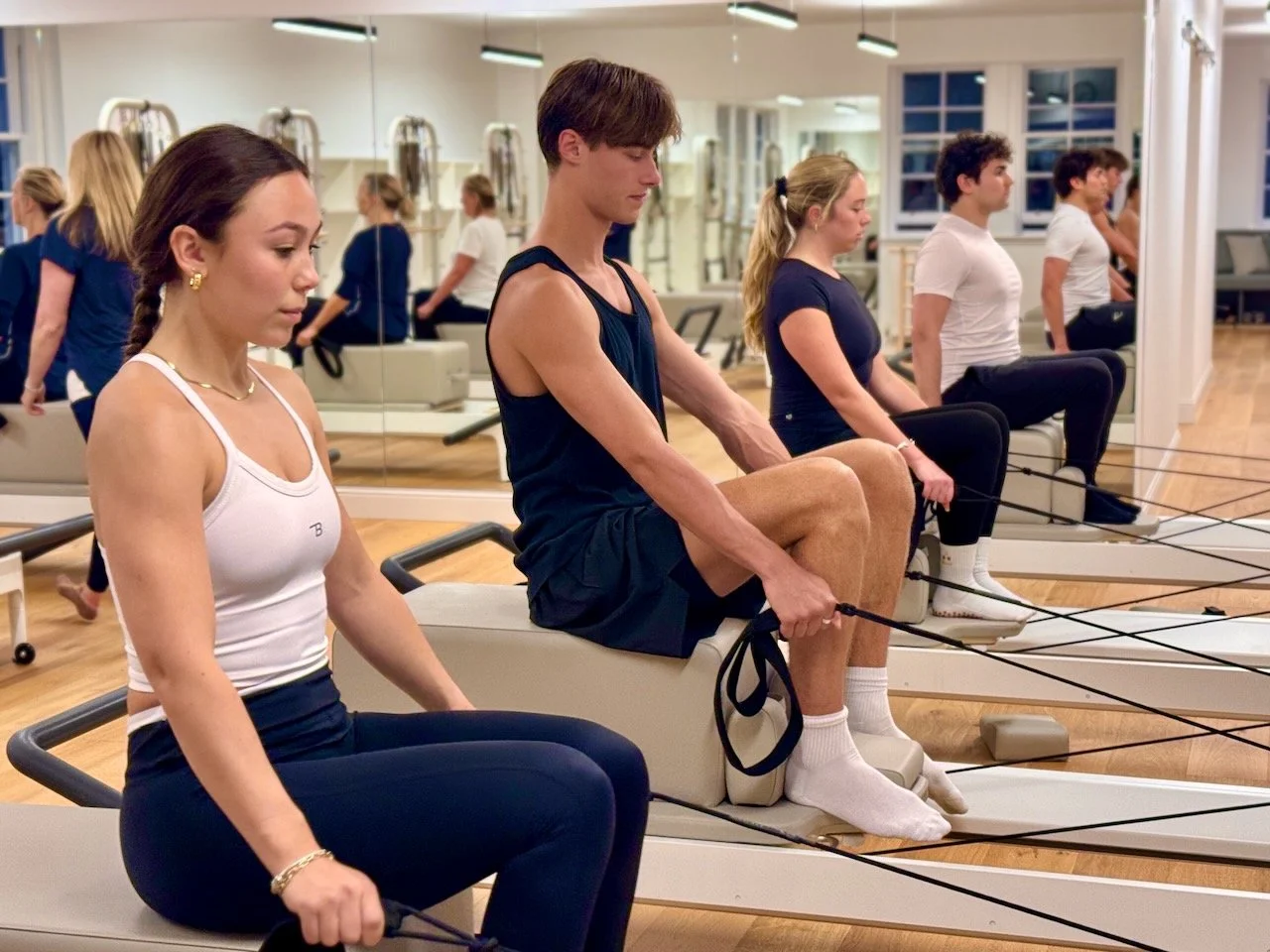
Reformer Pilates at Luma. Seated strap work developing postural control through the thoracic spine
Short answer
Pilates improves posture by strengthening the specific muscles responsible for holding the body upright: the deep spinal stabilisers, the muscles around the shoulder girdle, and the deep hip stabilisers. These are the muscles most commonly underused in people with poor posture, and the ones that conventional exercise tends to miss. At Luma Pilates in Edinburgh, most clients notice postural change within four to six weeks of consistent practice.
Pilates and posture are spoken about together so often that the connection can start to feel like marketing rather than mechanics. It isn't. There are specific, well-understood reasons why Pilates changes the way people stand, sit, and move. They're worth understanding properly.
What posture is
Posture isn't a fixed position. It's the product of a dynamic relationship between your muscles, your skeleton, and your nervous system. When people talk about poor posture, what they're usually describing is a set of muscular imbalances that have accumulated over time. Often from sitting, from repetitive movement patterns, or from protective responses to old injuries.
The most common presentation: the head drifts forward, the upper back rounds, the shoulders roll in, the lower back either flattens or overarches, and the hips tilt. None of this happens all at once. It accumulates, slowly and quietly, over years.
Why most approaches to posture don't work
Being told to sit up straight has limited effect because posture is not primarily a matter of effort or awareness. The muscles responsible for holding you upright need to be strong enough and balanced enough to do the job without you having to think about it. Reminding yourself to stand tall every few minutes is not a sustainable solution.
Stretching helps, but only partially. If a muscle is short and tight, stretching addresses the length but not the underlying weakness that allowed it to shorten in the first place. You need both: length and strength, across the right muscles, in the right relationship to each other.
What desk work does to your posture
For most people, poor posture is not the result of bad habits or lack of effort. It is the predictable physical consequence of how modern working life is structured. Our guide to Pilates for desk workers covers this in more detail.
Hours of sitting shorten the hip flexors and pull the pelvis into anterior pelvic tilt, increasing the lumbar curve and inhibiting the glutes. The deep spinal stabilisers, designed to work in movement, disengage. Screen work pulls the head and shoulders forward, weakening the muscles between the shoulder blades and shortening the chest. The thoracic spine, designed to rotate and extend, stiffens and locks up.
Each of these changes feeds the others. None of them reverse on their own.
What Pilates actually does
The Reformer addresses the specific muscular consequences of desk work with a precision that most other forms of exercise cannot match. The research supports this. Multiple randomised controlled trials have found that Pilates produces measurable improvements in spinal alignment, thoracic kyphosis, and forward head posture in adults. A systematic review published in PubMed found significant improvements in postural measures following Pilates intervention compared to control groups. Unlike general exercise, which tends to load the superficial muscles, Pilates specifically targets the deep stabilisers and posterior chain structures that postural correction actually requires.
It strengthens the deep spinal stabilisers. The muscles closest to the spine, the multifidus and the deep spinal erectors, are responsible for maintaining the spine's position under load. In most people, these muscles are underused and underdeveloped. Pilates targets them directly and consistently, in every class at every level.
It rebalances the relationship between the front and back of the body. Most postural problems involve the front of the body being overactive and the back being underactive. Pilates addresses this imbalance systematically, loading the posterior chain in ways that everyday life rarely does.
It works the hip flexors through their full range. Rather than simply stretching shortened hip flexors, the Reformer strengthens them in lengthened positions, retraining the nervous system to use the full range that years of sitting have compressed. The difference between stretching a hip flexor and training it through its full range is the difference between temporary relief and lasting change.
It opens the chest and strengthens the shoulder girdle. The strap and arm work on the Reformer specifically targets the serratus anterior, the lower and middle trapezius, and the muscles of the rotator cuff. For desk workers, this work tends to produce some of the most immediately noticeable changes: less tension across the upper back, better shoulder mobility, and a posture that no longer requires conscious effort to maintain.
It restores thoracic rotation and extension.Spinal articulation and rotation are built into almost every Reformer class. For a thoracic spine that has been held static for years, this work is genuinely transformative. The stiffness does not disappear overnight, but it responds consistently and progressively to this kind of specific, controlled movement.
It trains the deep hip stabilisers. The position of the pelvis determines everything above it. Weak hip stabilisers, particularly the deep hip rotators and the gluteus medius, allow the pelvis to drift into positions that cascade upward through the lumbar spine and beyond. Pilates addresses these muscles in isolation and in integration.
It develops body awareness. This is less tangible but genuinely important. Pilates teaches you to feel the difference between aligned and unaligned movement. Over time, that awareness becomes habitual. You stop slumping not because you're reminding yourself to sit up, but because your body has learned what supported feels like and starts to prefer it.
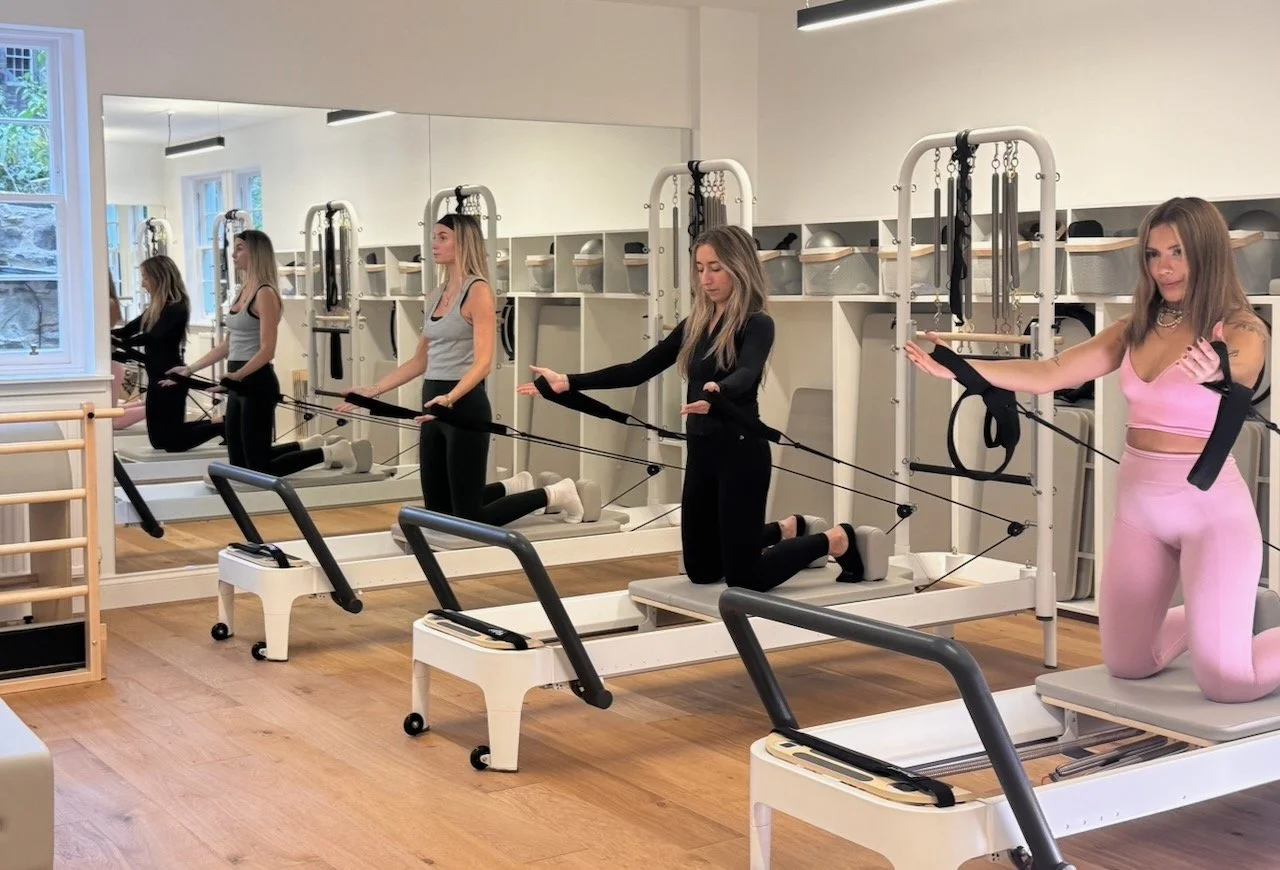
Reformer Pilates at Luma. Kneeling strap work developing the postural muscles of the upper back and shoulder girdle
How long does it take?
Most clients notice something within four to six weeks of regular practice. Not a dramatic transformation, more a sense that they're sitting differently, that the tension they carry in their neck and upper back is easing, that they feel taller at the end of a class than they did at the start.
The structural changes - genuine rebalancing of muscle length and strength - take longer. Three to six months of consistent practice, two to three times a week, produces results that are visible and lasting.
In Lucia Poulter's view, posture changes when the body stops having to fight against itself. Pilates gives it the tools to stop fighting. In her experience, that takes time, but it happens reliably.
Anna Marchington, who trained at The Pilates Center in Boulder, Colorado and has over 20 years of teaching experience, sees the same pattern among Luma's clients. The postural changes that last are the ones that come from strength rather than effort. In her experience, once the deep stabilisers are doing their job, clients stop having to think about their posture at all. It simply becomes how they hold themselves.
Where to start
If posture is your primary goal, Reformer Fundamentals is the right entry point. The foundational work in that class, spinal articulation, scapular stability, pelvic alignment, is precisely the work that drives postural change. It's also where you'll develop the body awareness that makes everything else more effective.
As your practice develops, Reformer Pilates 1 and 2 build on that foundation with progressively more demanding work for the posterior chain, the shoulder girdle, and the deep stabilisers.
Our Mat Pilates classes, taught by Catrin Dawson, Alex Sandgren and Julia Govan, are also excellent for postural work, particularly the floor-based exercises that target the thoracic spine and shoulder blades directly.
If you'd like to work on posture with focused, individual attention, a private session with Lucia, Anna ar Alex is worth considering. View our pricing for private session rates.
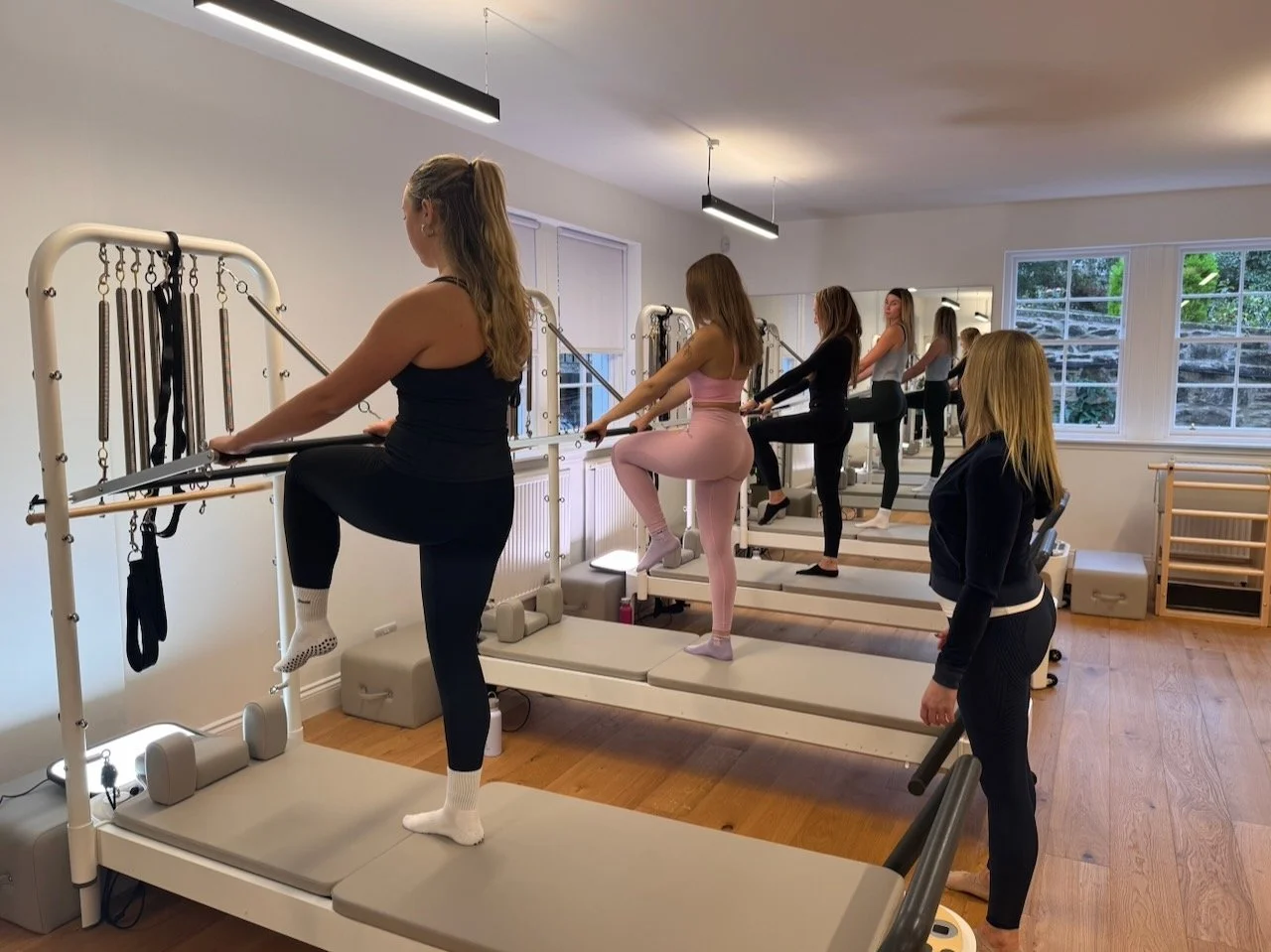
Clients working on balance and spinal control in a Tower class at Luma Pilates, Edinburgh
Our introductory offer of 3 Reformer or Tower classes for £48 is the right place to start. View our class schedule, browse all classes, or get in touch if you'd like to talk it through before booking.
Frequently asked questions
Does Pilates really improve posture? Yes. Pilates strengthens the deep spinal stabilisers, the shoulder girdle muscles and the deep hip stabilisers that hold the body upright. These are the muscles most commonly underused in people with poor posture. At Luma Pilates in Edinburgh, most clients notice a change within four to six weeks of consistent practice.
How long does it take to fix posture with Pilates? Most clients at Luma notice something within four to six weeks: sitting differently, less tension through the neck and upper back, feeling taller at the end of a class. Structural change, meaning genuine rebalancing of muscle length and strength, takes three to six months of consistent practice two to three times a week.
Is Reformer or Mat Pilates better for posture? Both work. Reformer Pilates offers more precise loading of the postural muscles through spring resistance, particularly for the shoulder girdle and posterior chain. Mat Pilates is excellent for the floor-based work that targets the thoracic spine and shoulder blades. Many clients at Luma do both.
Can Pilates fix rounded shoulders? Yes, in most cases. Rounded shoulders result from a tight chest and weak muscles between the shoulder blades. The strap and arm work in Reformer Pilates targets the serratus anterior and lower and middle trapezius directly, while the spinal extension work opens the chest. This is one of the changes clients tend to notice first.
Will Pilates help with forward head posture? Yes. Forward head posture is usually driven by a stiff thoracic spine and weak deep neck flexors. Pilates addresses both: thoracic rotation and extension work restores the mobility the mid-back has lost, and the deep stabiliser work strengthens the muscles that support the head over the spine.
Where can I do Pilates for posture in Edinburgh? Luma Pilates is at 15 Northumberland Street NE Lane in Edinburgh's New Town, offering Reformer, Mat, Barre and Yoga classes seven days a week. If posture is your primary goal, Reformer Fundamentals is the right starting point.
Written by Lucia Poulter
Lucia is lead instructor and co-founder at Luma Pilates, with 26 years of teaching experience and Comprehensive BASI certification. Posture is one of the things she talks about most with new clients – not as an aesthetic goal, but as a measure of how well the body is organising itself. In her experience, it changes reliably with consistent practice. The body, given the right work, figures it out.