
Pilates for Desk Workers and Office Workers in Edinburgh
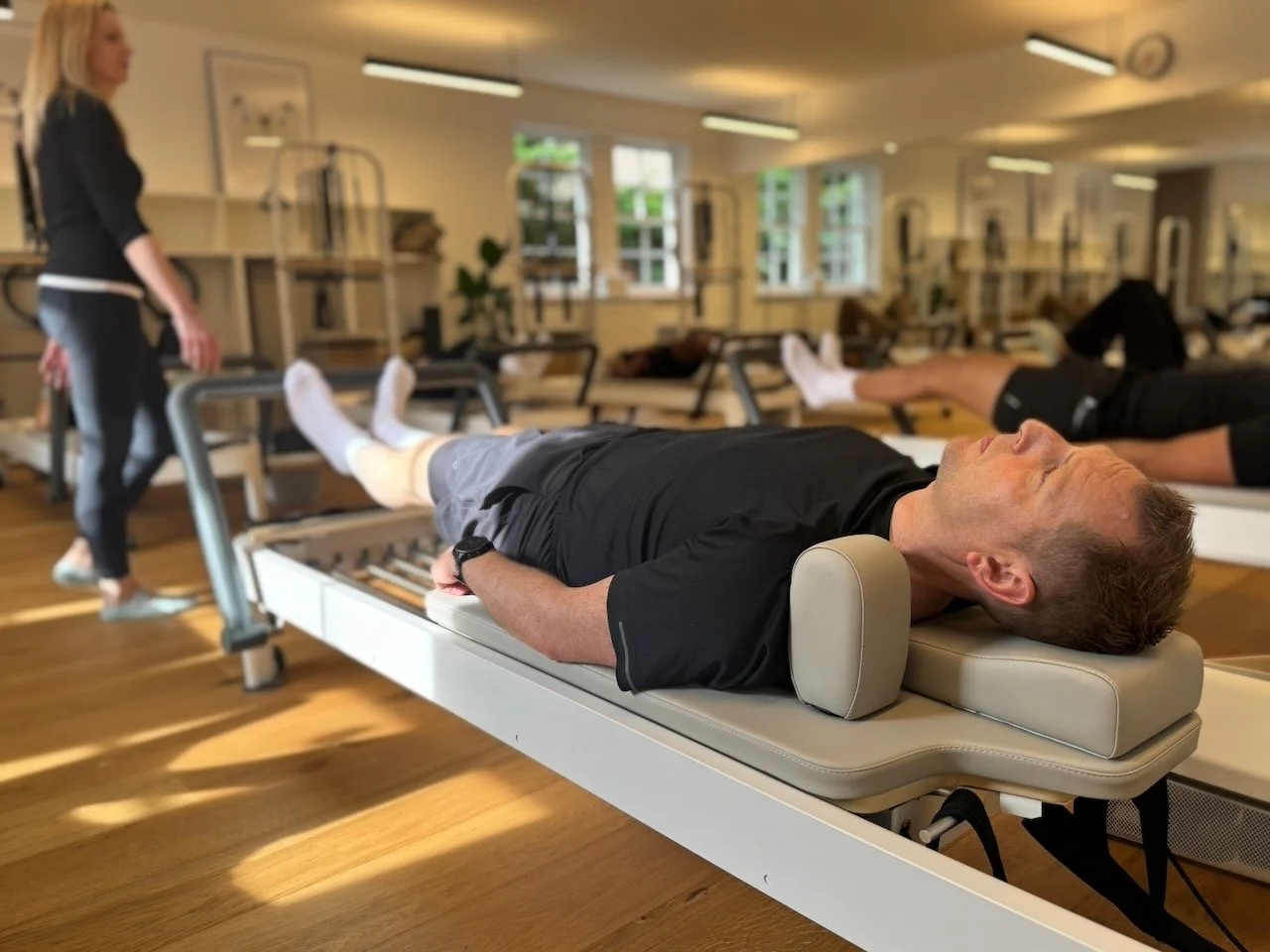
Reformer Pilates at Luma. The antidote to a day at a desk
Short answer
Desk work creates a specific and predictable set of physical problems: shortened hip flexors, disengaged deep stabilisers, a rounded shoulder girdle, and a stiffened thoracic spine. Reformer Pilates addresses all of them directly and precisely, in a way that most other forms of exercise do not reach.
If you work at a desk, you already know something is wrong. The stiffness when you stand up after a long call. The tension that builds across the top of your shoulders by mid-afternoon. The lower back that complains on the commute home. Most desk workers treat these things as the price of the job. They are not. They are the predictable consequences of a specific set of physical patterns, and they respond well to a specific kind of intervention.
I worked at a desk (a mixing desk actually) for decades before I found Reformer Pilates. I thought the stiffness and tension were just part of getting older. They were not. They were part of sitting still for too long in positions the body was not designed to hold, and doing very little that addressed the muscular consequences.
This guide is the case I would have wanted to read ten years earlier.
What sitting does to your body
The problem with desk work is not sitting itself. It is sustained, static sitting in a position that systematically shortens some muscles and switches others off entirely.
The hip flexors shorten. When you sit, the hip flexors, the muscles that connect your spine and pelvis to your femur, are held in a shortened position for hours at a time. Over months and years, they adapt to this. They stop working through their full range. The pelvis tilts forward into anterior pelvic tilt, increasing the curve in the lower back, and the glutes, which should be the primary stabilisers of the pelvis, stop engaging properly.
The deep spinal stabilisers disengage. The deep spinal stabilisers, the multifidus and transverse abdominis, need to be actively engaged to function well. Sitting, particularly in a slumped or unsupported position, reduces that engagement. Over time, these muscles become underactive, and the larger muscles of the back compensate. The result is the tension and fatigue that most desk workers feel across the upper and lower back by the end of a working day.
The shoulder girdle rounds forward. Screen work pulls the head and shoulders forward, lengthening and weakening the muscles between the shoulder blades and shortening the chest. The muscles that should hold the shoulders back and the chest open, the serratus anterior and the lower and middle trapezius, become underused. The result is the rounded, slightly collapsed posture that most desk workers recognise in themselves.
The thoracic spine stiffens. The thoracic spine, designed to rotate and extend, locks up when held in the same position for long periods. This restriction travels. It affects shoulder mobility, neck tension, and the ability of the lumbar spine to move freely.
None of this is irreversible. But it doesn't reverse itself on its own.
What Reformer Pilates does about it
The Reformer addresses the specific muscular consequences of desk work with a precision that most other forms of exercise cannot match. The evidence base supports this. The NHS and NICE both recommend exercise and movement as the primary intervention for the musculoskeletal problems associated with prolonged sitting. Multiple systematic reviews, including Cochrane reviews on exercise for neck pain and low back pain, consistently find that strengthening and movement-based interventions outperform passive treatments. Pilates specifically has been shown in randomised controlled trials to reduce pain and improve function in people with desk-work-related musculoskeletal conditions. The Reformer delivers this in a format that is low impact, time-efficient, and directly targeted at the specific muscle groups that desk work compromises.
It works the hip flexors through their full range. Rather than simply stretching them, the Reformer strengthens the hip flexors in lengthened positions, retraining the nervous system to use the full range that years of sitting have compressed. The difference between stretching a hip flexor and training it through its full range is the difference between temporary relief and lasting change.
It reactivates the deep spinal stabilisers. Every exercise on the Reformer requires engagement from the deep stabilisers. This is not optional or incidental, it is built into the method. Over weeks and months of practice, these muscles rebuild the capacity and the habit of engaging, and the compensation patterns that cause back tension begin to unwind.
It opens the chest and strengthens the shoulder girdle. The strap and arm work on the Reformer specifically targets the muscles between the shoulder blades, the serratus anterior, and the muscles of the rotator cuff. For desk workers, this work tends to produce some of the most immediately noticeable changes: less tension across the upper back, better shoulder mobility, and a posture that no longer requires conscious effort to maintain.
It restores thoracic rotation and extension.Spinal articulation and rotation are built into almost every Reformer class. For a thoracic spine that has been held static for years, this work is genuinely transformative. The stiffness does not disappear overnight, but it responds consistently and progressively to this kind of specific, controlled movement.
Lucia Poulter, Luma's lead instructor with 26 years of experience, sees desk workers as one of the client groups with the most to gain from Reformer Pilates. The changes are often faster and more noticeable for desk workers than for almost any other group, because the starting point is so specific and the Reformer addresses it so directly.
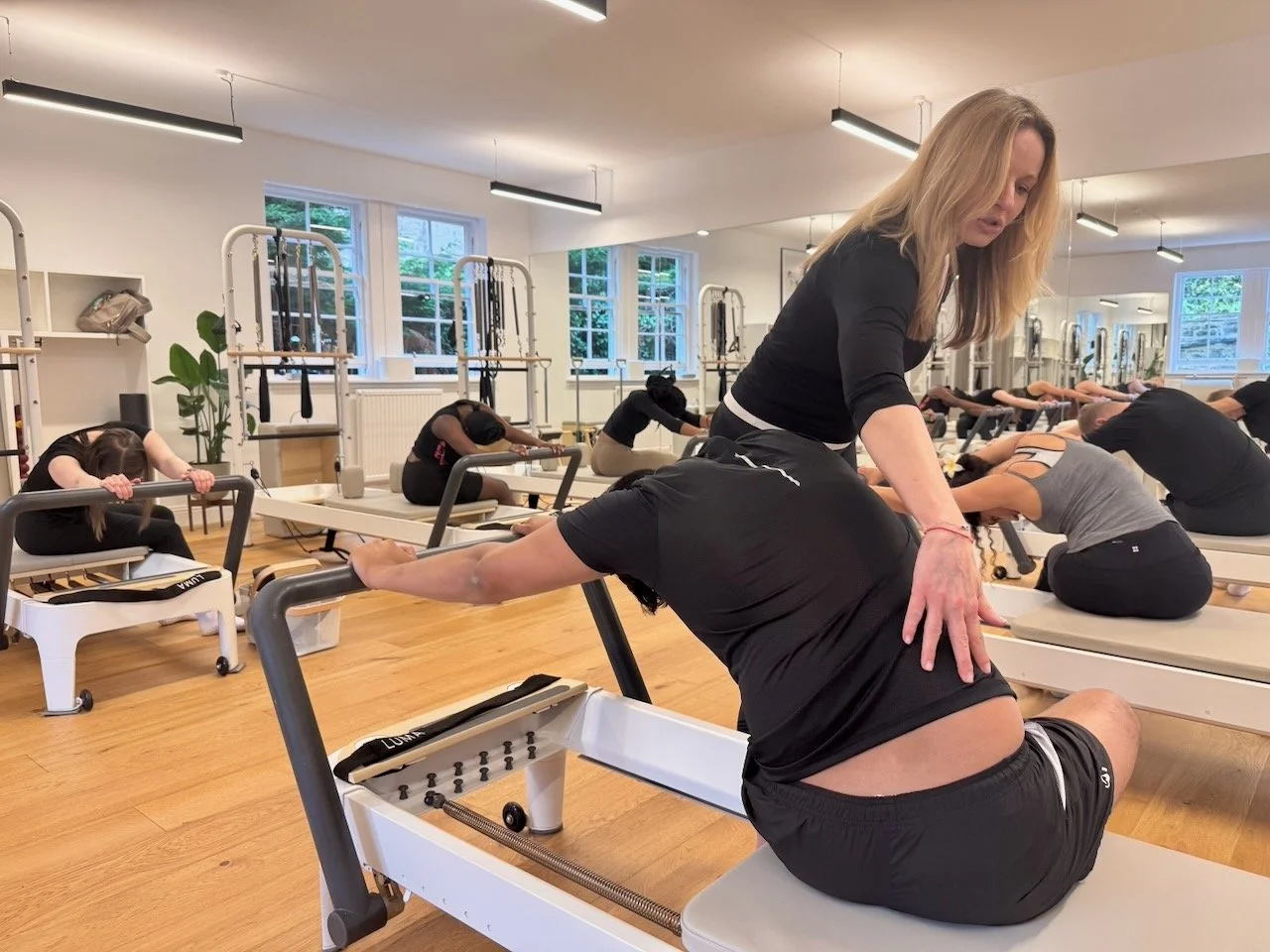
Lucia Poulter cueing a deep stretch on the Reformer at Luma Pilates, Edinburgh. The rotational work that a desk-bound spine needs most
What changes and when
Most desk workers notice something within the first four to six sessions. Not a dramatic transformation, but a shift: less tension in the neck and upper back at the end of the day, a greater sense of support through the lower back, the ability to sit for longer without the familiar stiffness setting in.
Within three months of two sessions per week, most clients report visible postural change. The shoulders sit differently. The lower back feels supported rather than strained. The morning stiffness that used to take half an hour to shake off reduces significantly.
Within six months, the muscular patterns that desk work created have begun to genuinely shift. The hip flexors have length and strength through their full range. The deep stabilisers engage reliably. The thoracic spine moves. These are not superficial changes, they are structural. And they persist.
For a detailed breakdown of what to expect and when, see our full guide to how long it takes to see results from Pilates.
Pilates alongside desk work
Two sessions per week is the pattern that produces the clearest and most consistent results for desk workers. One session per week maintains what you build and gives your body a reliable reset. Three sessions per week accelerates change noticeably. For a full breakdown of frequency options, see our guide to how often you should do Pilates.
The low-impact nature of Reformer Pilates means it does not add to the fatigue of a demanding working week – it tends to reduce it. Most clients find they leave a class with more energy than they arrived with, not less.
The posture question
Most desk workers have been told to sit up straight at some point. Most of them find it works for about four minutes before the familiar slump returns. This is not a failure of willpower. It is a predictable consequence of the fact that the muscles required to hold good posture without effort are not strong enough or balanced enough to do the job.
Pilates addresses posture at the muscular level, not the behavioural level. The goal is not to remind you to sit differently. It is to build the strength that makes good posture the default rather than the effort. See our full guide to why Pilates improves posture for the detailed explanation of how this works.
Lower back pain specifically
Lower back pain is close to universal among desk workers who have been at it for a few years. The underlying causes – weak deep stabilisers, shortened hip flexors, disengaged glutes – are exactly what Reformer Pilates addresses. See our dedicated guide to Pilates for lower back pain for a full breakdown. If your lower back pain is connected to a specific clinical diagnosis, speak to your GP or physio before starting. Our guide to Pilates vs physiotherapy covers how the two work together.
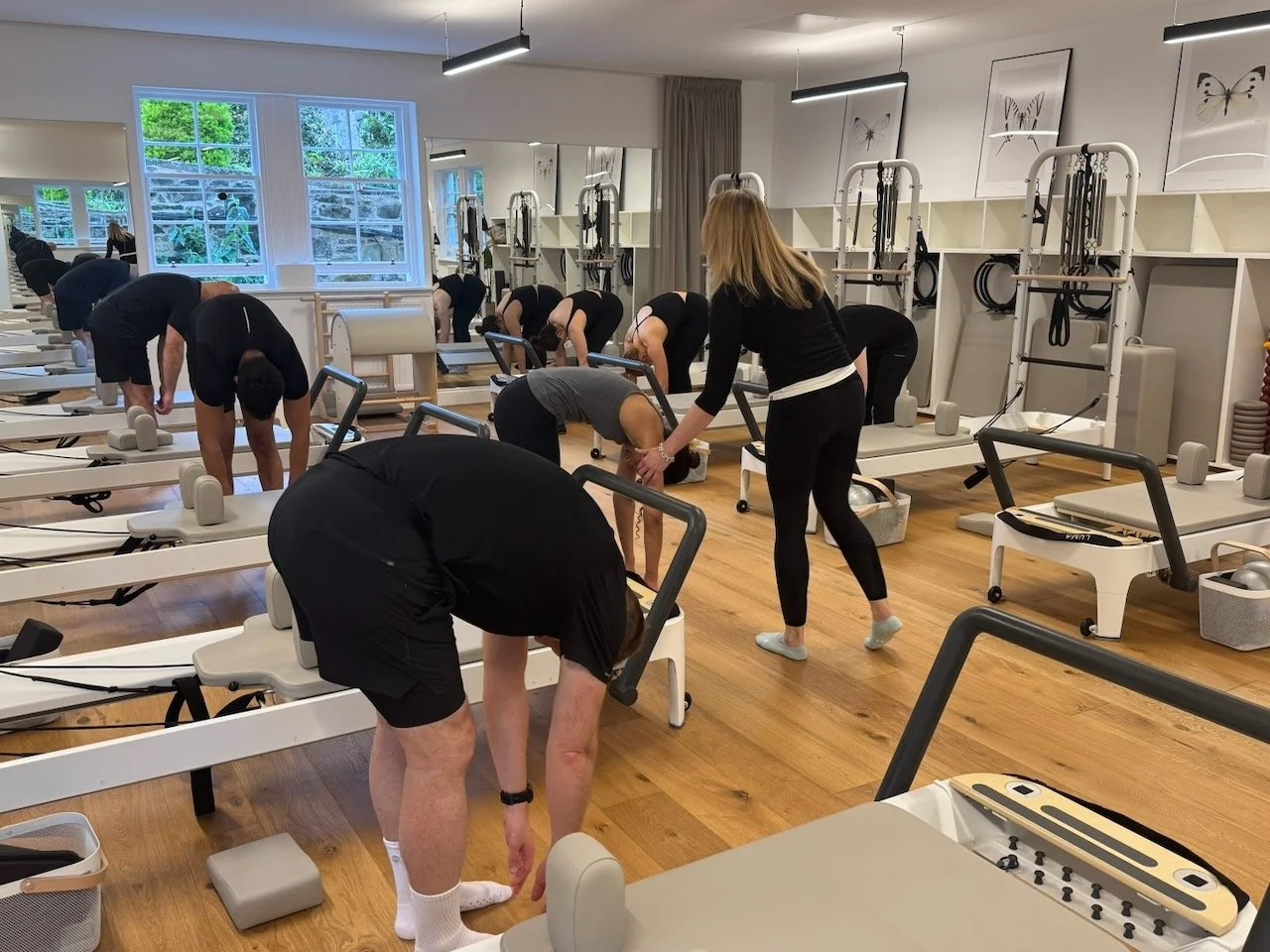
Roll-down at the end of class at Luma Pilates, Edinburgh. A moment to check in with your body before heading back to the desk
How to get started
Reformer Fundamentals is the right starting point. The foundational work, spinal articulation, hip flexor lengthening, deep stabiliser activation, and shoulder girdle strengthening, maps directly onto what desk workers need. Tell your instructor about your work setup and any specific areas of tension or discomfort before class. The more they know, the more precisely they can support you from the very first session.
Our introductory offer of 3 Reformer or Tower classes for £48 is designed for exactly this starting point. View our class schedule, browse all classes, or get in touch if you would like to talk it through first.
Written by Max Howarth
Max is co-founder of Luma Pilates. He spent years working at a mixing desk before discovering the Reformer in his fifties, expecting very little and finding rather a lot. He now teaches five classes a week at the studio and practises around double that. The stiffness he used to treat as inevitable turned out to be optional.