Pilates for runners in Edinburgh: what it does that the gym cannot

Edinburgh is a city that runs. Reformer Pilates at Luma helps keep it that way
Short answer
Reformer Pilates addresses the specific muscular imbalances that running creates and leaves unresolved. For Edinburgh runners dealing with tight hips, a complaining lower back, or recurring knee niggles, it is often the missing piece. One or two sessions a week alongside your training is enough to feel a meaningful difference.
Edinburgh is a city that runs. Arthur's Seat before work, the Water of Leith at the weekend, the Half Marathon in May. If you have been a runner in Edinburgh for any length of time, you will also know what comes with it: the tight hip flexors after a long run, the knee that niggles when the mileage creeps up, the lower back that starts complaining somewhere around mile eight.
Pilates does not replace your running. But it does address the things that running alone cannot, and in my experience coaching clients at Luma, it is often the missing piece that Edinburgh runners have been looking for.
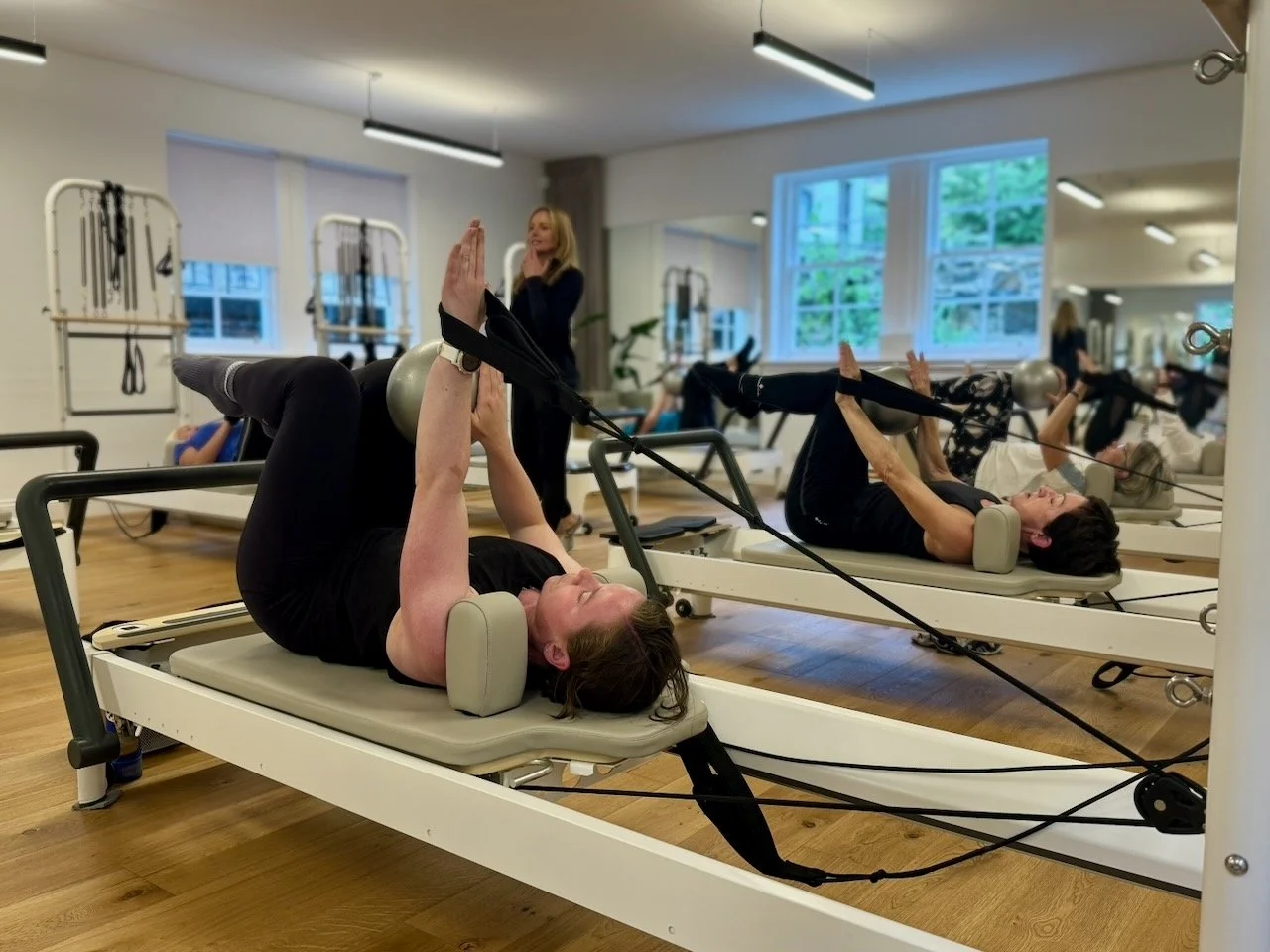
The work runners need most. Hip flexors, glutes and lateral stability on the Reformer at Luma, Edinburgh New Town
Why runners get injured
Running is a repetitive, single-plane movement. You move forward, over and over, loading the same muscles and joints in the same pattern. Over time, the hip flexors shorten, the glutes switch off, the lower back takes on work it was never meant to do.. The result is not bad luck. It is the predictable consequence of asymmetry and compensatory movement building up over thousands of strides.
The muscles that running develops well and the muscles it neglects are not evenly distributed. The hip flexors, hamstrings, and calves get plenty of work. The deep spinal stabilisers, the lateral hip stabilisers, and the muscles around the thoracic spine are largely ignored. When those underdeveloped muscles are asked to maintain form under fatigue, they cannot, and something else compensates. That compensation is usually where the injury lives.
What changes on the Reformer
On the Reformer, we can load and lengthen the hip flexors in ways that static stretching cannot replicate. We work the glutes in isolation and then integrate them into whole-body movement patterns. We address the thoracic spine, which stiffens in runners, and we rebuild the relationship between breath, core and movement that gets lost when you are focused on pace and distance.
The lateral hip stabilisers, particularly the gluteus medius, are among the most consistently underdeveloped muscles in runners and one of the primary drivers of IT band tightness, runner's knee and the lower back pain that arrives late in a long run.. The Reformer loads these muscles in the frontal and transverse planes, the directions that running almost entirely ignores.
The IT band itself cannot be meaningfully stretched, it is a band of connective tissue, not a muscle, so foam rolling and stretching only ever address the symptom. The actual fix is strengthening the gluteus medius so it does its job of keeping the pelvis level through each stride. We do this through side-lying leg work, single-leg press sequences on the carriage, and standing balance work, all of which train lateral hip stability directly, in planes that running and most gym training never reach.
Many of the runners who come to Luma notice a difference within a handful of sessions. Not just in how their body feels in class, but in how they run. Strides feel longer. Hips feel freer. The lower back stops complaining.
Edinburgh terrain and what it asks of your body
Running in Edinburgh is not flat. Arthur's Seat, Blackford Hill, Corstorphine Hill, the steady climb up the Mound: the terrain here places specific demands on the body that flat-road running does not.
Hill running loads the glutes and posterior chain more than flat running, which is positive. But it also increases the eccentric demand on the quads on descents, places greater stress on the IT band, and asks more of the ankle stabilisers and foot intrinsics on uneven ground. If those systems are not well conditioned, Edinburgh terrain accelerates the development of the imbalances that lead to injury.
The Reformer addresses all of these. Single-leg work on the carriage builds the ankle stability and lateral hip control that Arthur's Seat demands. Footwork sequences develop the foot and calf strength that keeps you efficient on climbs. And the precision required in every class trains the body awareness that protects you when the ground is uneven.
Edinburgh runners also tend to run in all weather and across all seasons, which means consistent high mileage with less variation in surface. The Reformer provides the variety of loading planes and movement patterns that the pavements of Stockbridge and Marchmont simply do not.
When to add Pilates to your training
You do not need to be injured to benefit. The best time to start is when things are going well, because Pilates builds the resilience that keeps them that way.
One or two sessions a week alongside your running is enough to make a meaningful difference. If you are training for a marathon or half marathon, the case is stronger, not weaker. High mileage weeks place sustained single-leg loading and hip flexor endurance demands on the body, and the Reformer's low impact nature means it supports recovery rather than adding to training load. Runners who keep one or two sessions a week through a training block consistently report better form retention in the later miles and faster recovery between long runs. The main adjustment during peak weeks is to keep sessions at a restorative level rather than pushing into a new class or intensity.
Many of our members find it works well on recovery days, when the body needs movement without impact. The Reformer is low-impact by nature, so it does not add to the cumulative loading your joints are already managing from your mileage.
If you are carrying a niggle or coming back from injury, our instructors are experienced at working around it. We are not physiotherapists, but we understand how the body moves and compensates, and we will adjust accordingly. Many runners find they return from Reformer-assisted recovery running more efficiently than before, because the underlying pattern that caused the injury has been addressed.
What to expect at Luma
Luma is a boutique studio in Edinburgh's New Town, a short walk from the city centre and easy to reach from most parts of the city. Classes are small, which means your instructor can see what is happening in your body and give you the cues that matter for you specifically.
We see a lot of runners. Lucia Poulter, Luma's lead instructor with 26 years of experience and Comprehensive BASI certification, finds that runners tend to be highly motivated clients once they feel the carryover to their running. The challenge is usually getting them through the door the first time.
If you have questions before booking, you are welcome to get in touch. We are always happy to talk through what would suit you best.
Where to start
Reformer Fundamentals is the right entry point if you are new to the machine. It introduces the equipment and the foundational principles in a small, unhurried setting. From there, Reformer Fundamentals Progressing and the levelled classes build the practice incrementally, and many runners find they enjoy the challenge more than they expected.
Our introductory offer of 3 Reformer classes for £48 is a practical way to start without committing to a full membership. Three sessions is enough to move past the unfamiliarity and start feeling the carryover to your running. View the timetable or browse all classes.
If you compete or train at a higher level, our guide to Pilates for athletes in Edinburgh covers performance and injury prevention in more depth.
Written by Lucia Poulter.
Lucia is lead instructor and co-founder at Luma Pilates. She holds Comprehensive BASI certification and has 26 years of teaching experience.