Pilates and Yoga During Menopause
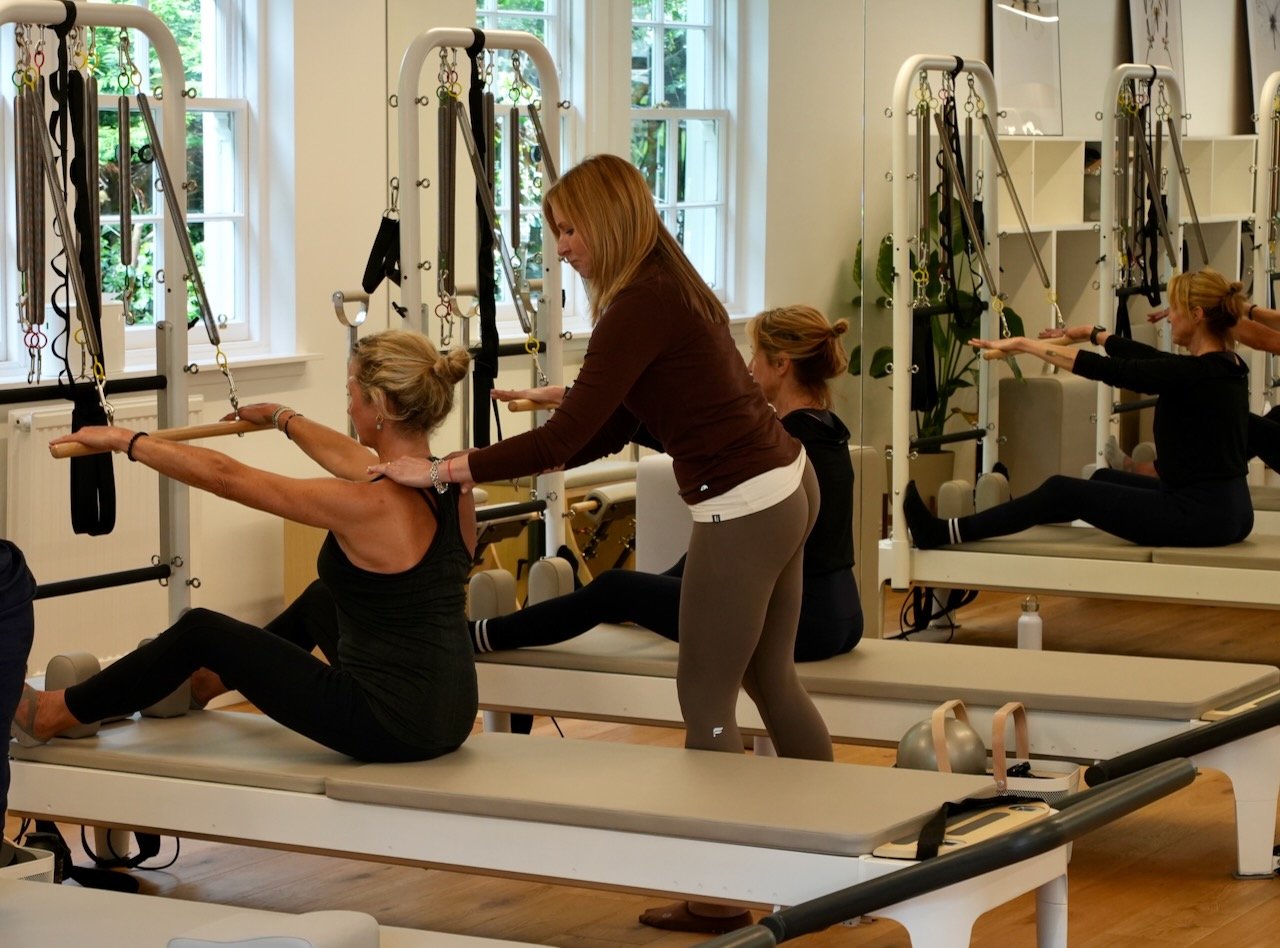
Lucia Poulter making a hands-on adjustment during the sitting lat press down. The kind of strength work that matters most through menopause
Short answer
Both are well suited to the menopause transition, and they address it from different angles. Reformer Pilates builds and maintains muscle mass, supports bone density, and targets the pelvic floor. Yoga supports the nervous system, improves sleep quality, and addresses the psychological dimension of the transition. Practised alongside each other, they offer one of the most complete responses available.
I have been teaching Pilates for 26 years. I’ve worked with thousands of clients across different stages of life, and I have watched the practice do things that surprised even me. But a stage I have come to feel strongly about, both as a teacher and as someone living it, is the menopause transition.
Perimenopause and menopause change the body in ways that most conventional exercise is not designed to address. The hormonal shifts affect muscle mass, bone density, joint stability, sleep, mood, and energy in ways that are interconnected and cumulative. For many women, the exercise approaches that worked for years suddenly feel harder, less effective, or simply wrong for where their body is.
I bring more to the menopause transition than movement expertise alone. I hold a BSc in Psychology from the University of Buckingham and a Diploma in Clinical Hypnotherapy, and am registered with the General Hypnotherapy Register and the Complementary and Natural Healthcare Council. The intersection of hormonal change, psychological wellbeing, and physical resilience is something I understand from multiple directions, and it informs both how I teach and how I work with clients navigating this stage.
Reformer Pilates and Yoga are, in my experience and in the growing body of research, two of the most intelligent tools available during this transition. At Luma we offer both, and the combination is more powerful than either in isolation.
What menopause does to the body
The decline in oestrogen during perimenopause and menopause affects the musculoskeletal system in several specific ways.
Muscle mass decreases more rapidly, a process called sarcopenia, which accelerates without resistance training to counteract it. Bone density reduces, increasing the risk of osteoporosis over time. Joints can become less stable as the connective tissues lose some of their hormonal support. The pelvic floor, which is oestrogen-dependent, often weakens, contributing to issues with continence and pelvic organ support.
Beyond the musculoskeletal system, disrupted sleep and increased cortisol levels affect recovery, energy, and the ability to sustain high-intensity exercise. Many women find that the approach to training that served them in their thirties and forties begins to work against them in perimenopause.
Why Reformer Pilates is particularly well suited to this stage
Reformer Pilates addresses the specific physical changes of menopause in a way that few other forms of exercise do.
It builds and maintains muscle mass. The spring resistance of the Reformer provides genuine load for the muscles, stimulating the kind of adaptation that counteracts sarcopenia. Unlike high-impact exercise, it does this without placing excessive stress on joints that may already be feeling the effects of reduced hormonal support.
It supports bone density. Weight-bearing and resistance-based exercise are among the most effective ways to maintain bone density during and after menopause. The Reformer provides both, across a wide range of movement patterns.
It specifically targets the pelvic floor. The deep stabiliser work that underpins every Reformer session directly engages the pelvic floor. Consistently practised, this has a measurable effect on pelvic floor strength and function.
It addresses posture and the posterior chain. The postural changes that often accompany the menopause transition, reduced muscle mass, shifting load patterns, and changes in connective tissue, respond directly to the kind of work the Reformer provides. See our guide to why Pilates improves posture for more on the specific mechanisms.
It is sustainable. This is not a minor point. Menopause is a transition, not a moment. The practice needs to be one that the body can sustain over years, not weeks. The low-impact, controlled nature of Reformer Pilates makes it genuinely sustainable through the full arc of the menopause transition and beyond.
In my own practice and in the experience of the clients I have worked with through perimenopause and menopause, the Reformer has been a consistent source of physical resilience and, honestly, of calm. The focused, breath-led nature of the work has a stabilising effect that I find particularly valuable when the body is navigating significant hormonal change.
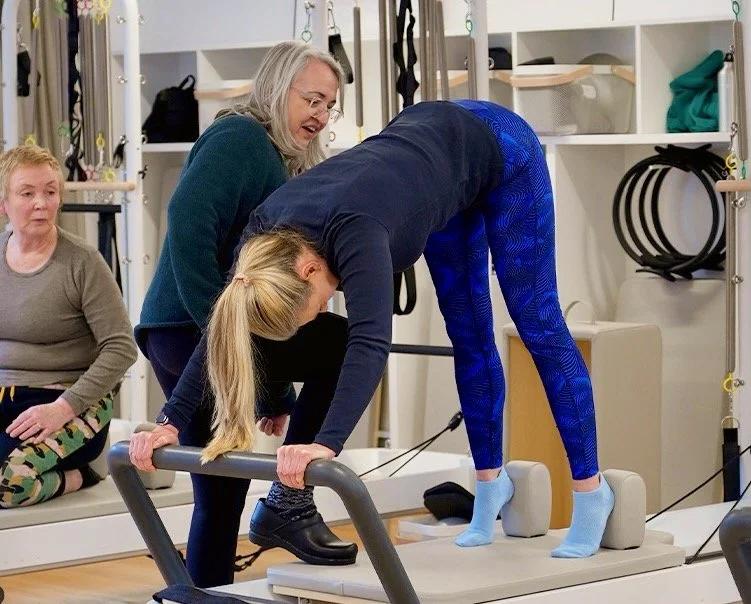
Anna Marchington cueing the Down Stretch on the Reformer. The full-body strength work that becomes especially valuable through menopause
Why Yoga is a powerful complement
Kat Aydin teaches Yoga at Luma. Her training spans Vinyasa, Yin, Restorative, Prenatal and Postnatal Yoga, Yoga for Perimenopause and Menopause, Qi Gong, Breathwork, and Sound Healing. Her specialism in perimenopause and menopause is not incidental. It is exactly the kind of targeted, evidence-informed practice that this stage of life deserves. What perhaps speaks loudest about her practice is where she has chosen to take it. Kat has shared Yoga with the Teenage Cancer Unit, Edinburgh Women's Aid, Maggie's Centre, and Cherry Road Centre. It is a reflection of what she believes Yoga is for.
Yoga addresses dimensions of the menopause experience that Reformer Pilates approaches less directly.
It supports the nervous system. The parasympathetic activation that comes from a well-taught Yoga practice has a direct effect on cortisol levels, sleep quality, and mood.
It develops flexibility and joint mobility. As connective tissues change during menopause, maintaining range of movement becomes increasingly important. Yoga's sustained holds and breath-supported stretching develop flexibility in a way that complements the strength work of the Reformer.
It addresses the psychological dimension. The menopause transition involves significant psychological as well as physical change. Yoga's emphasis on breath, presence, and self-awareness offers a framework for navigating that change with more ease and less resistance.
Kat brings that specialism into every Yoga class she teaches at Luma. Her knowledge of the perimenopause and menopause experience informs how she cues, how she sequences, and how she supports the clients in her classes. We are also exploring dedicated menopause workshops in the coming months. If that is something you would be interested in, get in touch and we will let you know when dates are confirmed. In the meantime, view our Yoga classes to see when Kat is teaching.
The combination
Reformer Pilates and Yoga practised alongside each other offer the most complete response to the physical and psychological demands of the menopause transition available in a single studio. The strength and stability from Pilates, the nervous system support and flexibility from Yoga, and the community of practising alongside people who are navigating similar territory.
At Luma, our introductory offer covers both disciplines: 3 Reformer or Tower classes for £48, or 3 Barre or Yoga classes for £30. Many clients start with one and add the other as their practice develops. View our full pricing.
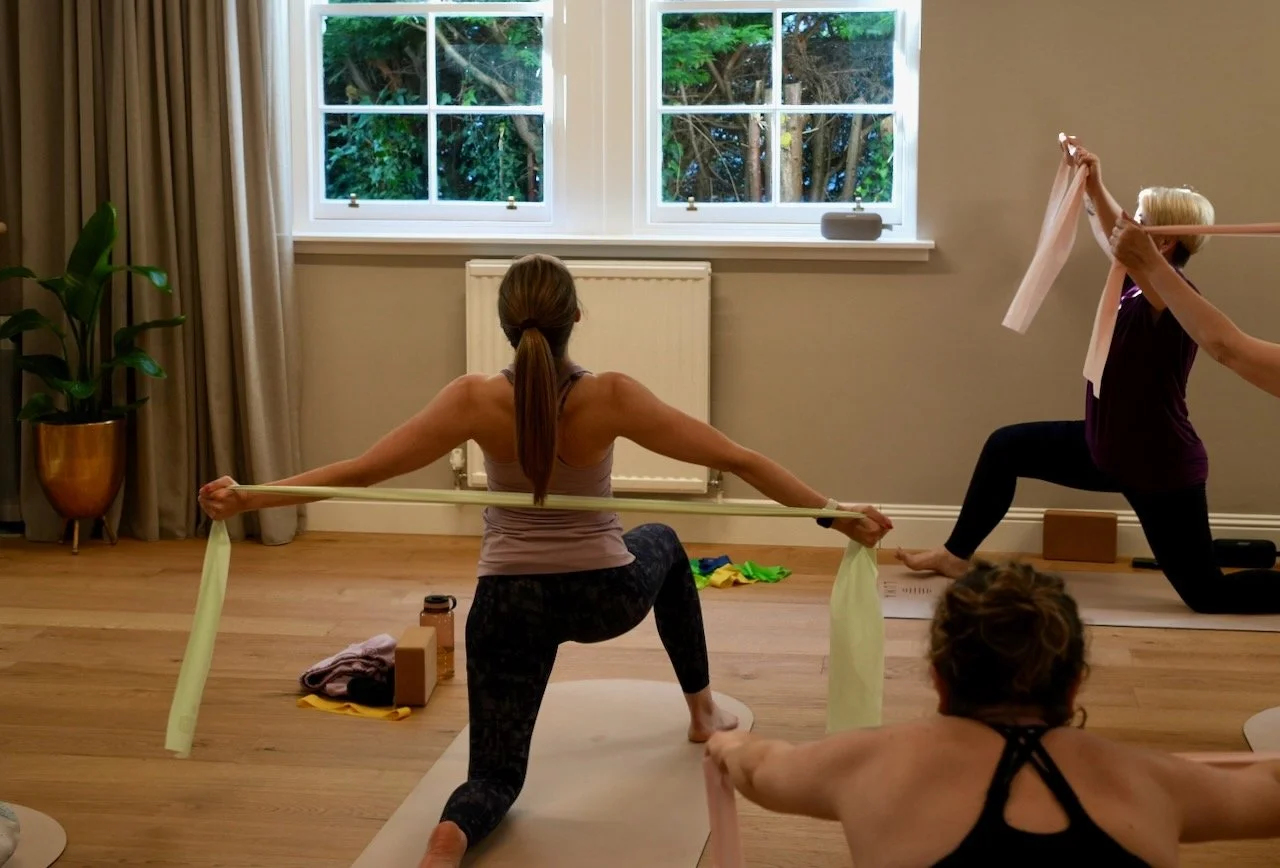
Kat Aydin cueing a strap-supported lunge in a Yoga class at Luma Pilates. Strength and balance work that supports the body through menopause
Where to start
If you are new to Reformer Pilates, Reformer Fundamentals is the right entry point. If Yoga is where you would like to begin, Kat's classes are listed on our Yoga page and in our full class schedule.
And if you’d like to talk through your situation before booking, please get in touch. This is a conversation I am always glad to have.
Browse all classes or view our schedule to find your starting point.
Written by Lucia Poulter
Lucia is lead instructor and co-founder at Luma Pilates. She holds Comprehensive BASI certification and has 26 years of experience working with clients at every stage of life. She came to understand the menopause transition from the inside as well as the teaching room, and it has shaped how she thinks about movement, resilience, and what the body needs at this stage. She teaches Reformer Pilates at Luma.