
Pilates for Hip Pain in Edinburgh
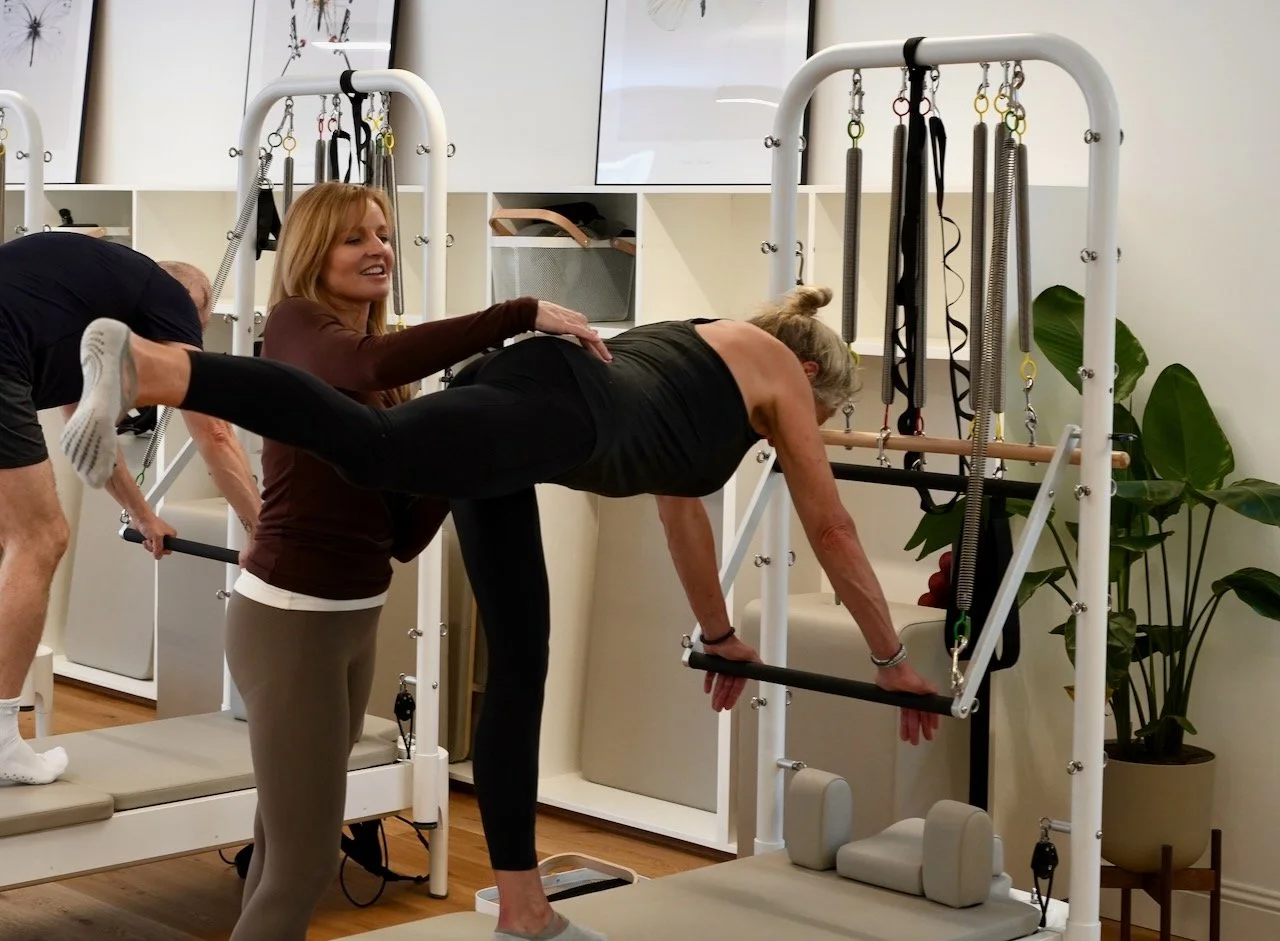
Lucia Poulter cueing hip alignment during Tower work at Luma Pilates, Edinburgh. The lateral hip control that most exercise never reaches
Short answer
Yes, for most people. Pilates strengthens the muscles around the hip joint, improves mobility, and addresses the postural habits and movement patterns that often cause pain in the first place. It's low impact, highly adaptable, and works whether your hip pain is from tightness, arthritis, bursitis, or years of sitting at a desk. Most clients at Luma Pilates in Edinburgh notice meaningful improvement within a few weeks of consistent practice. As always, it's worth checking with your GP or physiotherapist if you're unsure what's causing your pain before starting.
Hip pain has a way of making itself known at the worst moments. The ache when you stand up after an hour at your desk. The stiffness on the stairs first thing in the morning. The discomfort that starts as something you notice and gradually becomes something you work around.
It's one of the most common things clients mention when they first come to Luma. And in most cases, it has a clear cause and a more straightforward solution than people expect.
What causes hip pain?
Hip pain is rarely one thing. It can come from the joint itself, from the muscles and tendons around it, from the lower back, or from movement patterns that have built up over years.
Some of the most common causes we hear about at Luma:
Tight hip flexors from prolonged sitting, which pulls the pelvis out of alignment and creates pain at the front of the hip.
Weak glutes, which force other muscles to compensate and can cause pain on the outside or back of the hip.
Hip osteoarthritis, where cartilage in the joint gradually wears down.
Bursitis, inflammation of the fluid-filled sacs that cushion the joint, often felt on the outer hip.
Hip impingement (femoroacetabular impingement), where the bones of the hip joint don't move smoothly together.
Referred pain from the lower back, which can feel like hip pain but originates in the lumbar spine. If the pain travels into the leg, it may be sciatica rather than hip pain specifically.
Knowing what's causing your pain matters, because it shapes what kind of movement will help. If you're not sure, a GP or physiotherapist can help you get clarity before you start.
That said, Pilates is effective across most of these categories. The reason comes down to what it actually does to the hip.
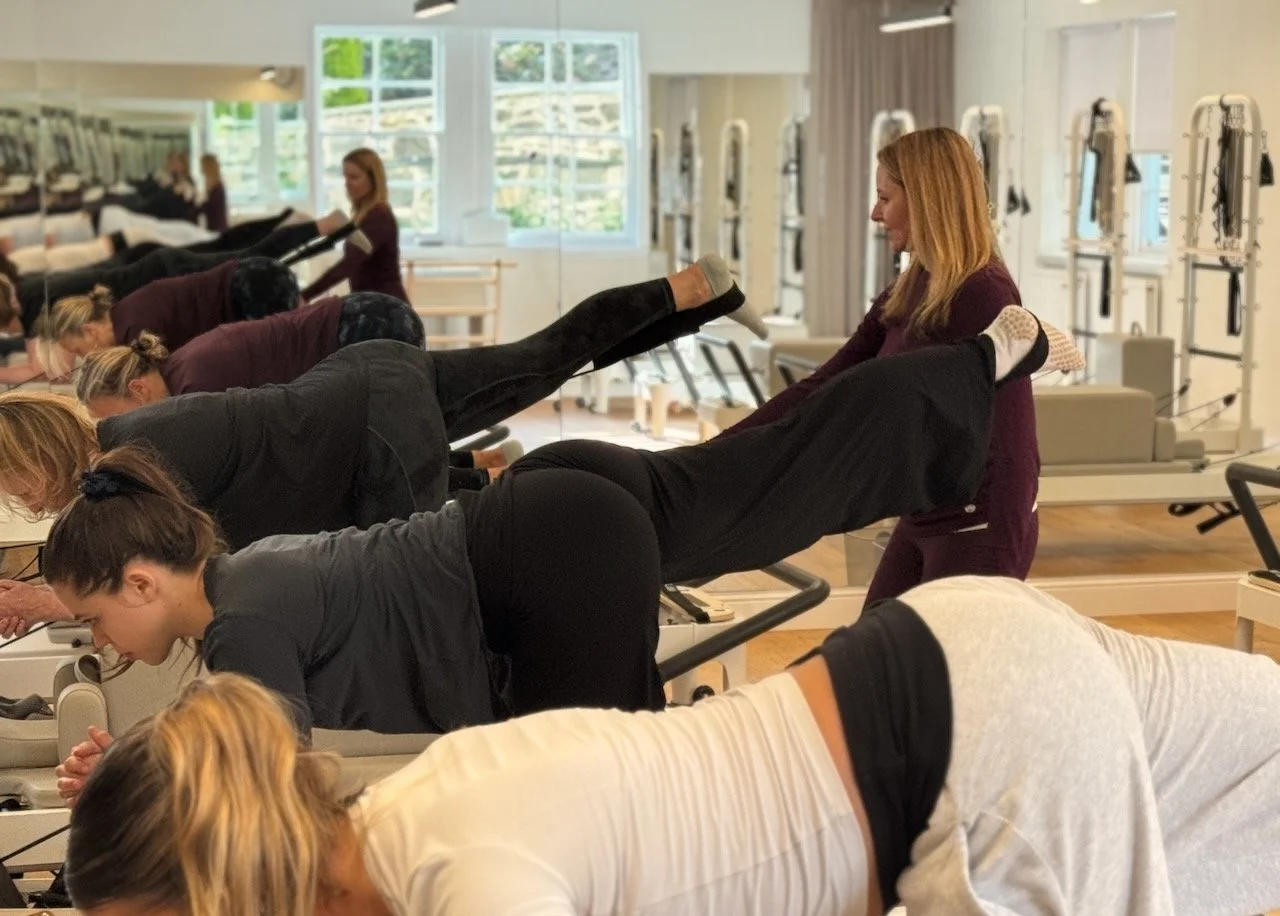
Lucia Poulter cueing single-leg strap work at Luma Pilates, Edinburgh. The posterior chain and hip stabiliser work that addresses pain at its source
Why Pilates helps with hip pain
The hip joint is designed to be both stable and mobile. It needs strong muscles holding it in place and good range of movement to function without pain. Most hip problems involve a breakdown in one or both of these things.
Pilates addresses both, and it does so without the impact or load that makes other forms of exercise difficult when you're in pain.
The evidence behind this is well established. NICE guidelines recommend strengthening and low-impact exercise as a first-line approach to hip pain, and multiple systematic reviews have found that exercise reduces pain and improves physical function in people with hip osteoarthritis specifically. Pilates is one of the most effective ways to deliver both: it builds the hip stabiliser strength the research points to, in a low-impact, controlled format that can be adapted to your current pain level and range of movement.
Strengthening the muscles that support the hip. The glutes, hip abductors, and deep hip rotators are the primary stabilisers of the joint. When these are weak, the hip works harder than it should, and pain follows. Pilates targets these muscles precisely and progressively, building strength in a way that translates directly to less pain and better movement in daily life.
Releasing tightness in the hip flexors. Tight hip flexors are almost universal in people who sit for long periods. They pull the pelvis forward into anterior pelvic tilt, compress the lower back, and restrict hip extension. Pilates systematically addresses this through lengthening work, pelvic alignment, and exercises that teach the body to move from a neutral pelvis rather than a tilted one.
Improving proprioception and movement control. A lot of hip pain is perpetuated by poor movement habits. The way you walk, sit, climb stairs, and get in and out of a car all load the hip in particular ways. Pilates develops body awareness and movement control so that the joint is loaded more evenly and efficiently. This is one of the reasons clients often find that pain improves not just during class but throughout daily life.
Working within a pain-free range. One of the most important things Pilates does is meet you where you are. Exercises are adapted to your current range of movement and pain levels. You build from there, gradually expanding what's possible without pushing into pain.
What to expect in class
If you come to Luma with hip pain, we want to know about it. We ask all new clients to share any relevant medical history before their first class, and our instructors will adapt your experience accordingly.
In practice, this might mean modified positions that keep you out of painful ranges, additional support from props like blocks or straps, a focus on glute and hip stabiliser activation before any dynamic movement, and avoiding loaded hip flexion until strength and control are established.
You won't be held back from class. You'll simply be guided through it more carefully, with adjustments made in real time as needed.
As your strength and confidence build, the work becomes more progressive. Many clients who come to us with hip pain find that after a few weeks of consistent Pilates, they're moving better than they have in years.
Different types of hip pain and what Pilates can do
Hip osteoarthritis. NICE guidelines and the wider clinical evidence both support exercise as a core part of managing hip OA, with strengthening and low-impact activity specifically recommended. Pilates delivers exactly this: it builds strength in the muscles around the joint, which reduces load on the articular surfaces and can meaningfully reduce pain. Systematic reviews also show that regular exercise helps maintain range of movement as the condition develops. Always let your GP or physiotherapist know you're starting, and share any specific guidance they've given with your instructor.
Hip bursitis. The outer hip is particularly sensitive to lateral load and compression. Pilates can help by strengthening the hip abductors and reducing the muscular imbalances that put excess pressure on the bursa. Side-lying work on both the mat and the Reformer is particularly useful here.
Hip impingement. Deep hip flexion and internal rotation are typically provocative for impingement. A good Pilates instructor will know to avoid or modify these ranges while still building the hip stability that reduces overall load on the joint. Tell your instructor about your diagnosis before your first class.
Tight hip flexors and anterior pelvic tilt. This is one of the most common presentations we see, and one of the most responsive to Pilates. The combination of lengthening work for the hip flexors and strengthening work for the glutes and deep abdominals produces reliable, lasting change. See our guide to Pilates for lower back pain for more on the relationship between hip flexor tightness and lower back issues.
Referred pain from the lower back. If your hip pain originates in the lumbar spine, the spinal stabiliser and mobility work at the heart of every Pilates class will address it directly. See our guide to Pilates for lower back pain.
Reformer or Mat: which is better for hip pain?
Both work. The right choice depends on where you are and what you need.
Mat Pilates is accessible, adaptable, and requires no equipment. Floor-based work in lying and seated positions keeps load light and allows careful attention to alignment and muscle activation. It's a good starting point if your pain is significant or if you're new to Pilates.
Reformer Pilates offers more variety and progressive challenge. The spring-based resistance allows you to work through hip-strengthening exercises with support, and the carriage system makes it easier to modify range and load in real time. The footwork series is particularly useful for hip pain, building leg and glute strength in a lying position with no axial load on the joint.
Many clients with hip pain benefit from both. At Luma, our Mat Pilates classes and Reformer Pilates classes are both small group, which means your instructor can keep a close eye on how you're moving and adjust accordingly.
What to avoid
Pilates is generally very safe for hip pain, but a few things are worth flagging.
Deep hip flexion can aggravate impingement and some forms of arthritis. Tell your instructor if this is a known trigger for you.
High-impact variations are rare in Pilates but worth noting: if an exercise feels like it's loading rather than supporting the joint, say so.
Pushing through pain is the most important one. Pilates should not hurt. Muscle fatigue and effort are expected; sharp, pinching, or worsening pain is not. If something doesn't feel right, tell your instructor immediately.
If you have a specific diagnosis, share it before your first class. The more context your instructor has, the better they can support you.
Getting started at Luma
If you're dealing with hip pain and wondering whether Pilates might help, the best thing to do is get in touch. We're happy to talk through your situation before you book, and our instructors are experienced at working with clients across a wide range of hip conditions.
New to Pilates? Our Reformer Fundamentals classes are designed for beginners and give you a thorough grounding in technique before progressing to our general Reformer classes. If you'd prefer to start on the mat, our Mat Pilates classes are open to all levels.
If you've recently had hip surgery, see our separate guide to Pilates after hip replacement for more specific guidance.
View our Reformer Pilates classes or Mat Pilates classes at Luma, or get in touch if you'd like to talk it through first.
Frequently asked questions
Is Pilates good for hip pain? Yes, for most people. Pilates strengthens the muscles that support the hip, improves mobility, and addresses the movement habits that often cause or perpetuate pain. At Luma Pilates in Edinburgh, hip stabiliser and glute work features in every Reformer class. It's low impact and highly adaptable to different conditions and pain levels.
Can Pilates make hip pain worse? It shouldn't, provided your instructor knows about your symptoms and adapts accordingly. Pilates should not be painful. If something doesn't feel right in class, say so immediately.
How quickly will I notice a difference? This varies depending on the cause and severity of your pain. Many clients at Luma notice improvement within a few weeks of consistent practice. Others take longer. The key is consistency and working with an instructor who understands your situation.
Is Pilates good for hip arthritis? Yes. Strengthening the muscles around the joint reduces load on the articular surfaces and can meaningfully reduce pain. It's widely recommended alongside physiotherapy for hip osteoarthritis. Always let your GP or physiotherapist know you're starting.
Do I need to tell my instructor about my hip pain? Yes, always. At Luma Pilates we ask about medical history before your first class. The more your instructor knows, the better they can support you.
Should I do Reformer or Mat Pilates for hip pain? Both can help. Mat Pilates is a good starting point; Reformer Pilates offers more variety and progressive challenge as you build strength and confidence. Many clients use both.
Written by Lucia Poulter
Lucia is co-founder and lead instructor at Luma Pilates Edinburgh. She holds Comprehensive BASI certification and has 26 years of teaching experience. She teaches Reformer classes at Luma weekly, and works regularly with clients managing hip pain and recovering from hip surgery.