Pilates for Shoulder and Neck Pain in Edinburgh
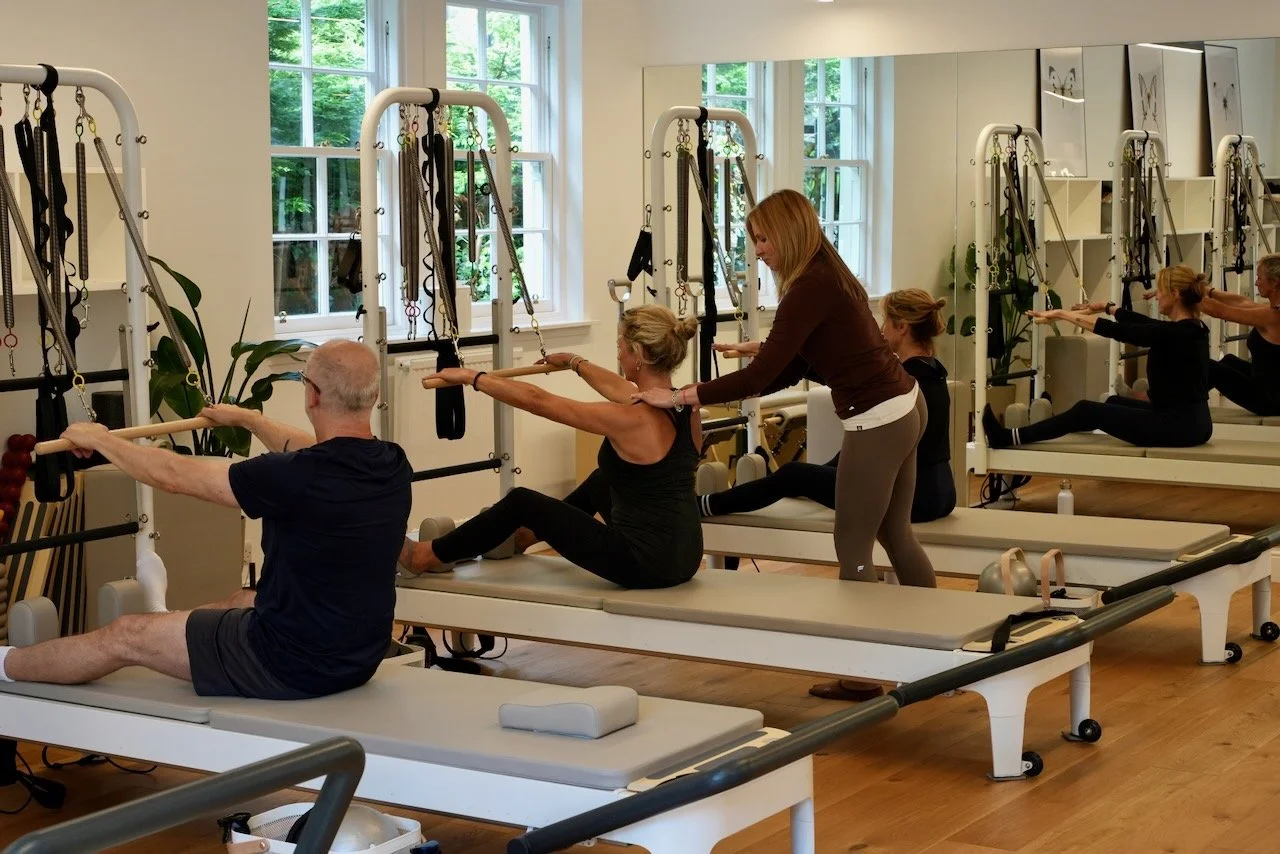
Lucia Poulter cueing shoulder and thoracic spine work in a group Reformer class at Luma Pilates, Edinburgh. The hands-on detail that makes the difference
Short answer
For most people, shoulder and neck pain is caused by muscular imbalance rather than structural damage. The upper trapezius is overworked and tight; the muscles that should support the shoulder girdle are weak and underactive. Pilates addresses this imbalance directly. Most clients at Luma Pilates in Edinburgh notice a meaningful reduction in tension within a few weeks of consistent practice.
If you carry tension in your neck and shoulders, you're in good company. It's one of the most common things clients mention when they first come to Luma, sometimes as the main reason they're here, sometimes almost as an aside, as if it's so normal it barely warrants mentioning.
It is normal. But it isn't inevitable. And in most cases, it has a clear cause and a clear solution.
Why shoulder and neck pain happens
Most shoulder and neck pain isn't the result of injury or structural damage. It's the result of muscular imbalance: some muscles working too hard for too long, others barely working at all.
The pattern is remarkably consistent, and it's driven largely by the way most of us spend our days. Screens pull the head forward. Prolonged sitting rounds the upper back. Repetitive movements in one plane reinforce the same muscular habits over and over. Over time, a predictable set of imbalances develops.
The evidence base here is clear. NHS physiotherapy guidelines recommend exercise and movement as the primary treatment for neck and shoulder pain, with strengthening and postural work specifically indicated. Multiple systematic reviews support exercise-based approaches for both conditions, and Pilates delivers exactly what the research points to: targeted strengthening of the underactive muscles, restoration of thoracic mobility, and retraining of postural habits in a controlled, low-impact format.
The upper trapezius, the large muscle running from the base of the skull across the top of the shoulders, becomes chronically overloaded. It's doing work it was never designed to do alone: holding the head up against gravity, bracing against stress, compensating for the muscles around it that have stopped pulling their weight.
Those muscles, the lower and middle trapezius, the serratus anterior, and the deep muscles of the cervical spine, become progressively weaker and less responsive. The shoulder girdle rounds forward. The neck loses its natural curve. And pain becomes a reliable feature of most days.
This is the pattern Pilates is designed to unwind.
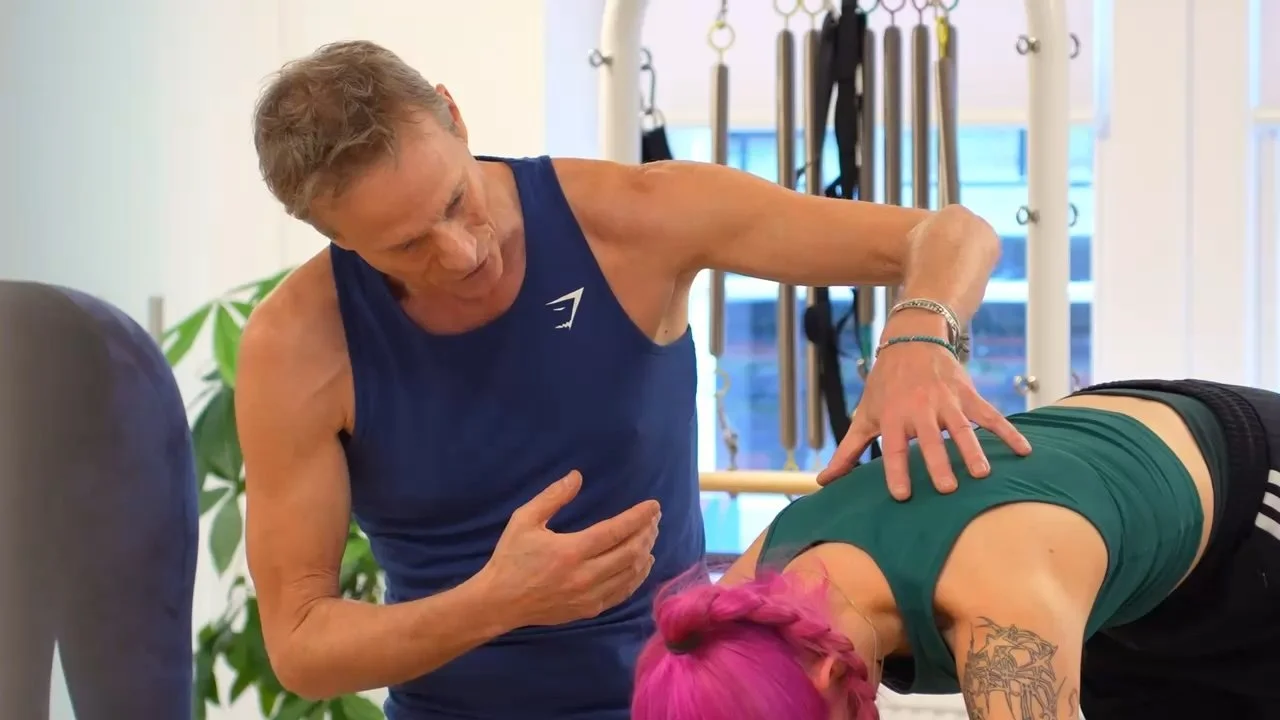
Max Howarth cueing spinal alignment during Up Stretch at Luma Pilates, Edinburgh. Hands-on correction at the point where it matters most
Shoulder pain: what Pilates does
The shoulder is the most mobile joint in the body, which makes it inherently less stable than other joints. Stability comes almost entirely from the muscles around it, which means that when those muscles are imbalanced, the joint pays the price.
The most common presentation we see at Luma: tightness or pain at the front of the shoulder, reduced range of movement overhead, and a general sense of the shoulder sitting too far forward. Sometimes there's a specific diagnosis (rotator cuff strain, bursitis, impingement) but often the pain is simply the result of years of imbalance without a named structural cause.
Pilates works on the shoulder through several mechanisms:
Strengthening the shoulder stabilisers
The serratus anterior and the lower and middle trapezius are the primary stabilisers of the shoulder blade. When they're weak, the blade sits poorly on the ribcage, the joint moves inefficiently, and pain follows. Reformer strap work targets these muscles specifically. It's one of the areas where clients most often notice rapid, tangible change.
Restoring thoracic mobility
A stiff thoracic spine is one of the most underappreciated contributors to shoulder pain. When the mid-back can't rotate and extend properly, the shoulder has to compensate for every overhead or reaching movement. Restoring thoracic mobility takes load off the shoulder joint directly. Almost every Reformer class includes thoracic rotation and extension work.
Rebalancing the chest and upper back
Years of screen work tighten the chest and front of the shoulder while the upper back weakens. Pilates addresses both simultaneously: lengthening the anterior chain through movement while strengthening the posterior chain structures that pull the shoulders back into a healthy position.
Working within a pain-free range
This matters. Pilates is not about pushing through discomfort. Every exercise can be modified so that you're working productively without aggravating the joint. Your instructor will always want to know about any shoulder pain or diagnosis before class.
Neck pain: what Pilates does
Neck pain and shoulder pain share most of the same root causes, but the neck has its own specific pattern worth understanding.
The cervical spine is designed to sit directly above the thoracic spine, with the head balanced over it. When the thoracic spine rounds forward, the head follows and then compensates by tilting back up to keep the eyes level. This forward head posture increases the effective weight the neck muscles have to support considerably. The result is the chronic tension, stiffness, and headaches that many people accept as normal.
Pilates addresses neck pain in three main ways:
Restoring cervical alignment
Most of the spinal alignment work in Pilates, including neutral spine, axial elongation, and the way the head is positioned during exercises, directly addresses the forward head pattern. Over time, the neck relearns what it feels like to sit in a supported, balanced position rather than a compensated one.
Deloading the upper trapezius
When the muscles that should support the shoulder girdle start doing their job properly, the upper trapezius no longer has to carry the load alone. This is usually the change clients notice most directly: the tension that used to build across the top of the shoulders and into the base of the skull starts to ease. It doesn't happen overnight, but it happens consistently.
Strengthening the deep neck flexors
The deep neck flexors are the neck's equivalent of the deep spinal stabilisers in the lower back: small, close to the bone, and critical for postural support. They're almost universally underactive in people with chronic neck pain. Pilates engages them as part of the broader pattern of deep stabiliser work that runs through every class.
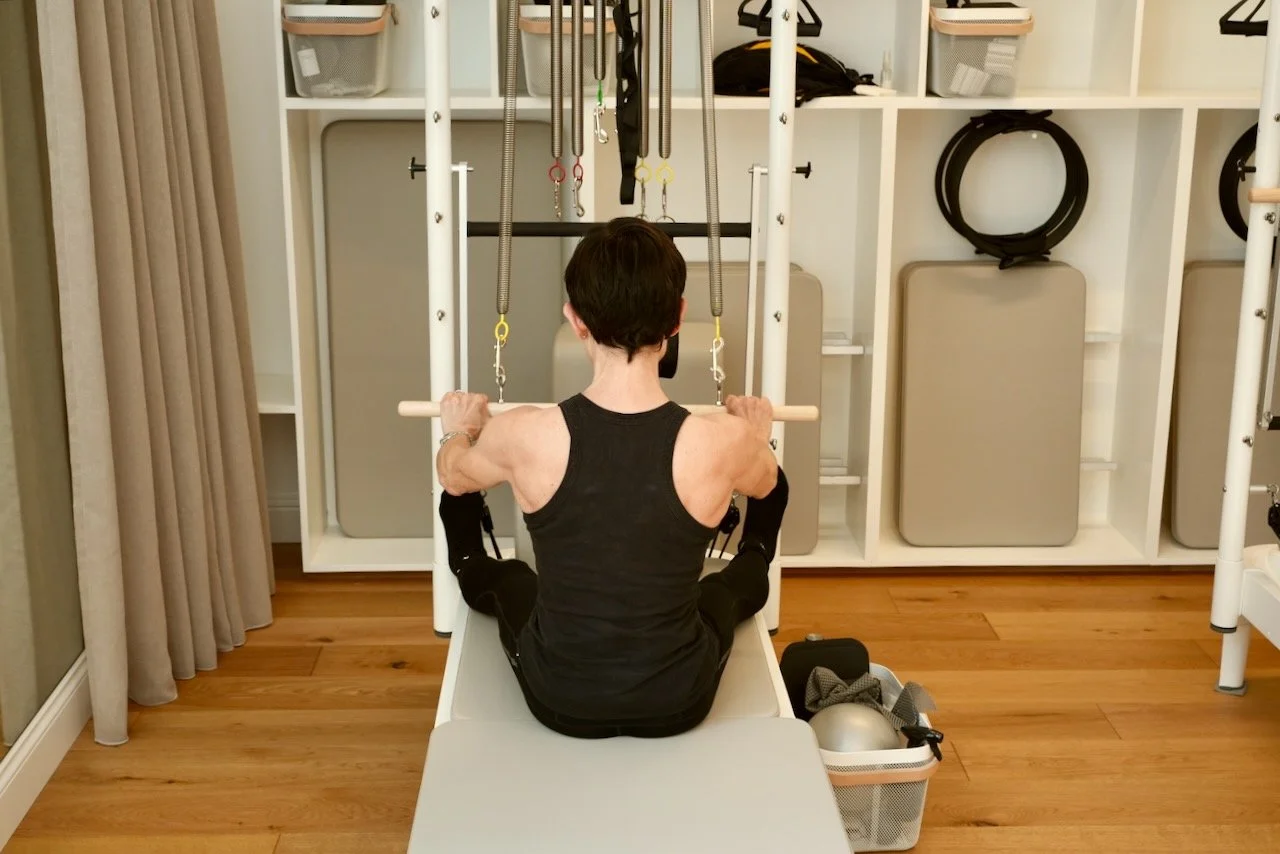
Lat presses on the Tower at Luma Pilates, Edinburgh. The shoulder girdle work that changes how the upper back feels within weeks
What to expect in class
Tell us about your shoulder or neck pain before your first class. We ask about medical history as standard, and the more your instructor knows, the more precisely they can support you.
In practice, if you're coming with shoulder or neck issues, you can expect:
Careful attention to head and neck positioning throughout. Modifications to any exercises that load the shoulder in a provocative range. A focus on thoracic mobility and shoulder blade stability from the first session. Gradual progression as strength and range of movement improve.
You won't be held back from class. You'll simply be guided through it more carefully, with adjustments made in real time as needed.
Most clients with shoulder or neck pain notice something shifting within three to four weeks of consistent practice. The tension that builds through the day reduces. The range of movement opens up. The posture starts to change in a way that doesn't require constant effort to maintain.
Reformer or Mat: which is better for shoulder and neck pain?
Both are effective. The choice depends on what you need and where you are.
Mat Pilates offers careful, controlled work without equipment. Floor-based exercises in lying and seated positions allow close attention to alignment and muscle activation. It's accessible and a good starting point if your pain is significant or you're new to Pilates.
Reformer Pilates offers more targeted work for the shoulder specifically. The strap system allows the arms and shoulders to be loaded through a range of movement against spring resistance, which is particularly effective for building the shoulder stabilisers. The Reformer also makes it easier to modify exercises in real time by changing the spring load or the range of movement without stopping the flow of the class.
For most people with shoulder or neck pain, a combination of both is ideal. At Luma, our Reformer Pilates classes are small group, which means your instructor can keep a close eye on your movement. Our Mat Pilates classes complement that work well.
What to be careful about
Pilates is generally very well tolerated for shoulder and neck pain, but a few things are worth knowing.
Overhead loading can be provocative for certain shoulder conditions, particularly impingement or rotator cuff issues. Your instructor will know to approach this carefully and can modify or avoid it as needed.
Neck loading in flexion, exercises where the head is lifted off the mat, can aggravate neck pain if performed without sufficient deep neck flexor strength. Your instructor will assess this and progress it carefully.
Pushing through pain. As with all Pilates work: sharp, pinching, or worsening pain is a signal to stop and tell your instructor. Effort and mild discomfort are expected; pain is not.
If you have a specific diagnosis such as a rotator cuff tear or cervical disc issue, share it before your first class. It changes how your instructor works with you.
When to see a GP or physiotherapist first
Pilates is appropriate for the vast majority of shoulder and neck pain. But there are some symptoms that warrant a conversation with your GP or physiotherapist before you start.
Seek advice first if you have pain that radiates down one or both arms, numbness or tingling in the hands or fingers, persistent headaches that start at the base of the skull, dizziness or balance problems associated with neck movement, or pain that came on after a fall, accident, or impact.
These can be signs of nerve involvement or other conditions that need to be assessed before exercise. None of them mean Pilates is off the table, but your GP or physio can advise on timing and any precautions your instructor should know about.
If you're unsure, get in touch before booking. We're happy to talk it through.
Getting started at Luma
If shoulder or neck pain is something you're dealing with, Pilates is worth trying. The underlying causes respond well to this kind of work, and most people notice meaningful change within a few weeks.
New to Pilates? Our Reformer Fundamentals classes are the right starting point. They cover the foundational principles, spinal alignment, deep stabiliser activation, shoulder girdle positioning, that everything else builds on. If you'd prefer to start on the mat, our Mat Pilates classes are open to all levels.
View our Reformer Pilates classes or our Mat Pilates classes at Luma, or get in touch if you'd like to talk it through first.
Frequently asked questions
Is Pilates good for shoulder pain? Yes, for most people. Pilates strengthens the muscles that stabilise the shoulder joint, restores thoracic mobility, and rebalances the chest and upper back. At Luma Pilates in Edinburgh, shoulder girdle and thoracic spine work features in every Reformer class. Most clients notice meaningful improvement within a few weeks of consistent practice.
Is Pilates good for neck pain? Is Pilates good for neck pain? Yes. Most neck pain is driven by forward head posture and overloaded upper trapezius muscles, both of which Pilates addresses directly. The deep neck flexor strengthening and thoracic mobility work that runs through every Reformer and Mat class at Luma Pilates makes a consistent difference.
How quickly will I notice a difference? How quickly will I notice a difference? Most clients at Luma notice less tension in the neck and upper back within three to four weeks of two sessions per week. Postural change takes longer, typically three to six months of consistent practice.
Can Pilates make shoulder or neck pain worse? It shouldn't, provided your instructor knows about your symptoms. Pilates should not be painful. If something doesn't feel right in class, say so immediately.
Do I need to tell my instructor about my shoulder or neck pain? Yes, always. At Luma we ask about medical history before your first class. Specific diagnoses, previous injuries, and areas of pain all shape how your instructor works with you.
Should I do Reformer or Mat Pilates for shoulder and neck pain? Both work well. Reformer Pilates offers more targeted shoulder strengthening through the strap system. Mat Pilates is a good starting point if your pain is significant. Many clients benefit from both.
Written by Lucia Poulter
Lucia is co-founder and lead instructor at Luma Pilates Edinburgh. She holds Comprehensive BASI certification and has 26 years of teaching experience. She teaches Reformer classes at Luma weekly.