What Are the Deep Spinal Stabilisers and How Does Pilates Train Them?
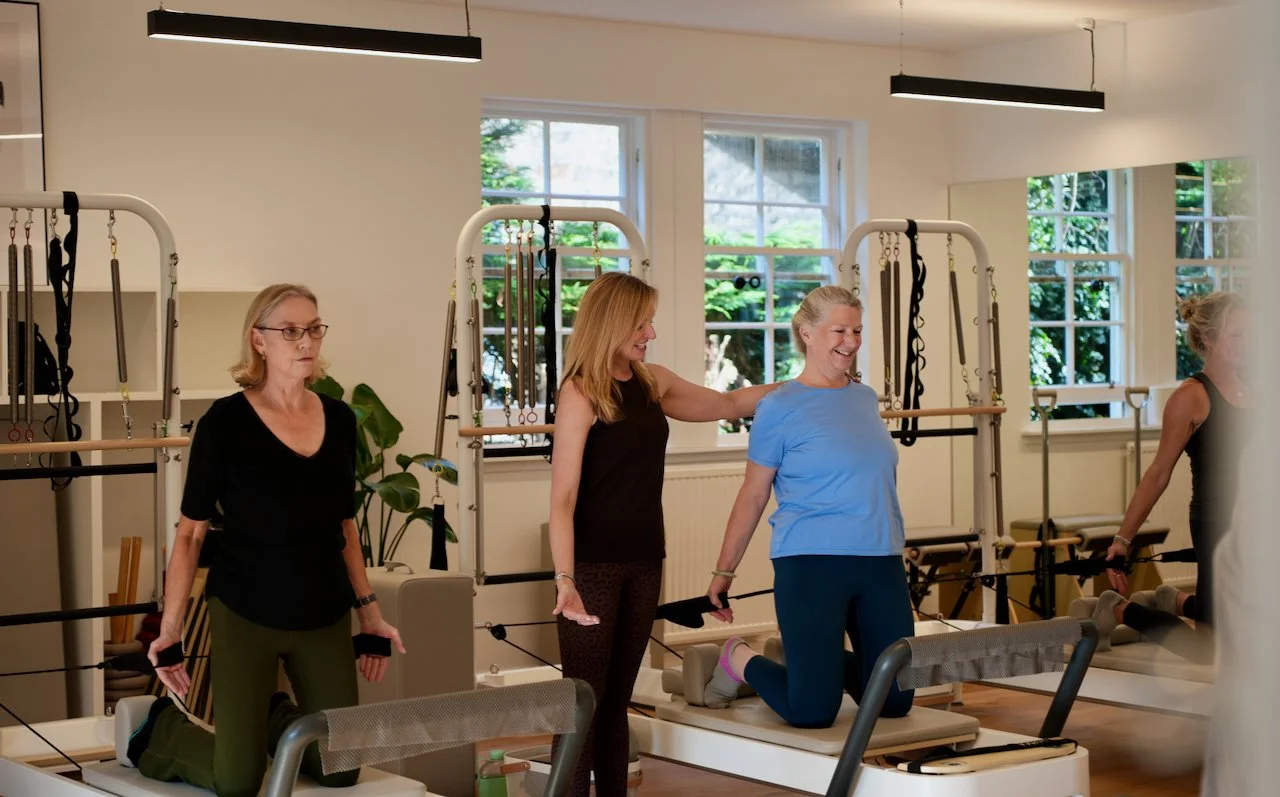
Lucia cueing alignment during a class at Luma Pilates, Edinburgh
Short answer
The term "deep spinal stabilisers" is commonly used for muscles including the transversus abdominis, multifidus, pelvic floor and diaphragm. They contribute to trunk control, breathing, pressure management and spinal movement alongside many other muscles. Pilates places particular emphasis on coordinating these systems while the arms, legs and spine move. The Reformer adds adjustable resistance and support, but these muscles aren't exclusive to Pilates: they're active during many forms of movement and resistance exercise.
What are the deep spinal stabilisers?
The spine is supported by many muscles working in coordination. The term "deep spinal stabilisers" is commonly used to describe a group of muscles that sit close to the spine and pelvis and contribute to trunk control during movement. The four most frequently referenced are the transversus abdominis, multifidus, pelvic floor and diaphragm.
These muscles tend to work at lower levels of activation than the larger surface muscles, and they're involved in coordination and pressure management rather than producing the big movements you can see from the outside. They're part of a broader trunk system that includes many other muscles, and they don't work in isolation.
The term "core" gets used loosely in fitness contexts. The deep spinal stabilisers are something more specific: muscles with particular roles in trunk organisation, breathing and spinal control that Pilates teaching has traditionally emphasised.
The four muscles
Transversus abdominis
The transversus abdominis, or TA, is the deepest of the abdominal muscles. It wraps around the torso from the spine at the back to the linea alba at the front. When it contracts, it contributes to abdominal wall tension and trunk stiffness. It doesn't flex the trunk the way a sit-up does. Its role is more about organisation than movement.
Research in people with chronic lower back pain has found altered timing and recruitment patterns in some of these muscles, including the TA, though findings vary and the relationship between muscle activation patterns and pain is not straightforward. Training the TA in a Pilates context is less about raw strength and more about coordination: learning to engage it at the right moment, with appropriate effort, in coordination with other muscles and with breath.
Multifidus
The multifidus runs in short segments along the spine, from the sacrum to the cervical vertebrae. It contributes to spinal control and positioning during movement. Like the TA, it works as part of a wider system rather than in isolation.
Motor-control exercises often place particular attention on the multifidus, which is why it features prominently in Pilates teaching and rehabilitation approaches for back pain. It can also be trained through other forms of exercise, including loaded strength work.
Pelvic floor
The pelvic floor is a group of muscles forming the base of the pelvis. It contributes to pressure management within the trunk and works in coordination with the other muscles in this group during movement and breathing.
It's often discussed primarily in the context of postnatal recovery or women's health, but pelvic floor function is relevant to everyone. Its role in trunk coordination applies regardless of sex.
Diaphragm
The diaphragm is the primary breathing muscle and also contributes to trunk control and pressure management alongside the other muscles in this group. Some researchers describe these four muscles as a functional unit: TA at the front, multifidus at the back, pelvic floor at the base and diaphragm at the top.
This is a useful teaching model. The Pilates emphasis on coordinating breath and movement fits well with this broader understanding of trunk function.
Why they matter
The deep stabilisers matter because trunk control is part of almost everything the body does. The spine is both load-bearing and mobile: it needs to manage the forces of movement while allowing the arms, legs and trunk to move freely.
How these muscles coordinate can change with pain, injury, training and movement demands, but there is no single pattern that explains why someone develops back pain or other symptoms. In Pilates, the practical aim is simpler: to develop more control, awareness and options for how the trunk works during movement.
This matters for posture, for back pain, for hip function, and for how the body holds up under the cumulative demands of everyday life.
Do other forms of exercise train them too?
Yes. These muscles are active during ordinary movement, sport and resistance exercise. They're not switched off until Pilates teaches you how to use them, and gym training can involve substantial trunk muscle activation, particularly in compound loaded exercises.
What Pilates does differently is place sustained, explicit attention on trunk organisation, breathing and controlled movement. Rather than isolating one deep muscle, a good Pilates session asks the trunk to coordinate with the limbs under changing loads and positions, with an instructor observing and cueing throughout.
This doesn't make Pilates superior to other forms of exercise in an absolute sense. Pilates and gym training train overlapping but distinct things, and many of our clients do both. The difference is one of emphasis and teaching approach rather than access to muscles that would otherwise remain untrained.
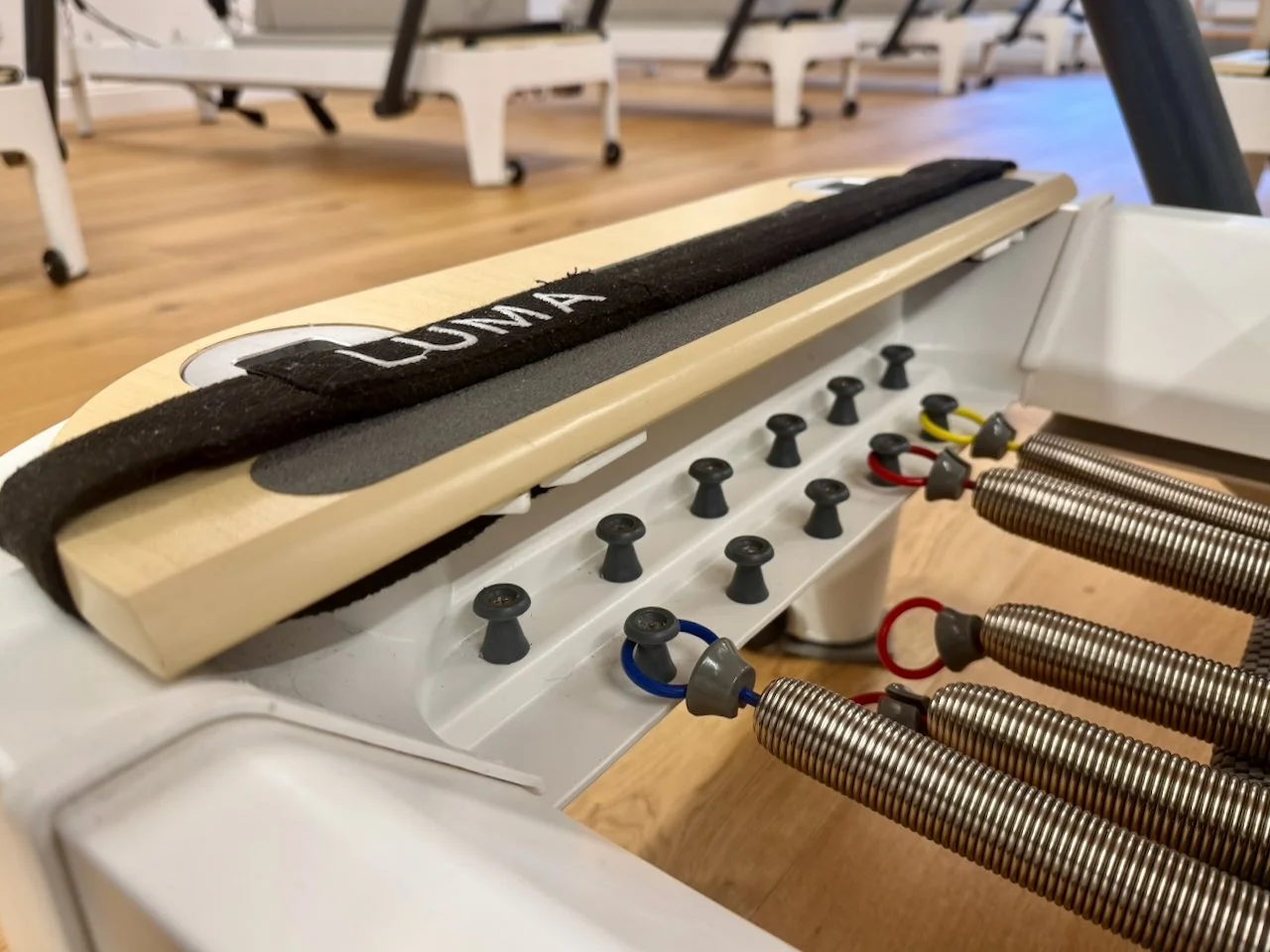
The Reformer's spring resistance is adjustable to match each client's level. Studio A at Luma Pilates, Edinburgh
How Pilates trains trunk control
Pilates trains trunk control through several features that work together.
Adjustable resistance and support. The spring resistance on the Reformer is adjustable and can be set to match what a client can manage with good organisation. The moving carriage changes the demands on the trunk as the exercise progresses. Instructors can modify load, range and position to suit where each client is.
Breath and movement. Every Reformer exercise is cued with breath. Coordinating breath with movement is one of the first things that changes in the early weeks of practice, and it's one of the reasons clients often describe feeling more supported or more settled in their body after sessions, even before obvious physical changes have accumulated.
Different spinal and pelvic positions. Reformer exercises move through a variety of positions: lying, seated, kneeling, standing, on one leg. Each places different demands on trunk organisation. Neutral spine is one useful reference point among several, not a fixed rule.
Instruction and feedback. Small class sizes allow instructors to observe movement and respond to what they see. Cueing and feedback can help clients become more aware of how they organise the trunk, breathe and move under different loads. This is one of the reasons we keep class sizes small at Luma: not for atmosphere, but because it changes the quality of attention that's possible in the room.
What this looks like at Luma
At Luma Pilates in Edinburgh's New Town, trunk coordination work is built into every class from Reformer Fundamentals onwards. The foundations established in the early classes: breath coordination, neutral spine awareness, learning to organise the trunk under load, carry through into more complex work at higher levels.
This is why clients who've been doing other forms of exercise for years sometimes find the early Reformer classes ask for something different from what they're used to. Not because they haven't been using these muscles, but because they haven't consciously attended to this kind of coordination before. That adjustment takes a few sessions, and it's one reason we start everyone at Fundamentals regardless of fitness background.
The changes that follow over time, in posture, in how the body feels during everyday movement, in the relationship between effort and ease, tend to reflect this layer of work becoming more habitual.
If you're dealing with lower back pain, hip pain, or shoulder and neck tension, or simply want to understand what Reformer Pilates is doing when it works, get in touch and we'll help you work out whether it's the right starting point.
Frequently asked questions
What are the four deep spinal stabilisers?
The four muscles most commonly grouped under this term are the transversus abdominis, the multifidus, the pelvic floor and the diaphragm. They contribute to trunk control, breathing and pressure management and tend to work in coordination with each other and with many other muscles.
Do other forms of exercise train the deep spinal stabilisers?
Yes. These muscles are active during many forms of movement and resistance exercise. What Pilates does differently is place sustained, explicit attention on trunk coordination, breath and controlled movement, with an instructor observing and cueing throughout. The difference is one of teaching emphasis rather than exclusive access to muscles that other exercise can't reach.
How quickly do people notice a difference?
This varies considerably between individuals and depends on how often they practise, what they're starting from, and what they're noticing. Some people become more aware of how they organise and control the trunk relatively quickly; changes in strength, movement and physical capacity develop progressively with consistent practice. There is no fixed number of sessions by which you should expect a particular result.
Is this relevant if I don't have back pain?
Yes. Trunk coordination underlies movement quality, posture and how the body manages load during everyday activity, regardless of whether pain is present. Pilates is practised by people across a wide range of starting points and goals, not only those managing pain or injury.
Can I work on trunk coordination in Mat Pilates as well as on the Reformer?
Yes. Mat Pilates works through the same principles: breath coordination, controlled range of movement, attention to spinal and pelvic organisation, and precise instruction. Without the Reformer's spring assistance, some exercises place different demands on the trunk. Both are valid approaches and many clients do both.
Do men need to think about pelvic floor function?
Yes. The pelvic floor contributes to trunk coordination and pressure management in everyone. Its role in how the trunk organises during movement applies regardless of sex. It's one reason the men's Reformer sessions at Luma include the same attention to breath and trunk organisation as all other classes.
Written by Lucia Poulter
Lucia is co-founder and lead instructor at Luma Pilates, and has been teaching Pilates for 26 years. Trunk coordination and the deep stabilising system are central to how she teaches every class, from Fundamentals through to Level 3. She holds Comprehensive BASI certification, the highest level of qualification in the BASI system, covering all Pilates apparatus. Her understanding of how these muscles work has been shaped by decades of teaching bodies at every level, and by her own experience returning to full practice after a hip replacement in 2025.