Pilates for Osteoporosis: What You Need to Know
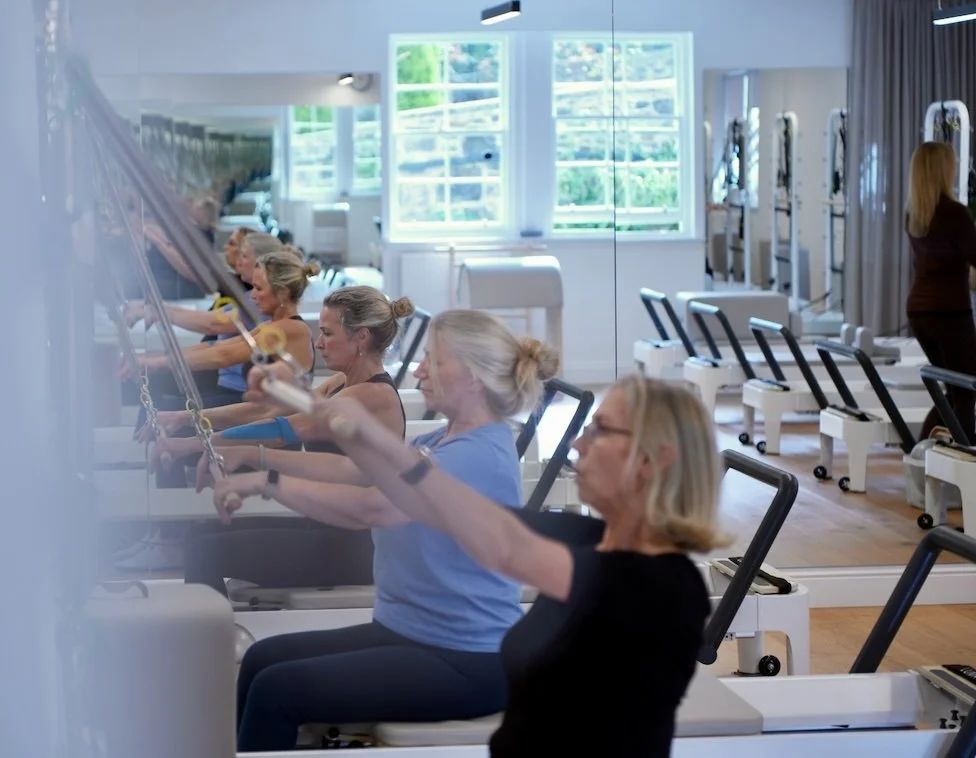
Clients doing seated lat pulldowns on Reformers in a group class at Luma
Short answer
Many people with osteoporosis can do Reformer Pilates safely, but the programme needs to be adapted to your fracture history and current risk level. Pilates can contribute to the strength, balance and physical function that matter for living well with osteoporosis. If bone strength is the primary goal, it works best alongside appropriate weight-bearing and impact activity. A diagnosis of osteoporosis is not a reason to stop moving.
In this guide
- What osteoporosis means for exercise
- What the evidence recommends
- Where Pilates fits
- Which movements may need modifying
- Why spinal flexion is nuanced
- Osteoporosis vs previous fracture: an important distinction
- How Luma approaches new clients with a diagnosis
- When we would want physiotherapy input first
- Key takeaways
- FAQs
What osteoporosis means for exercise
Osteoporosis is a condition in which bone density and bone quality are reduced, making bones more susceptible to fracture. In the UK, around 3.5 million people are affected, the majority of them women over 50. The most common sites for fragility fractures are the spine, hip and wrist.
A diagnosis of osteoporosis does not mean you should stop being active. The Royal Osteoporosis Society (ROS) and the National Osteoporosis Guideline Group (NOGG) both emphasise that physical activity is important for managing the condition. The question is which activity, at what intensity, and with what modifications.
For exercise to help bone health, it needs to provide some mechanical load – bones respond to stress placed on them. This is why prolonged rest is counterproductive, and why exercise that removes all load from the skeleton is unlikely to be the right approach for bone strength specifically.
What the evidence recommends
NOGG guidelines recommend a combination of weight-bearing and impact exercise alongside progressive muscle-strengthening work. The reasoning is that both types of loading stimulate bone remodelling through different mechanisms.
Weight-bearing activity – walking, dancing, low-impact aerobics – puts the skeleton under gravitational load. Impact activity – gentle jogging, heel drops, jumping where appropriate – provides short bursts of higher mechanical stress that have been shown to have beneficial effects on bone mineral density. Progressive resistance exercise builds muscle, which in turn places tension on bone and supports joint stability.
Balance training also matters, and is a central part of the NOGG recommendations. Falls are a major route to fracture in people with osteoporosis, and improving balance and lower-limb strength is one of the most effective ways to reduce that risk.
Pilates addresses several parts of this picture – progressive resistance, balance, postural control and muscular support – but it is not a complete bone-health programme on its own. If improving bone strength is the primary goal, people usually need additional weight-bearing and impact activity alongside their Pilates practice.
More detail on what the research says about Pilates specifically is covered in our article: What Pilates Actually Does: The Evidence.
Where Pilates fits
Pilates contributes to bone health indirectly through the things it does well: building muscular strength and endurance, improving balance and proprioception, and reinforcing postural control. These are outcomes that matter considerably for someone managing osteoporosis, even if Pilates does not replace the mechanical loading that comes from weight-bearing or impact activity.
One useful feature of the Reformer for people with osteoporosis is its adaptability. Springs allow load to be progressively increased or decreased. Exercises can be performed lying, seated, kneeling and standing, so spinal position and range can be controlled throughout. Balance challenges can be introduced and progressed carefully. For women over 50 managing osteoporosis alongside other midlife changes, the Reformer offers a lot of flexibility in how work is structured and paced. You can read more about this in Pilates for Women Over 50.
The ROS specifically provides guidance on practising Pilates safely with osteoporosis and making appropriate modifications. The exercise itself is not the concern; the approach to it is.
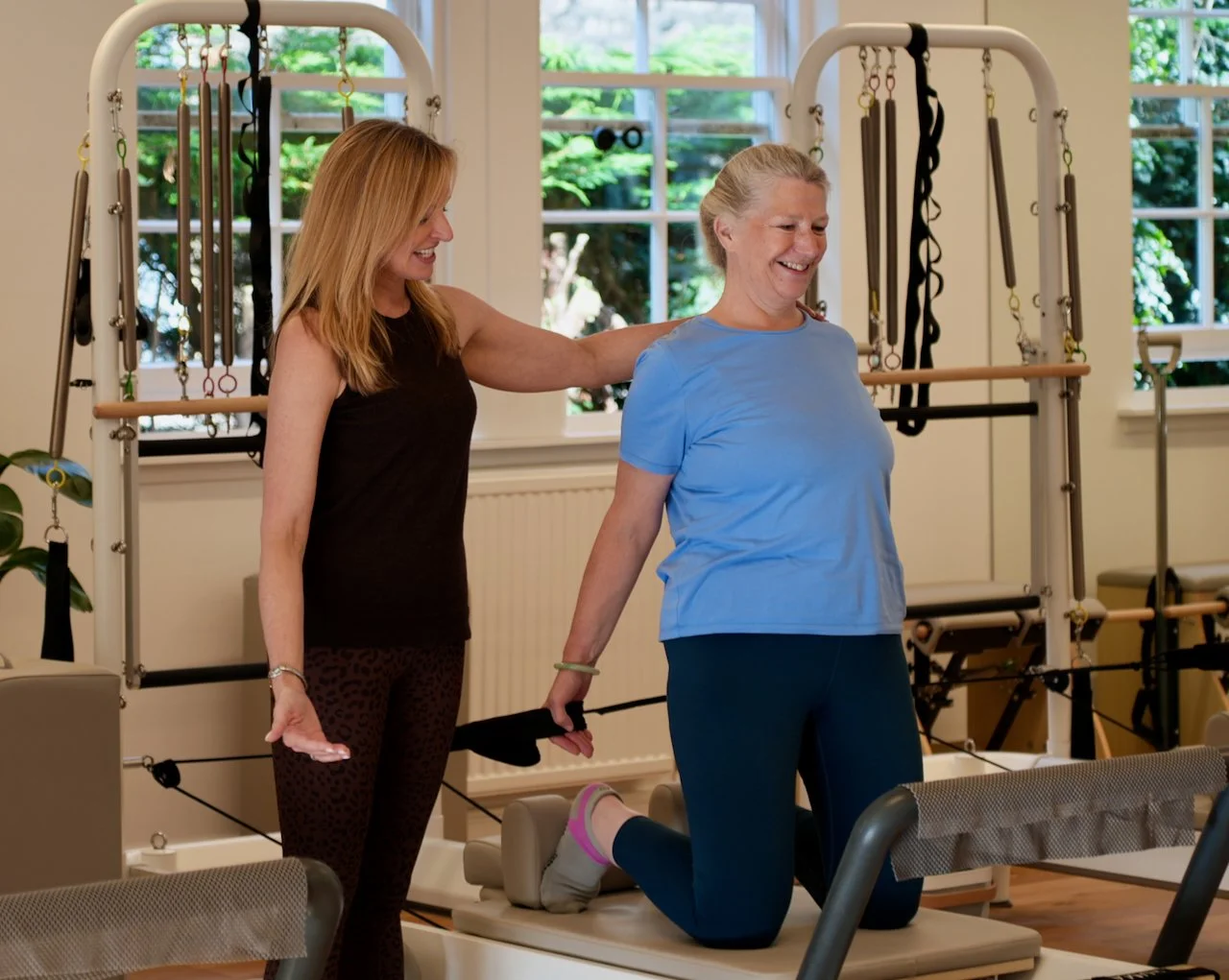
Lucia Poulter cueing a client during a Reformer class at Luma Pilates, Edinburgh
Which movements may need modifying
Not all Pilates exercises carry the same level of consideration for someone with osteoporosis, and the degree of modification depends significantly on individual fracture risk. The following are the movements most commonly flagged for review:
Loaded spinal flexion. Exercises that repeatedly curl or round the spine under load, such as roll-downs with resistance, curl-ups and sit-up style movements. The concern is repetitive, forced, end-range flexion in people at higher vertebral fracture risk, not spinal movement in general.
Extreme ranges of rotation. Rotation is generally safe and beneficial, but deep or forced rotation combined with flexion is worth moderating.
High-impact jumping. Jumping on the Reformer jumpboard may not be appropriate depending on fracture risk, although this is individual. The goal is not to remove all impact, but to choose appropriate levels of impact.
What this list does not include is most of Pilates. Supported extension work, hip and glute strengthening, side-lying leg series, standing balance exercises, seated rotation, and upper back work are all generally well suited to people with osteoporosis. A good instructor focuses on what is appropriate, not on what needs to be removed.
Why spinal flexion is nuanced, not simply banned
One of the most persistent pieces of guidance people bring to class is that they have been told never to flex their spine. This is an oversimplification of the actual clinical guidance, and it is worth addressing directly.
NOGG guidance states that repetitive, forced forward flexion should be undertaken with care in people with osteoporosis. The ROS flags specific loaded movements – roll-downs, curl-ups, toe-touching – as exercises that may need modifying, particularly in those at higher vertebral fracture risk.
What neither guideline recommends is eliminating all spinal movement from daily life or exercise. Everyday spinal movement – bending to pick something up, rounding slightly when sitting, turning to look behind you – is normal and appropriate. The concern is with repetitive, loaded, end-range flexion, not with spinal movement in general.
For Pilates specifically, this means avoiding exercises like loaded roll-downs and curl-up series for clients at higher fracture risk, while keeping the many Pilates exercises that involve neutral or extended spinal positions, rotation within comfortable range, and hip hinge mechanics. Understanding the distinction matters both for safety and for making sure people are not over-restricted in their movement.
A hip hinge, where the movement comes from the hips rather than rounding the back, is generally preferable to deep spinal flexion for lifting and loading. This is a practical technique we reinforce throughout our approach to movement at Luma, and is something covered in more depth in What Are the Deep Spinal Stabilisers and How Does Pilates Train Them?
Osteoporosis vs previous fracture: an important distinction
A diagnosis of osteoporosis without a history of fragility fractures is very different from a history that includes one or more vertebral fractures, hip fractures, or other fragility fractures. This distinction affects the starting point considerably.
| No previous fracture | Previous fracture(s) | |
|---|---|---|
| Exercise approach | Modified group class often appropriate | Physiotherapy guidance or 1:1 instruction recommended first |
| Spinal flexion | Care with loaded, end-range positions | Avoid repetitive loaded flexion; neutral and extension preferred |
| Impact | Appropriate levels of impact beneficial | Individual assessment; recent fracture needs clinical guidance |
| Balance work | Encouraged | Especially important; fall prevention a priority |
| Starting point at Luma | Modified group class or private 1:1 | Private 1:1 strongly recommended; physio input often appropriate |
For someone with a history of vertebral fracture specifically, NOGG recommends progressive back-extensor strengthening and endurance work, and notes that a physiotherapist-supervised exercise programme may be appropriate, particularly if pain is present. This is not a reason to avoid exercise, but it is a reason to approach it carefully and with appropriate support.
How Luma approaches new clients with a diagnosis
A diagnosis of osteoporosis does not mean you can’t come to Luma. It does mean we need to understand your situation before you book a class.
Before you book, drop us an email. Send a note to [email protected] and let us know your diagnosis, your fracture history if relevant, and any clinical advice you have been given. This gives us the information we need to recommend the right starting point and means we can hit the ground running rather than spending the first session working out what you need.
Medical or physiotherapy guidance. Most people with osteoporosis can exercise safely. If you have a history of spinal or multiple fragility fractures, are recovering from a fracture, have significant pain, have been told you are at very high fracture risk, or are uncertain about what is appropriate for you, we will ask for guidance from your GP or physiotherapist before you start.
Private 1:1 as a starting point. For many clients with osteoporosis, particularly those with a history of fractures, significant pain, marked postural changes, or uncertainty about what is appropriate for them, a private 1:1 session is a better way to begin than joining a group class straight away. A 1:1 allows us to take a thorough history, assess how you move, identify which exercises need modifying and which are straightforward, and build a programme that reflects your specific situation. Once we understand what works for you, moving into a group class is a natural next step for many clients.
In our group classes, clients are currently asked to disclose any relevant health conditions when they get in touch. We are integrating a new client intake form in the coming weeks, which will include a full pre-activity questionnaire (PAR-Q) built into the booking process. In the meantime, the conversation before you arrive is the most important step. We would rather spend ten minutes on a conversation before your first class than have you arrive without the context we need to look after you well.
When we would want physiotherapy input first
We’re not trying to be cautious for the sake of it. These are the situations where a physiotherapist’s assessment genuinely changes what we do with you in the studio:
A history of one or more vertebral (spinal) fractures
Multiple fragility fractures
Current fracture recovery
Significant pain that has not been assessed
Very high fracture risk flagged by your GP or specialist
Marked kyphosis (forward curvature of the upper spine) that has not been assessed
Significant balance problems
Uncertainty about what is safe for your specific situation
None of this is a barrier to Pilates. It’s a way of making sure the Pilates you do is right for you from the first session. Physiotherapy and Pilates work well together: a physiotherapist can diagnose and advise on your specific presentation, and Pilates provides the ongoing structured movement practice that builds on that foundation. We cover the relationship between the two in more detail in Pilates vs Physiotherapy: Do You Need One or Both?
If you’ve had a hip fracture or hip replacement, our article on Pilates After Hip Replacement is also relevant.
Key takeaways
Osteoporosis means reduced bone density, but it does not mean stopping exercise. The clinical guidance from ROS and NOGG is to remain active with appropriate adaptations.
The most effective exercise for bone strength combines weight-bearing and impact activity with progressive muscle strengthening. Pilates contributes to this picture through strength, balance and postural work, but is not a complete bone-health programme on its own.
Spinal flexion is not simply banned. The concern is with repetitive, loaded, end-range flexion, not everyday spinal movement or the majority of Pilates exercises.
A history of fragility fractures, particularly vertebral fractures, changes the approach significantly. Physiotherapy input and 1:1 instruction are usually more appropriate starting points than a group class.
If you have a diagnosis of osteoporosis and are thinking about starting at Luma, get in touch before you book: [email protected]. We want to understand your situation before your first class.
Frequently asked questions
Can I do Reformer Pilates if I have osteoporosis?
Yes, in most cases. A diagnosis of osteoporosis is not a reason to avoid Reformer Pilates, but the programme needs to be adapted to your fracture history, your bone density findings and any clinical guidance you have been given. One useful feature of the Reformer for people with osteoporosis is its adaptability: load, range and position can all be adjusted. Before booking, email us at [email protected] so we can understand your situation and recommend the right starting point.
Is Pilates good for osteoporosis?
Pilates contributes to muscle strength, balance and postural control; all useful parts of reducing fall risk. It is not the most direct route to improving bone mineral density – that requires weight-bearing and impact activity – but it is a valuable part of a broader bone-health programme. The ROS specifically provides guidance on practising Pilates safely with osteoporosis and making appropriate modifications.
Which Pilates exercises should I avoid with osteoporosis?
The movements most commonly modified are loaded or repeated spinal flexion (roll-downs with resistance, curl-up series, sit-up style movements that repeatedly round the spine under load) and forced end-range rotation. What remains is the majority of Pilates: extension work, hip and glute strengthening, standing balance exercises, side-lying series, seated rotation and upper back work. The specific list depends on your fracture history and current risk level.
Is Reformer or Mat Pilates better for osteoporosis?
The Reformer is often more adaptable for people with osteoporosis because the spring resistance can be precisely adjusted, and many exercises can be performed in positions that keep the spine in a more neutral or extended alignment. Mat Pilates is also appropriate for many people, but some mat exercises involve more loaded spinal flexion than their Reformer equivalents. The format matters less than whether the exercises have been selected and modified appropriately. A fuller comparison is at Reformer vs Mat Pilates.
Do I need to see a physiotherapist before starting Pilates with osteoporosis?
Not in every case. Someone with a straightforward diagnosis, no history of fragility fractures and clearance from their GP may be well suited to a modified group class or a 1:1 session from the start. A physiotherapy assessment is strongly recommended for anyone with a history of vertebral or other fragility fractures, significant pain, very high fracture risk, or marked postural changes. When in doubt, starting with a physiotherapist is not lost time - it gives you better information to bring to your Pilates sessions.
Does Pilates improve bone density?
The evidence that Pilates alone increases bone mineral density is limited. The clearest evidence for exercise improving bone density is for progressive resistance training and weight-bearing or impact activity. Pilates can be part of a programme that includes those elements, and it contributes through muscle strengthening and balance work, but it should not be described as a primary bone density intervention.
Written by Lucia Poulter
Lucia is the lead instructor and co-founder of Luma Pilates in Edinburgh’s New Town. She holds a BASI Comprehensive certification in Pilates and has worked with clients managing osteoporosis, hypermobility, back pain and postnatal recovery throughout her 26 years of teaching. New clients with a health condition are welcome to email [email protected] before booking.