What Pilates Actually Does: The Evidence
Short answer
The evidence base for Pilates is real but uneven. There is reasonable support for improvements in core strength and control, back pain and function, flexibility and mobility, balance, and strength and physical function as we age. Evidence for wellbeing and psychological outcomes looks promising. Some claims made about Pilates – fixing posture, creating long lean muscles, dramatically improving bone density – are harder to support and often overstated. The research matters, but so does 26 years of watching what actually happens in the studio.
After 26 years of teaching, there are changes I see repeatedly in people who practise Pilates consistently. Some of them have a fairly solid evidence base. Others are plausible and commonly reported, but the research is thinner or more complicated than the claims often suggest. A few things the Pilates industry regularly says don't hold up well on closer inspection.
Those are not the same thing, and I think it’s worth being clear about the difference.
This article is not a sales pitch for Pilates. I believe in it because of what I see in the studio over years of practice, and because the evidence, when read carefully rather than selectively, supports a reasonable case for it. But I am more interested in giving you an honest picture than an impressive-sounding list.
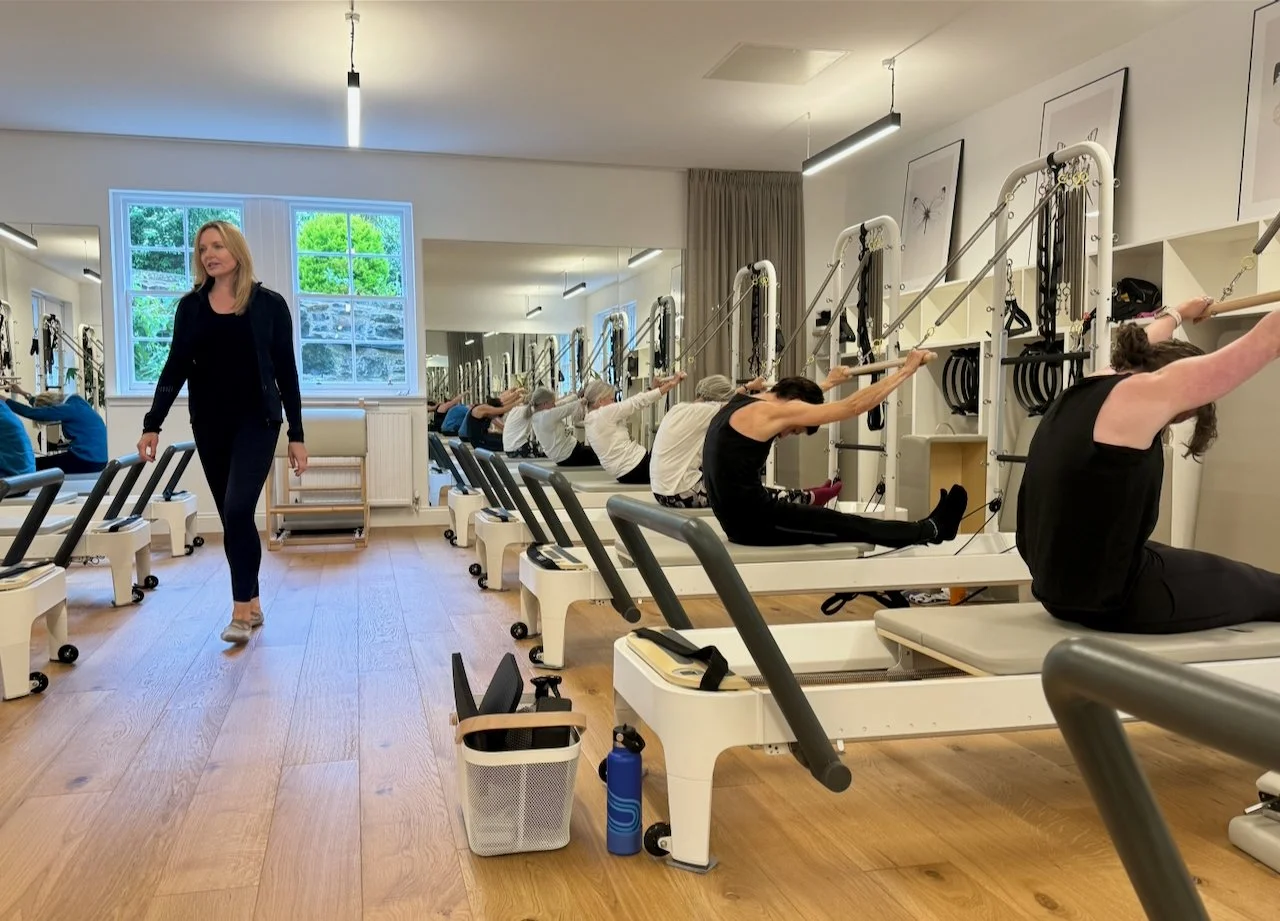
Lucia Poulter in Studio A at Luma Pilates, Edinburgh. Twenty-six years of watching what consistent practice actually does
About the evidence base
The research on Pilates has grown considerably over the last two decades. A 2023 umbrella review published in PubMed, covering 27 systematic reviews, examined Pilates across multiple health outcomes. It found benefits across several areas, but the certainty of evidence ranged from very low to moderate, and most of the underlying systematic reviews were themselves rated as low or critically low quality.
That is not unusual for exercise research. It reflects the difficulty of designing well-controlled exercise trials, not necessarily a failure of the intervention. But it does mean that claims presented as "science-backed" deserve scrutiny. The evidence supports a reasonable case for Pilates. It does not support strong guarantees.
With that in mind, here is an honest read of what it shows.
What we are reasonably confident about
Core strength and control. Research supports improvements in trunk muscle strength and endurance following Pilates training. What the evidence also shows, and what is worth knowing, is that Pilates does not appear consistently superior to equivalently dosed exercise for this outcome. Other well-structured exercise can produce similar gains. What Pilates offers is a systematic, precision-focused approach to this kind of work that many people find more accessible and sustainable than alternatives.
In the studio, this shows up clearly. Clients develop the kind of deep trunk stability that changes how they move when nobody is watching their form: how they sit, stand, and carry load in everyday life. That is the kind of change the research is trying to capture, and it is something I see repeatedly in practice.
Back pain and physical function. This is one of the stronger areas of the evidence base. Meta-analyses of Pilates for chronic lower back pain generally find meaningful improvements in pain and disability. If your lower back pain includes pain that travels into the leg, our guide to Pilates for sciatica covers that presentation specifically. Some reviews also find that other forms of exercise can achieve comparable results, which again reinforces the point that Pilates is not magic, but it is a genuinely effective approach for this presentation.
The clinical picture is consistent with what I see in the studio. Clients who come with chronic back pain and practise consistently, not hoping for a quick fix but building over months, make meaningful progress. The ones who do best are usually the ones who build the strongest understanding of how their body is actually moving. That understanding is one of the reasons Pilates can be useful for people with persistent back pain.
Flexibility and mobility. Research supports improvements in flexibility following Pilates training, and this is consistent with what clients report. Pilates often develops flexibility through controlled strength across range rather than passive stretching, which can make those gains feel more useful in movement.
Our guide to why Pilates improves posture and whether Pilates improves flexibility cover these areas in more detail.
Maintaining strength and physical capacity as you age. The importance of resistance exercise for maintaining strength, physical independence, and quality of life as we age is one of the clearest findings in exercise science. Resistance training is an important part of preserving strength and muscle function as we age, and it becomes increasingly difficult to maintain without it. Pilates, through the spring resistance of the Reformer, provides adjustable resistance that can contribute to that work in a format that many people find accessible and sustainable over the long term.
The clients at Luma who have been practising for five or ten years in their sixties are moving with a quality and confidence that is striking. That is not incidental. It is the cumulative effect of consistent resistance-based work.
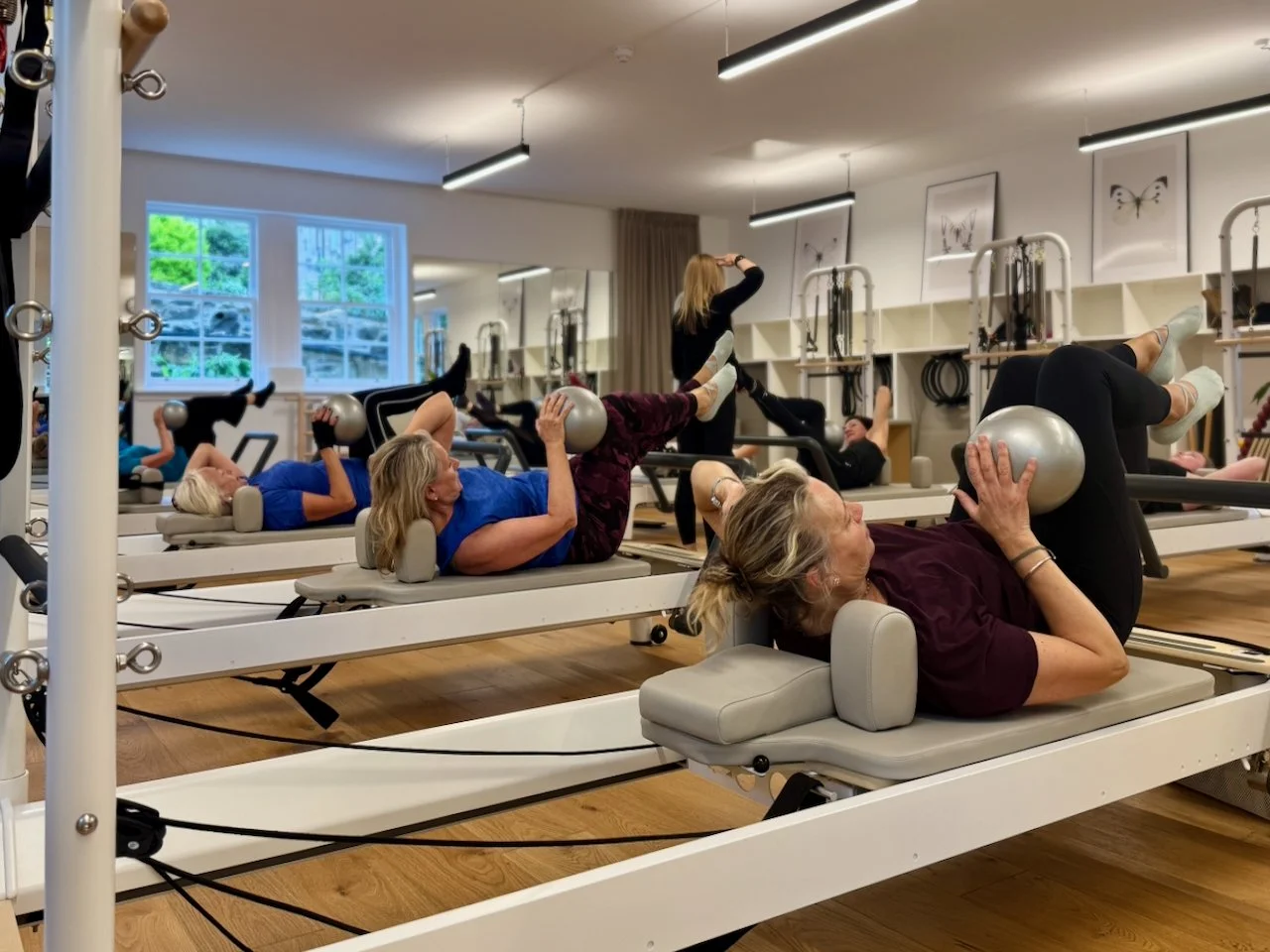
A group Reformer class at Luma Pilates, Edinburgh. Props, precision, and individual attention in every session
What looks promising
Balance. The 2023 umbrella review found evidence of benefit for balance outcomes, and this is plausible given the proprioceptive demands of Pilates practice. Balance matters more as we age, and the studio work, particularly exercises that challenge stability on the moving carriage, challenges balance and proprioception in ways that may transfer beyond the studio. The evidence is not as strong here as for back pain or core strength, but it points in a consistent direction.
Psychological wellbeing. A 2026 systematic review and meta-analysis examining Pilates across mental health outcomes including anxiety, depressive symptoms, wellbeing, and quality of life found positive effects across these measures. This is worth taking seriously. It is also worth being appropriately careful: exercise in general is associated with improved psychological wellbeing, and it is difficult to separate the effects of Pilates specifically from the effects of regular movement, focused attention, routine, and being part of a group.
I would frame this as: Pilates may support psychological wellbeing, and there is growing evidence for that. It is not a treatment for anxiety or depression. But for clients managing the kind of low-level stress and mental fatigue that comes with busy modern life, the focused, breath-led quality of the practice (the fact that it demands your full attention and leaves little room for the day's noise) is something many report as genuinely valuable.
What gets overstated
"Pilates fixes your posture." Pilates trains alignment, body awareness, and the muscular control that supports better posture. But posture is not a simple, correctable problem with a fixed ideal. People's spines and bodies vary; what looks like poor posture in one frame is a normal variation in another. What I can say is that Pilates helps people develop a better understanding of how their body is organised in space, and more capacity to adjust it. That is more useful than the promise of a fixed correction.
"Long, lean muscles." This one needs to go away. Pilates does not literally lengthen your muscles in the way the phrase suggests. It builds strength and control through a full range of movement, which changes how the body moves and can change body composition over time. But the "long, lean" claim is a marketing construct with no meaningful basis in physiology.
Dramatic improvement in bone density. Bone health generally benefits from weight-bearing and resistance exercise, and Pilates includes both of those elements. But Pilates alone, particularly mat Pilates, is unlikely to produce significant improvements in bone mineral density. The research on this is limited and mixed. If bone density is a specific concern, it is worth discussing with your GP or a specialist, and considering whether higher-impact or heavier-load exercise should be part of the picture.
"Pilates prevents injury." Pilates develops strength, body awareness, and movement quality, all of which may reduce injury risk in certain contexts. But no exercise programme prevents injury, and the evidence for Pilates as an injury prevention tool specifically is not strong. I would not make this claim for Pilates or for any other method.
What 26 year’s experience shows
The research matters. It tells us something real about what is happening when people practise Pilates consistently over time. But research studies measure averages across groups, and they cannot fully capture what I see in individual clients over years of work.
What I see is this. People who practise Pilates consistently, two or three times a week over months and years, move differently. They carry themselves differently. They often approach setbacks and injuries with more confidence, because they understand their bodies better. They manage the physical demands of their fifties, sixties, and seventies with a confidence that people who have not built that foundation do not always have.
I cannot point to a randomised controlled trial that fully captures that. But it is real, and it is what keeps me teaching after 26 years.
If you are thinking about starting, browse our Reformer classes or get in touch. The research gives you the broader picture. Consistent practice tells you what Pilates does for you.
Written by Lucia Poulter
Lucia is lead instructor and co-founder at Luma Pilates, with 26 years of teaching experience and Comprehensive BASI certification. She has spent most of those years watching what consistent Pilates practice actually does to bodies over time. This article is her attempt to separate what she is confident about from what is plausible but uncertain, and from what, in her view, the industry simply should not be saying.