Reformer Pilates vs Mat Pilates
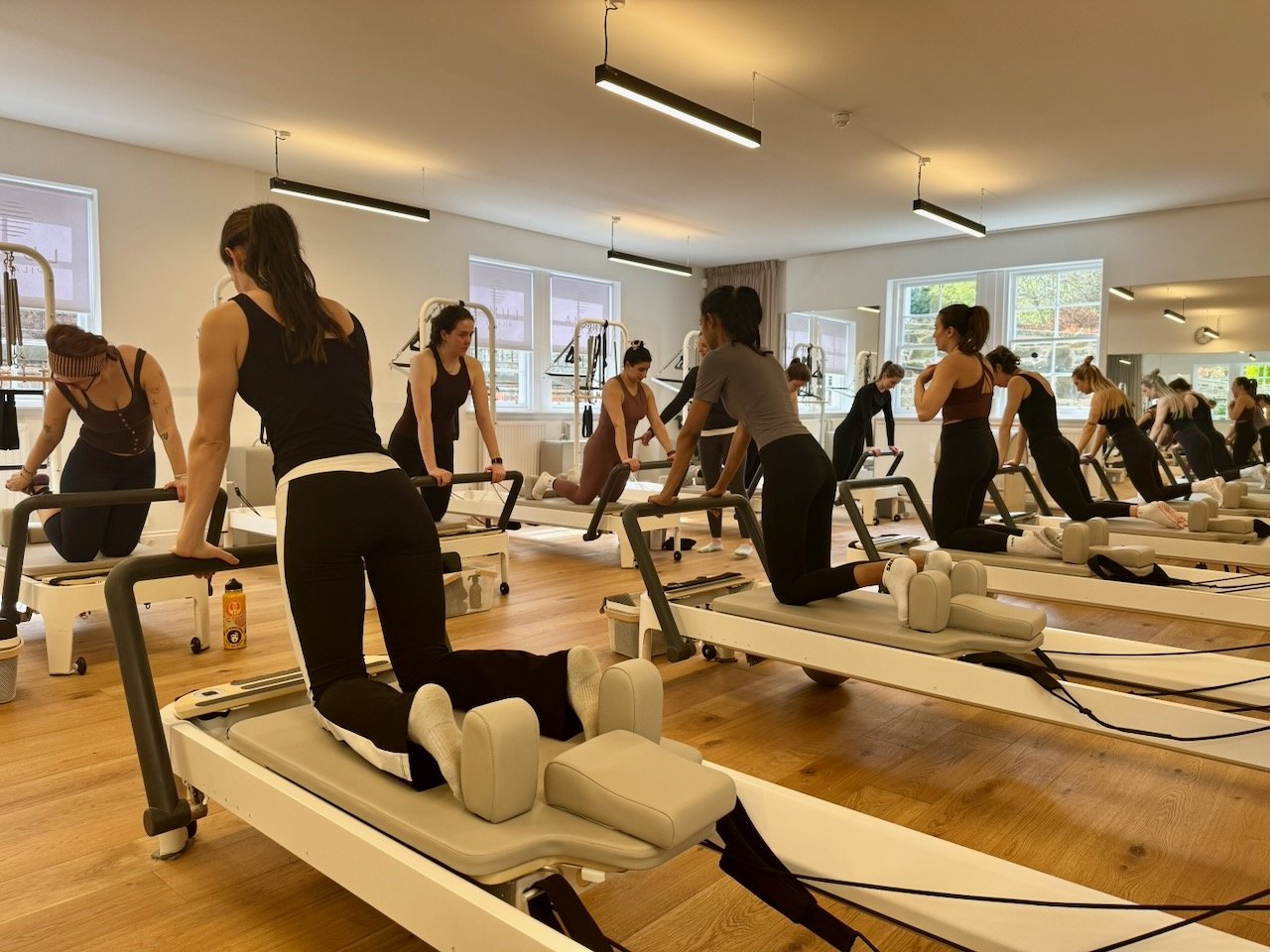
Lucia Poulter cueing the Down Stretch in a group Reformer class at Luma Pilates. The three-dimensional range the Reformer offers that a mat simply can't replicate
Short answer
Both are Pilates. Both develop strength, control, mobility, coordination, and body awareness through the same underlying method. The Reformer adds adjustable spring resistance, a moving carriage, straps, and a much wider range of options for changing load and support. Mat Pilates strips the practice back to your body, gravity, and the floor. Neither is inherently better. They challenge you in different ways, and the right choice depends on where you are starting and what you want from the practice..
Pilates was originally a mat-based practice. Joseph Pilates developed the Reformer as a way to assist movement that was difficult on the floor, to add resistance where the body needed challenge, and to extend the range of what the practice could do. The two disciplines have been complementary from the beginning.
At Luma, we offer both. Understanding the difference helps you make better decisions about your practice.
What they share
Reformer and Mat Pilates are built on the same underlying principles: control, precision, breath, coordination, spinal movement, and centring. Both ask you to organise the trunk and pelvis while the arms and legs move. Both develop awareness of how different parts of the body work together. Both include movements in flexion, extension, rotation, and side bending.
The exercises may look different because the Reformer changes the environment, but the movement principles underneath them are closely related.
If you understand what your instructor is asking for on the Reformer, much of that understanding will transfer to the mat. And vice versa.
Core strength and posture
Mat Pilates asks your core to work harder in a very direct sense. Without spring assistance or resistance, every movement is entirely self-generated, so your deep spinal stabilisers have to control your own bodyweight through the full range of motion. Reformer Pilates works core strength differently: the moving carriage demands stabilisation from the deep spinal stabilisers on every repetition, while spring resistance allows precise loading of muscles that most other exercise doesn't reach directly.
Posture follows a similar pattern. Mat-based exercises target the thoracic spine and shoulder blades directly, building the mobility and scapular stability that complements Reformer work. The Reformer, meanwhile, allows targeted loading of the shoulder girdle and posterior chain, the areas most central to postural strength and where the Reformer is particularly effective.
What the Reformer adds
The Reformer is a more versatile tool. The spring resistance allows for eccentric loading, strengthening muscles as they lengthen, which produces active flexibility gains that mat work cannot replicate as directly. The moving carriage demands stabilisation from the deep spinal stabilisers on every repetition. The straps, the box, and the Tower attachment extend the range of possible movement patterns considerably.
The Reformer is also assistive. For beginners, or for clients working with injury or limited range of movement, the spring resistance can support movement that would be too demanding on a mat. This makes it accessible at a much earlier stage of the practice.
For work on the posterior chain, the shoulder girdle, and the thoracic spine, the Reformer is particularly effective. Spring resistance allows for precise loading of the muscles that most other forms of exercise do not reach directly. See our guide to why Pilates improves posture for more on this.
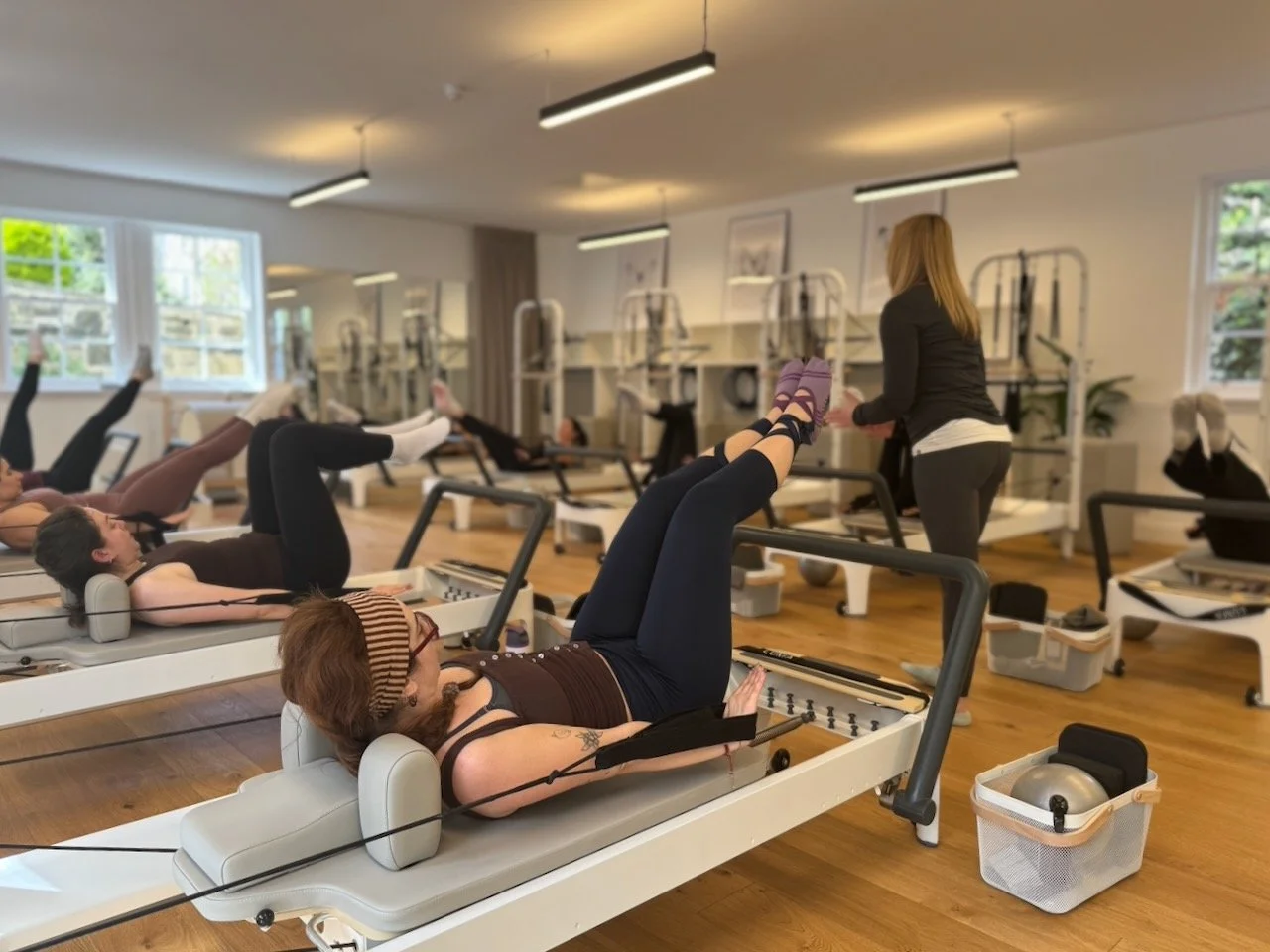
Lucia Poulter cueing the Hundred in a group Reformer class at Luma Pilates. The foundational exercise that every level returns to
What Mat Pilates offers
Mat Pilates asks something different of the body. Without the assistance or resistance of the springs, every movement is entirely self-generated. That demands more from the deep stabilisers and more from the practitioner's ability to control their own bodyweight through a full range of movement.
For experienced practitioners, the mat is a rigorous test of what has actually been internalised. Exercises that feel manageable on the Reformer often reveal gaps when transferred to the floor. Rolling exercises, in particular, develop spinal articulation and abdominal control in ways that the Reformer approaches differently.
Mat Pilates is also more accessible in a practical sense. No equipment is required beyond a mat, which means the practice travels. Clients who develop a mat practice alongside their Reformer work have a movement tool they can use anywhere.
For work on the thoracic spine and shoulder blades, floor-based Mat exercises are particularly effective, targeting these areas from positions and angles that the Reformer does not always reach as directly.
| Factor | Reformer Pilates | Mat Pilates |
|---|---|---|
| Equipment | Spring-resistance carriage, straps, box and Tower | Mat only, with occasional small props |
| Resistance | Springs, both assistive and resistive | Bodyweight, entirely self-generated |
| Beginner starting point | Generally easier; springs assist early movement | Accessible, but asks for more self-control |
| Early-stage rehab | More accessible; spring support when in discomfort | Effective, with less assistance |
| Particularly strong for | Posterior chain, shoulder girdle, single-leg loading | Spinal articulation, abdominal control, rolling work |
| Flexibility | Eccentric loading through the springs | Self-generated range through bodyweight |
| Portability | Studio-based | Travels anywhere, no equipment needed |
| As you advance | Extends range with straps, box and Tower | Tests genuine strength; often the more demanding |
Which is better for beginners?
Both can work for beginners.
At Luma, we recommend Reformer Fundamentals as the starting point for clients who want to learn Reformer Pilates because the class is specifically designed to introduce the machine and the foundational principles gradually.
One advantage of the Reformer is that the springs and equipment can provide support while you are learning. The carriage also gives immediate feedback: if one side moves differently from the other, or if control is lost, you often feel it straight away.
But Mat Pilates is not an "advanced" version that beginners need to earn their way into. A well-taught beginner Mat class can introduce exactly the same foundational principles without a machine.
At Luma, Mat Pilates is taught by Liron Bleischer, Catrin Dawson, and Julia Govan.
If you specifically want to learn the Reformer, start with Reformer Fundamentals. If Mat appeals to you more, there’s no reason you can’t begin there instead.
See our guide to whether beginners can do Reformer Pilates for more on starting out.
Which is better for specific goals?
Usually, the better question is not "Which one wins?" but "What does each format let us do?"
For lower back pain. Exercise, including Pilates, can be useful for some people with persistent lower back pain, but neither Mat nor Reformer is automatically the correct choice for every presentation. The Reformer's ability to change support, range, and resistance can make it useful when exercises need adapting. Mat work may also be entirely appropriate depending on the person and their symptoms. See our guide to Pilates for lower back pain.
For posture. Both develop body awareness, spinal movement, strength, and shoulder control. The Reformer offers more options for resisted pulling, pushing, and standing work, while Mat Pilates develops control using bodyweight and gravity. Neither has a unique claim on better posture. See our guide to why Pilates improves posture.
For flexibility and mobility. Both involve moving through controlled ranges and developing strength within those ranges. The Reformer changes how resistance can be applied through the movement, while Mat work asks you to control the range without spring assistance. See our guide to whether Pilates improves flexibility.
For runners. Both can complement running. The Reformer offers useful options for single-leg resistance, standing work, lateral movement, and rotation, while Mat Pilates offers portable strength and mobility work that can be practised without equipment. Which is more useful depends on the runner and what the rest of their training already includes. See our guide to Pilates for runners.
For experienced practitioners. Both become more demanding as the practice develops. Advanced Mat work can require considerable bodyweight strength, control, and coordination. Advanced Reformer work adds greater resistance, instability, and complexity. Difficulty depends much more on the exercise and how it is taught than on whether you are on a Mat or a Reformer.
The case for both
You don’t need to practise both Reformer and Mat Pilates to have a worthwhile Pilates practice, but they do complement one another well.
The Reformer gives you resistance, assistance, and a huge range of equipment-based possibilities. The Mat takes that equipment away and asks what you can organise with your own body.
Practising both can expose you to different versions of the same underlying principles and make the relationship between exercises clearer.
For some clients, that variety is useful. Others simply prefer one format and practise it consistently for years.
There’s no requirement to do both for your Pilates to be "complete."
At Luma, Subscription credits can be used across eligible class types, so adding Mat to a Reformer practice is straightforward. Class Packs are also available for clients who prefer more flexibility. See our Class Packs vs Subscriptions guide for the current options.
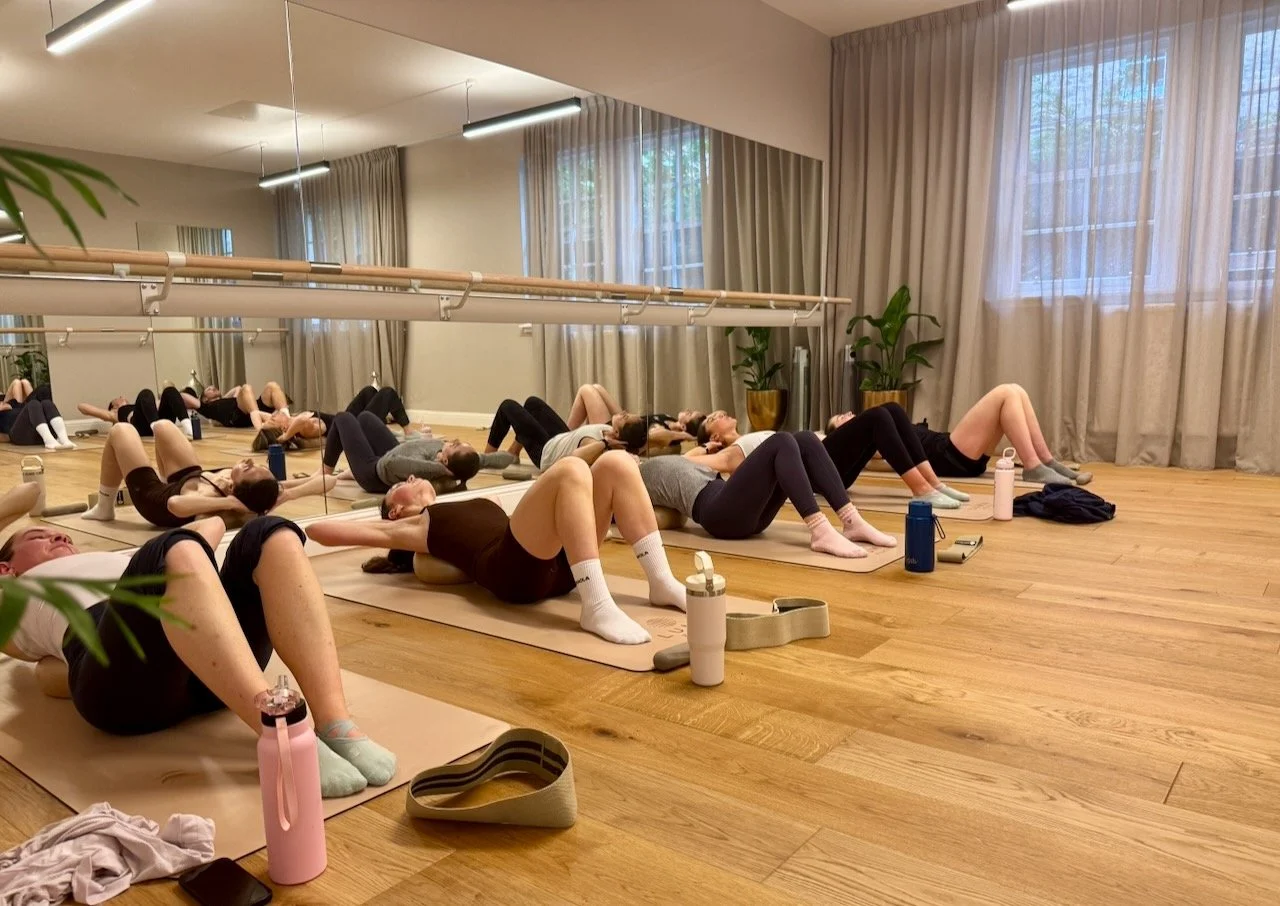
A Mat Pilates class in Studio B at Luma Pilates. No springs, no carriage, just the work
Where to start
If you specifically want to learn Reformer Pilates, Reformer Fundamentals is the place to begin at Luma.
If you want to start with Mat Pilates, you can do that too.
And if you already practise one and are curious about the other, there’s no need to wait until you ‘ve reached a particular level before asking your instructor where it might fit.
View our full class schedule or browse all classes to see what’s available.
And if you’re unsure which format suits you, get in touch. We can help you choose a sensible starting point.
Lucia is lead instructor and co-founder at Luma Pilates, with 26 years of teaching experience and Comprehensive BASI certification. She has taught both Reformer and Mat Pilates throughout her career. Her answer to which is better is straightforward: neither. They are different parts of the same method, and what matters is choosing the work that is appropriate for the person in front of you.