
How Pilates Enhances Your Daily Life
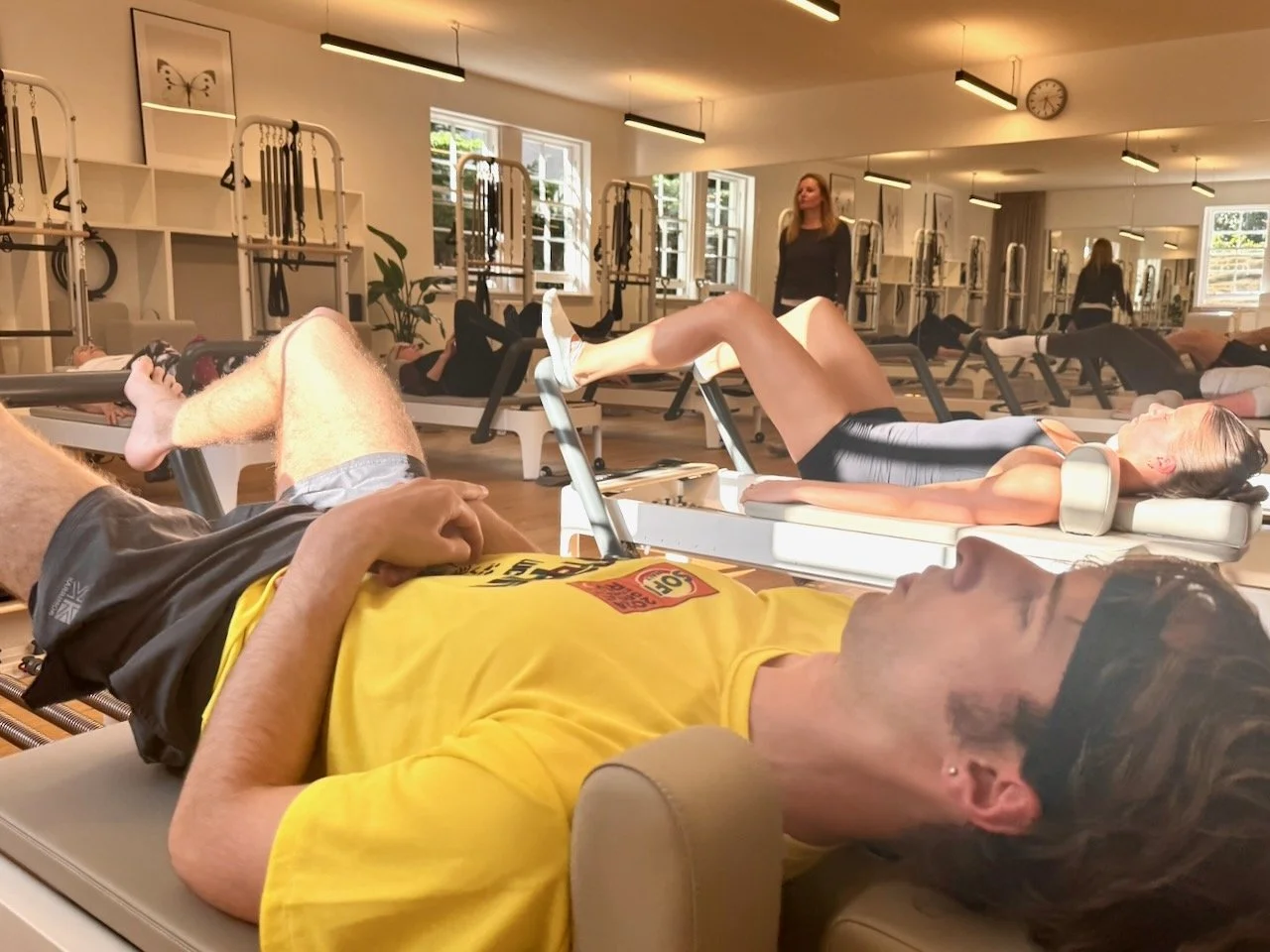
Lucia Poulter cueing a group Reformer class at Luma Pilates. The kind of focused, individual attention that changes how you move
Short answer
Consistent Reformer Pilates changes how you stand, how you move, and how your body feels across everything you do. The benefits don't stay in the studio. They show up at your desk, on a run, in the way you sleep, and in the absence of the aches you used to treat as normal.
Most people start Pilates for one reason and stay for another.
They come in because a physio suggested it, or because their back has been giving them trouble, or because a friend wouldn't stop talking about it. They stay because something changes that they weren't expecting. Not just in the studio, but in the rest of their life.
I started in my mid-fifties. The reason I kept going wasn't the classes themselves, though I came to value those a great deal. It was what happened between them. The way I stood at a bus stop. The way I got out of a car. The absence of the lower back stiffness I'd been treating as an inevitable feature of middle age.
Here's what consistent Reformer Pilates actually does, outside the studio.
Posture
The deep spinal stabilisers are the muscles closest to the spine that hold it in its optimal position. They're not the muscles you feel when you do a crunch. They're the ones that work quietly in the background, maintaining your posture without you having to think about it.
In most people, these muscles are undertrained. Years of sitting, of forward-facing activity, of training that prioritises the anterior chain over everything else, leave them disengaged. The result is posture that requires conscious effort to maintain, and that deteriorates the moment your attention is elsewhere.
Pilates trains these muscles specifically, in every session. Over time, the improvement in posture stops being something you have to remember and becomes something that just happens. You stand differently. You sit differently. The change is noticed by other people before you notice it yourself.
See our full guide to why Pilates improves posture for more on the specific mechanisms.
Mobility and ease of movement
One of the most consistent things clients report in the first few months is that ordinary physical tasks become easier. Reaching, bending, twisting, getting up from a low chair, carrying something heavy on one side. Things that had started to feel like small efforts stop feeling that way.
This happens because Pilates develops active flexibility: strength through a full range of movement, rather than the passive flexibility of a stretch that doesn't translate into function. The eccentric loading built into Reformer work strengthens muscles in lengthened positions, which signals to the nervous system that extended ranges are safe and accessible.
The thoracic spine is a good example. It's designed to rotate and extend. After years of desk work and forward-facing activity, it stops doing either well. Pilates addresses this directly and consistently. Most clients notice the improvement in spinal mobility within the first six to eight weeks, and it carries through into everything else they do.
See our guide to does Pilates improve flexibility for more detail.
Energy
This one surprised me. I expected Pilates to be tiring in the way most exercise is tiring. It isn't. Or at least not in the same way.
A Reformer class is demanding. You leave having worked. But the fatigue is different from high-intensity training: it's the fatigue of muscles that have been used precisely rather than driven to failure, and it tends to resolve quickly. Most clients report feeling better after a session than before it, and better still the following day.
Part of this is the breath work. Pilates uses breath deliberately, coordinating it with movement in a way that activates the parasympathetic nervous system and produces a physiological calm that most forms of exercise don't. You leave a class having worked hard and having actively recovered at the same time.
The longer-term energy effect is a function of efficiency. A body that moves well uses less energy moving. The postural improvements, the reduced muscular compensation, the better sleep: all of these compound into a general sense of having more in reserve.
Body awareness
Proprioception is the body's ability to sense its own position and movement in space. It's what allows you to know where your limbs are without looking at them, to catch yourself before you trip, to make small adjustments to your balance without thinking about them.
Pilates develops proprioception more directly than most forms of exercise, because it requires you to pay attention to exactly this: where your body is, how it's moving, whether what you're doing matches what your instructor is asking for. That attention, practised consistently, transfers into daily life.
The practical effect is a body that moves more accurately and responds more reliably. Clients who play sport notice it in their performance. Clients who are managing old injuries notice it in their stability. And people who have simply been moving through life on autopilot notice it in the sudden awareness of habits they'd never registered before, and the ability to change them.
Stress and mental clarity
A Pilates class requires your full attention. The precision of the movement, the coordination with breath, the constant calibration of effort and alignment: there isn't much room left for whatever you brought in with you. Most clients find this one of the most valuable things about the practice, even if they didn't come for it.
The deliberate breath work activates the parasympathetic nervous system, which has a measurable effect on cortisol levels and the physiological stress response. This isn't incidental to Pilates. It's built into the method.
The clarity that follows a session is something clients mention consistently. Decisions feel easier. The list of things to worry about feels shorter. This isn't a claim about therapy or mental health treatment. It's a straightforward observation about what happens when you spend fifty minutes breathing deliberately and moving with intention.
See our guide to Pilates and Yoga for stress and anxiety for more on this.
Sleep
This is the benefit that most surprises people, and the one that tends to be most immediately noticeable.
The combination of physical exertion, breath regulation, and nervous system activation that a Pilates session produces creates conditions that are genuinely conducive to sleep. The reduction in muscular tension alone, particularly in the neck, shoulders, and lower back, removes some of the physical discomfort that disrupts sleep for a significant proportion of people.
The parasympathetic activation from breath work, sustained across regular sessions, shifts the baseline of the nervous system toward a state that is more conducive to rest. This is not a dramatic effect in any single session. Across months of consistent practice, it becomes clearly noticeable.
The compound effect
The changes Pilates produces don't arrive all at once. They accumulate.
In the first few weeks, you feel muscles you didn't know needed attention. By month two or three, you notice the posture shift. A few months after that, the mobility improvements become part of how you move rather than something you consciously register. And somewhere along the way, you realise that things you used to manage, lower back tightness, afternoon energy slumps, the stiffness that greeted you in the morning, have quietly stopped being features of your life.
This is why consistency matters more than intensity in Pilates. Two sessions a week, sustained over six months, produces changes that sporadic harder effort doesn't. See our guide to how often you should do Pilates for more on finding the right frequency for your goals.
If you're new to Luma, our introductory offer of three Reformer or Tower classes for £48 is the right starting point. Three sessions is enough to move past the unfamiliar and start experiencing what the practice is genuinely about. View our class schedule, browse all classes, or get in touch if you'd like to talk it through first.
Written by Max Howarth
Max is co-founder of Luma Pilates. He came to Reformer Pilates in his mid-fifties with no movement background and now teaches five classes a week at the studio. The stiffness he used to treat as inevitable turned out tobe optional.