Pilates and Mindfulness: Why Attention Is the Practice
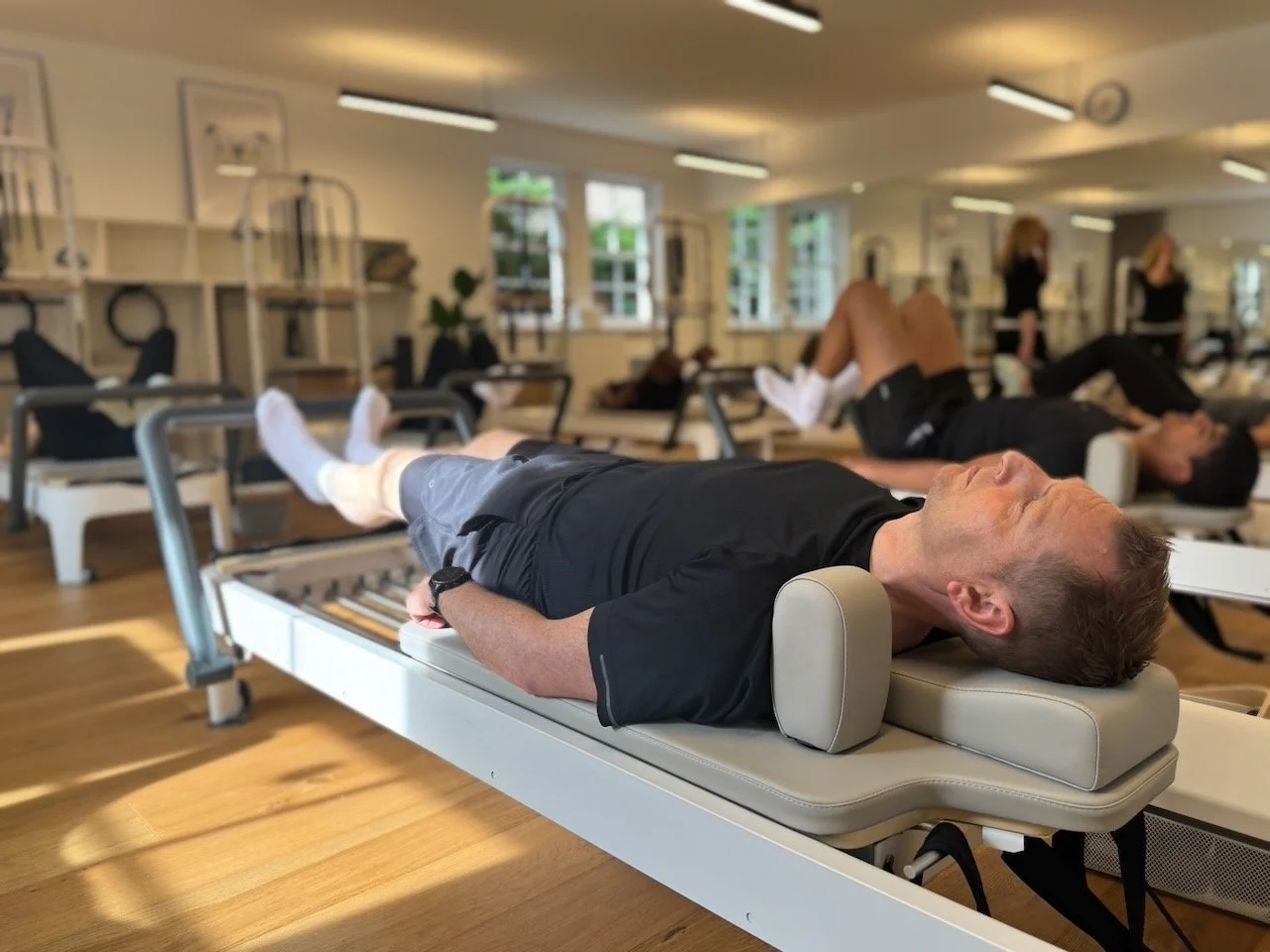
Lucia Poulter cueing footwork in a group Reformer class at Luma Pilates. The focus in the room is the practice itself
Short answer
Mindfulness in Pilates isn't a mood or an intention. It's a technical requirement. The precision the method demands, the coordination of breath and movement, the constant calibration of alignment and effort, can only be achieved through sustained attention. That attention is also what makes Pilates uniquely effective for the nervous system, and why the practice produces benefits that go well beyond the physical.
The word mindfulness gets used loosely. In a wellness context it tends to mean something like paying attention, being present, not being on your phone. These are not bad things. But they don't quite capture what happens in a Pilates class, or why the attention Pilates requires is different in kind from a general intention to be present.
Pilates was developed as a precise physical method. Joseph Pilates called it Contrology: the complete coordination of body, mind, and spirit. The mindfulness built into the practice isn't incidental. It's structural. The method only works if you're paying attention, and paying attention in a particular way.
Here's what that actually means.
What mindfulness actually means in Pilates
In a Reformer class, you're managing several things simultaneously: the position of your pelvis, the engagement of your deep abdominals, the direction of your breath, the load on the spring, the alignment of your feet, the relationship between your shoulder blades and your spine. None of this can be done on autopilot.
This is different from most forms of exercise, where the movements become automatic relatively quickly and your mind can wander freely while your body carries on. On the Reformer, the moment your attention drifts, the quality of the movement changes. Your instructor notices. Often you notice too.
This sustained, directed attention is what Joseph Pilates meant by the mind-body connection, and it's what distinguishes Pilates from exercise that happens to be done slowly. The precision isn't aesthetic. It's functional. And it requires the same quality of attention that formal mindfulness practices cultivate through meditation.
The difference is that in Pilates, the attention has an object: the movement, the breath, the alignment. For many people this is easier than open awareness meditation, and equally effective at producing the neurological and psychological benefits associated with sustained present-moment focus.
Breath as a technical tool
Breath in Pilates is not background. It's foreground.
The Pilates breath pattern, a lateral thoracic breath that expands the ribcage sideways and backwards on the inhale and draws the deep abdominals in on the exhale, is coordinated with every movement in the repertoire. The exhale supports effort. The inhale prepares. Getting this right requires you to track your breath continuously, which means your attention is anchored to a physiological process happening in real time.
This is functionally identical to the breath awareness practices at the heart of most mindfulness traditions. The difference is that in Pilates the breath is also doing mechanical work: managing intra-abdominal pressure, supporting spinal stability, and coordinating the timing of muscular engagement. The attention and the physical benefit are inseparable.
The result is that consistent Pilates practice tends to change how people breathe outside of class. Clients notice they breathe more slowly, more fully, and with more awareness in daily life. This is not a small thing. Breathing pattern has a direct and well-documented effect on the parasympathetic nervous system, and therefore on stress, mood, and sleep.
Body awareness and proprioception
Proprioception is the body's ability to sense its own position and movement in space. It's what allows you to know where your limbs are without looking at them, and to make fine adjustments to balance and alignment without conscious deliberation.
Pilates develops proprioception more directly than most forms of exercise, because it asks you to attend to exactly this: where your body is, how it's moving, whether the felt sense of the movement matches what you're being asked to do. That gap, between what you think you're doing and what you're actually doing, is where most of the learning happens.
Over time, this develops into a more refined and reliable relationship with your own body. Clients become better at noticing tension they're carrying, compensations they've developed, habits of movement that are contributing to pain or restriction. And because they can feel these things more clearly, they're better placed to change them.
This is the body awareness dimension of mindfulness that Pilates develops most distinctively. It isn't abstract. It's practical, physical, and directly transferable to daily life.
The nervous system effect
The combination of deliberate breath, sustained attention, and precise physical effort that a Pilates session involves produces a specific effect on the nervous system.
The breath work activates the parasympathetic nervous system, which governs rest, recovery, and digestion. The sustained attention reduces the kind of mind-wandering associated with rumination and anxiety. And the physical demand, calibrated to be challenging without being overwhelming, produces the focused engagement that psychologists associate with flow states: absorption in an activity that is demanding enough to require full attention but not so demanding as to produce stress.
This is why clients consistently report leaving a Pilates class feeling calmer than when they arrived, even though they've worked hard. The class has activated the body and settled the nervous system at the same time. See our guide to Pilates and Yoga for stress and anxiety for more on the specific mechanisms.
What it produces beyond the studio
The mindfulness dimension of Pilates doesn't stay in the class. It carries.
Clients who practise consistently develop a quality of attention to their own body and movement that transfers into everything else they do. They notice how they're sitting at their desk, how they're holding their jaw, how they're breathing when they're stressed. They develop the capacity to interrupt habitual patterns rather than just repeating them.
This is not a claim about therapy or spiritual development. It's a straightforward description of what sustained, precision-led physical practice does to the nervous system and the quality of attention over time.
Joseph Pilates described his method as the complete coordination of body, mind, and spirit. The mind and spirit part is sometimes treated as aspirational language. In practice, it's a description of what happens when you spend years paying close attention to how you move. The body changes. The mind follows.
If you're new to Luma, our introductory offer of three Reformer or Tower classes for £48 is the right starting point. View our class schedule, browse all classes, or get in touch if you'd like to talk it through first.
Written by Lucia Poulter
Lucia is co-founder and lead instructor at Luma Pilates Edinburgh. She holds Comprehensive BASI certification and has 26 years of teaching experience. She teaches Reformer classes at Luma weekly.