
What Is Barre? Everything You Need to Know Before Your First Class
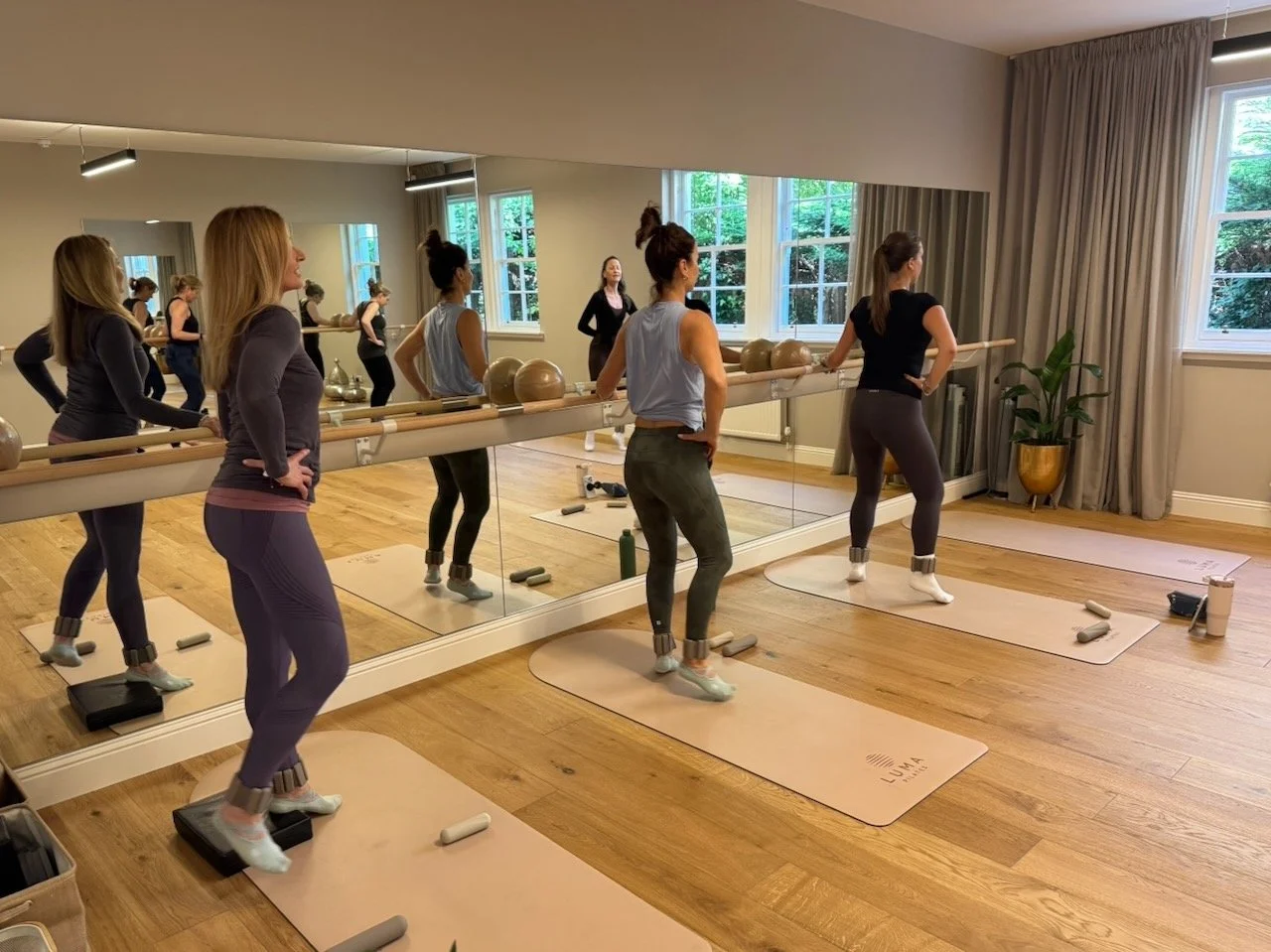
Barre class in Studio B at Luma Pilates, Edinburgh. Ankle weights, the barre, and full attention on the work
Short answer
Barre is a low-impact, high-engagement workout rooted in ballet-inspired movement and mindful strength work. Using the barre for support and balance, it targets the legs, glutes, core, and postural muscles through precise, controlled movements that build endurance, stability, and body awareness. It is suitable for all levels, deeply effective, and one of the most enjoyable ways to move that most people have never tried.
What Barre actually is
Barre takes its name from the horizontal rail borrowed from ballet studios. You use it for support and balance, not as the focus of the workout. The real work happens in the muscles: sustained holds, small controlled movements, and precise positioning that loads the body in ways most conventional exercise does not reach.
The method draws from ballet training, Pilates, and strength work. It is low impact by design, which means it’s accessible to almost everyone, but that should not be mistaken for easy. The small, isometric movements that define Barre produce a muscular burn that surprises most people in their first class, and the postural and stability demands are real throughout.
What makes Barre distinctive is its combination of physical challenge and a particular quality of movement. Classes have a rhythm and a flow that feels different from the gym or the Reformer. Many clients describe it as the class that makes them feel most alive in their body.
What Barre does for your body
Muscular endurance and stability. The sustained holds and small movements of Barre load the muscles under continuous tension, building endurance in the legs, glutes, and core in ways that heavier, lower-repetition training does not replicate. The posterior chain and the lateral hip stabilisers are particularly well targeted.
Postural strength. Barre develops the shoulder girdle, the thoracic spine extensors, and the deep spinal stabilisers through an upright, alignment-focused practice. Clients who come to Barre alongside their Reformer work consistently find the two reinforce each other in ways that accelerate postural change.
Balance and single-leg stability. Much of the work in Barre is done on one leg, or with minimal base of support. The balance and proprioceptive demands this creates transfer directly to everyday movement, sport, and the kind of functional stability that becomes increasingly valuable with age.
Active flexibility. The lengthening and extension work woven through every Barre class develops active flexibility through the hips, hamstrings, and thoracic spine. The range of movement you build in Barre is the kind you can control and use, not just demonstrate in a stretch.
How it makes you feel. This is worth naming directly. Barre has a particular quality that clients return to again and again: the combination of physical challenge, musical rhythm, and precise movement produces something that feels both energising and grounding. Most people leave feeling taller, stronger, and noticeably better than when they arrived.
What to expect in a class
A Barre class at Luma runs for 50 minutes. The class moves through a sequence of standing work at the barre, floor work, and stretching, guided by your instructor throughout. Small props, including Pilates balls, resistance bands, and Luma hand weights in 1kg and 2kg, are used in some classes to add variety and challenge.
The pace is deliberate and the instruction is detailed. Your instructor will cue alignment, breath, and muscle engagement throughout, and will offer modifications and progressions in real time. Nobody is left to figure things out on their own.
Wear fitted, comfortable clothing and grip socks. We stock them at the studio if you don’t have a pair. Nothing else is required.
Most people leave their first Barre class having felt muscles they did not know needed attention, and curious to come back.
Barre and Reformer Pilates together
Barre and Reformer Pilates are built on complementary principles and address the body from different angles. Many of our clients practise both, and the combination is consistently more effective than either in isolation.
The Reformer develops deep stabiliser strength, spinal mobility, and functional movement through spring resistance and a wide range of exercise positions. Barre develops muscular endurance, balance, and postural control through upright, alignment-focused work that the Reformer approaches less directly. The hip stability and single-leg balance that Barre builds transfers directly into Reformer work, and the spinal awareness and centring that the Reformer develops shows up clearly in how clients move at the barre.
Clients who combine both tend to notice the crossover within a few weeks. The practices speak to each other in a way that makes both more productive. See our guide to Pilates vs Barre for a fuller comparison.
Barre at Luma
Barre classes at Luma are taught by Serena Crolla, Fi Hendry, and Liron Bleischer, each of whom brings their own background and specialism to the class.
Serena Crolla brings a background in professional dance to every class she teaches. Her approach to Barre is precise, musical, and built around how the body moves when it is really paying attention. Clients who come to her classes consistently find the alignment detail and the quality of movement cuing unlike anything they have experienced elsewhere.
Fi Hendry holds full certification in Pilates Mat work and brings the same depth of instruction to Barre that clients expect from our Reformer programme. Her classes are attentive, methodical, and particularly well suited to clients who want to understand what each movement is doing and why.
Liron Bleischer teaches both Barre and Yoga at Luma and brings a background that spans movement, breath, and body awareness across disciplines. Her classes have a quality of presence and intention that clients find both grounding and challenging.
Classes are open to all levels, kept deliberately small, and designed around the idea that Barre deserves to be taught with the same rigour and attention as any other discipline at the studio.
Our introductory offer of 3 Barre or Yoga classes for £30 is the right place to begin. View our full class schedule to find when Serena, Fi, and Liron are teaching, or get in touch if you would like to talk it through first.
Frequently asked questions
Is Barre suitable for complete beginners? Yes. Classes at Luma are open to all levels and your instructor will offer modifications throughout. No dance background or prior experience is required.
Is Barre low impact? Yes. Barre is low impact throughout, which makes it accessible for most people including those managing joint issues or returning to exercise after a break. The challenge comes from precision and endurance rather than impact or heavy load.
How is Barre different from Reformer Pilates? Both are low impact and built around alignment, control, and body awareness. Barre develops muscular endurance, balance, and postural strength through upright, bodyweight work at the barre. Reformer Pilates develops deep stabiliser strength and functional movement through spring resistance and a wider range of positions. The two complement each other well and many clients practise both.
How often should I do Barre? Once a week maintains what you build and gives your body a reliable reset. Twice a week is where most clients find their rhythm and start to notice consistent change. See our guide to how often you should do Pilates for a full breakdown.
Can I do Barre if I have no dance background? Absolutely. Most of our Barre clients have no dance background at all. The ballet influence is in the movement quality and the vocabulary, not in any expectation that you already know how to move that way.
Written by Serena Crolla
Serena is a Barre and Reforner instructor at Luma Pilates. She brings a background in professional dance to every class she teaches, and her approach to Barre reflects that: precise, musical, and built around how the body moves when it is really paying attention. In her experience, most people who try Barre once come back. The ones who stay tend to wonder why they waited so long.