
Pilates for Men in Edinburgh
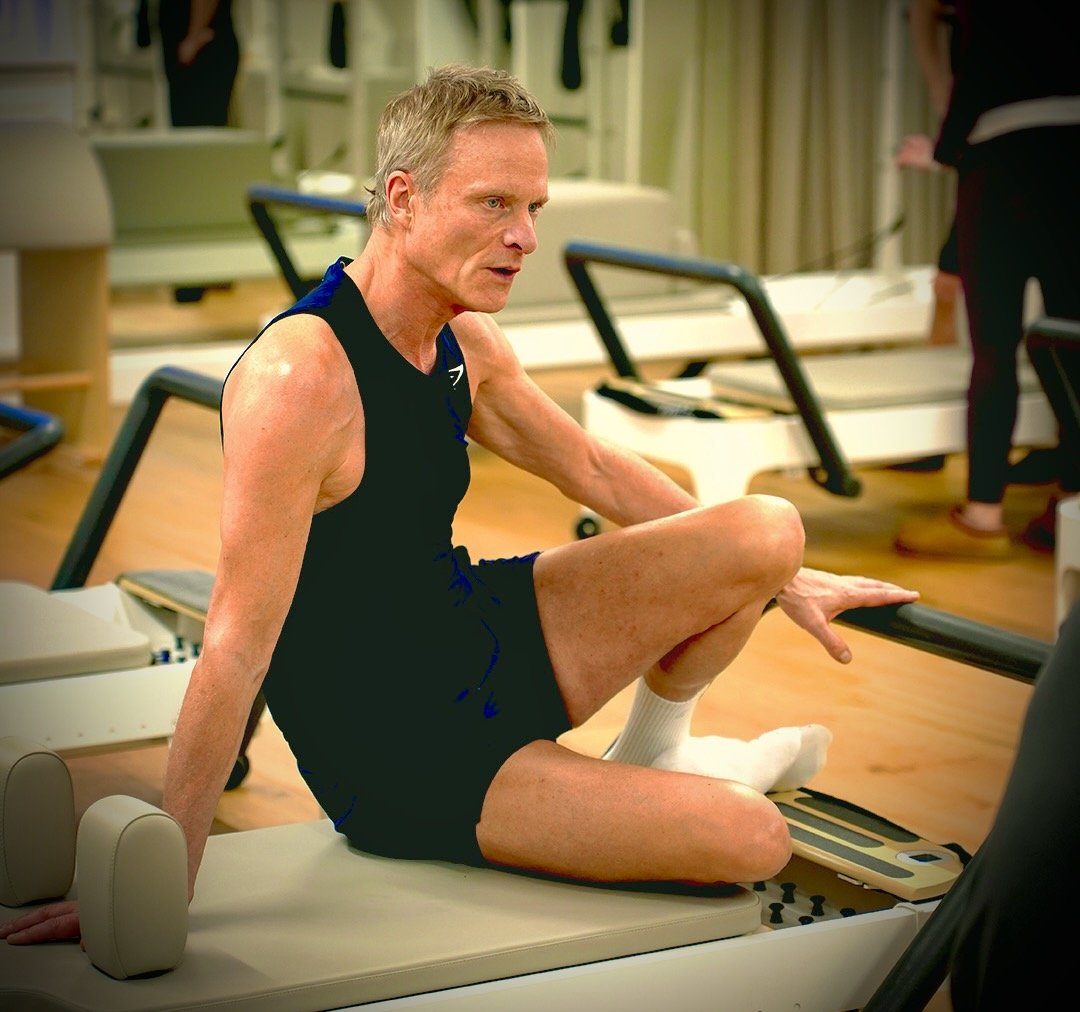
Max Howarth on the Reformer at Luma Pilates Edinburgh
Short answer
Reformer Pilates is one of the most effective physical practices available to men. It builds the deep stabilising strength, mobility, and movement quality that most training leaves out. Classes suit all levels, and men who try it consistently wish they had started sooner.
Okay, let's address the obvious thing first: Pilates was invented by a man. Joseph Pilates developed the method in the early twentieth century, originally for soldiers, dancers, and athletes. The Reformer machine he designed was built to develop strength, control, and physical resilience. For most of its history the practice was used by men and women in roughly equal measure.
Somewhere along the way that changed, and Pilates acquired a reputation as something that belonged primarily to women. That reputation is worth setting aside, because it is getting in the way of a lot of men feeling and moving significantly better.
I came to Reformer Pilates in my mid-fifties. I had no background in it, no particular flexibility, and no strong reason to expect it would be the most useful physical practice I had ever encountered. I was wrong about that last part. I now teach five classes a week at Luma and practise at least double that.
What men actually get from Reformer Pilates
The physical case is straightforward once you understand what the Reformer is actually doing.
Most men who train regularly, whether in the gym, through sport, or both, develop strength in certain directions and considerable weakness in others. The patterns are predictable: strong anterior chains, underused posteriors, tight hip flexors, weak deep spinal stabilisers, restricted thoracic spine rotation. These are not problems you necessarily feel until something goes wrong. A lower back that gives out. A shoulder that does not recover properly. A persistent knee issue that no amount of stretching seems to shift.
The Reformer addresses these patterns directly. Not because it is corrective therapy, but because it trains the body in three dimensions across a full range of movement, loading the muscles that conventional training systematically misses.
Posterior chain strength.Footwork and leg press sequences on the Reformer isolate and load the glutes in ways that squats and deadlifts do not reach. The carryover to athletic performance, lower back resilience, and general physical function is direct.
Spinal stability under load. The deep muscles closest to the spine, the multifidus and transverse abdominis, are what keep your form together when fatigue sets in, whether that is mile eight of a run, the last set of a heavy lift, or hour six at a desk. Pilates trains them specifically, in every class at every level.
Shoulder and thoracic mobility. Tight shoulders and a restricted upper back are almost universal among men who lift, sit for long periods, or do both. The Reformer works the muscles around the shoulder girdle, the serratus anterior and the lower and middle trapezius, in ways that open the chest and restore range of movement without a single passive stretch.
Hip flexor strength through full range. Long hours at a desk keep hip flexors shortened and overactive, creating anterior pelvic tilt and a chain of issues upstream and downstream. Pilates strengthens them in lengthened positions rather than just stretching them, which produces lasting change rather than temporary relief.
The result is a body that moves better. Less stiffness, less lower back pain, better posture, better recovery, and a noticeably improved performance in whatever else you do, whether that is running, cycling, rugby, golf, or simply getting through the working week without your back complaining.
It’s harder than it looks
This is something nearly every man who comes to Luma says, usually about twenty minutes into their first Fundamentals class.
The movements are precise, controlled, and deliberate. They require real concentration. There is nowhere to hide behind momentum or brute strength, which is exactly why they work.
The challenge in Pilates is not about how much you can lift. It is about how well you can move, how accurately you can control your body, and how connected you can stay through a sequence. For a lot of men, that is genuinely unfamiliar territory, and it turns out to be the territory where the most valuable gains are hiding.
Lucia Poulter, Luma's lead instructor with 26 years of experience and Comprehensive BASI certification, finds that men often arrive expecting the practice to be straightforward and leave surprised by how much it asked of them. That surprise tends to become motivation very quickly.
David Ness, one of our longest-standing male clients, puts it simply: seven years ago his wife encouraged him to try Pilates with Lucia, and now, in his sixties, he says he hates to think how stiff he would be without it. That is a fairly common story.
The strength question
The most common assumption men bring to Pilates is that it will not be a real workout. It is.
The spring resistance, the precision required, and the sustained engagement of the stabilising muscles all add up to genuine physical demand. Most men leave their first class having felt muscles they did not know needed attention. The practice is not cardio in the conventional sense, but as a strength and conditioning tool it is serious and effective, and it produces results that complement almost any other form of training.
Anna Marchington, who trained at The Pilates Center in Boulder, Colorado and has over 20 years of teaching experience, works regularly with male clients coming to Pilates through sport or injury. In her experience, the men who get the most from the practice are the ones who stop trying to muscle through it. When they let the work do what it is designed to do, the strength gains are significant and they stay.
Reformer Pilates alongside other training
Most men at Luma train alongside other things: gym work, running, cycling, sport. The combination is consistently more effective than either in isolation.
Pilates addresses the gaps that other training creates. The stabiliser weaknesses, the movement quality issues, the imbalances that accumulate over years of doing the same things in the same directions. Many clients find their gym performance improves once they start Reformer Pilates, because they are no longer limited by the muscular deficits that were holding them back.
For runners, the carryover is direct. See our guide to Pilates for runners in Edinburgh. For desk workers, the postural and lower back benefits are among the most immediate of any client group. See our guide to why Pilates improves posture. And if lower back pain is a factor, see our guide to Pilates for lower back pain.
On starting later in life
I started in my fifties. I want to be straightforward about this because it matters.
I move better now than I did at 30, recover faster, and have none of the lower back issues that were becoming a regular feature of my forties. I cannot attribute all of that to Pilates, but consistent Reformer practice has been the most significant physical investment I have made.
The Reformer suits people who are starting later because it works with wherever your body currently is. The adjustable resistance means you are not competing against a fixed standard. The precision means you are building genuine strength and awareness rather than compensating your way through movements. And the low-impact nature means you can train consistently without the recovery cost of higher-impact exercise.
The men I see benefit most from Pilates at Luma are often in their forties and fifties: experienced enough to understand what good physical practice looks like, and honest enough with themselves to recognise that what they have been doing has gaps. The Reformer fills those gaps in a way that very little else does.
If your focus is specifically on what Pilates offers men in midlife, we have written a longer piece on Pilates for men over 50.
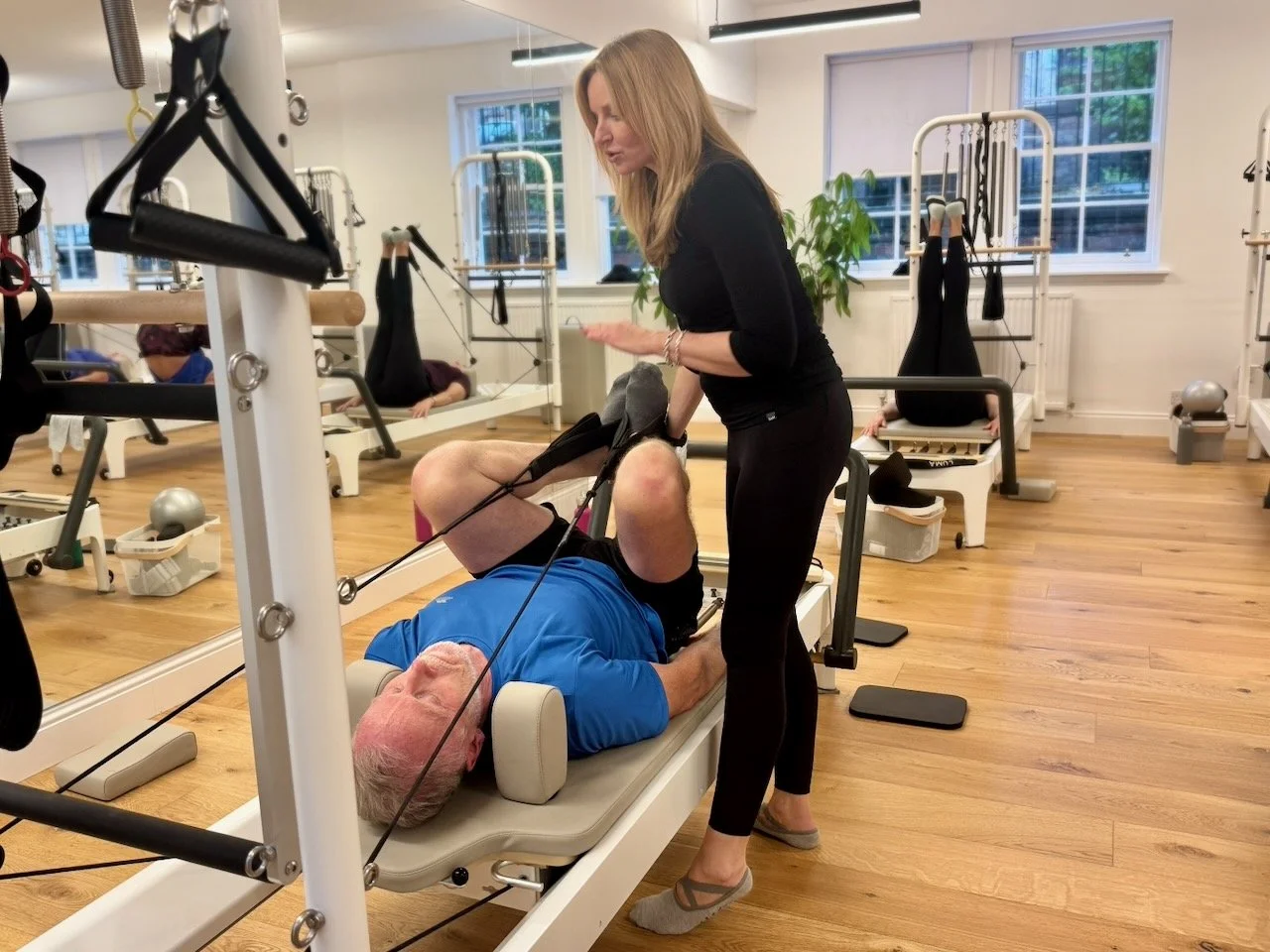
Lucia cueing Short Spine Massage in a Reformer class at Luma Pilates, Edinburgh
How to get started in Edinburgh
Reformer Fundamentals is the right entry point. It is where you learn how the machine works and build the foundational vocabulary that makes everything else more effective. The footwork series alone will tell you more about how your body moves than most training programmes manage in months. From there, Reformer Fundamentals Progressing and the levelled classes develop the practice progressively.
If the idea of walking into a mixed class still feels like a hurdle, we also run two men-only classes every Tuesday evening: Fundamentals Progressing at 6pm and Fundamentals at 7pm, both taught by me. I started them for a simple reason. A lot of men who would genuinely benefit from this practice never try it, not because of the exercises, but because of what is in their head before they have even walked through the door: not wanting to look unfit or out of place in a room full of women, or the quiet assumption that Pilates is somehow easier than it is. A men-only class with a male instructor removes both of those at once. Same standard, same practice, no audience to perform for. They are bookable through our normal schedule and app like any other class.
If you would prefer to start with a private session, a one-to-one gives your instructor your complete attention to learn at your own pace. View all pricing.
Our introductory offer of 3 Reformer classes for £48 is designed for exactly this: three sessions is enough to move past the unfamiliarity and start experiencing what the practice is genuinely about.
View the class schedule, browse all classes, or get in touch if you would like to talk it through first.
For more on choosing a studio, see our guide to how to choose a Reformer Pilates studio in Edinburgh.
Written by Max Howarth.
Max is co-founder of Luma Pilates. He came to Reformer Pilates in his fifties with no movement background and now teaches five classes a week at the studio. His view is simple: the men who try it and stick with it consistently wish they had started sooner. He is one of them.