Can Pilates Help Cyclists in Edinburgh?
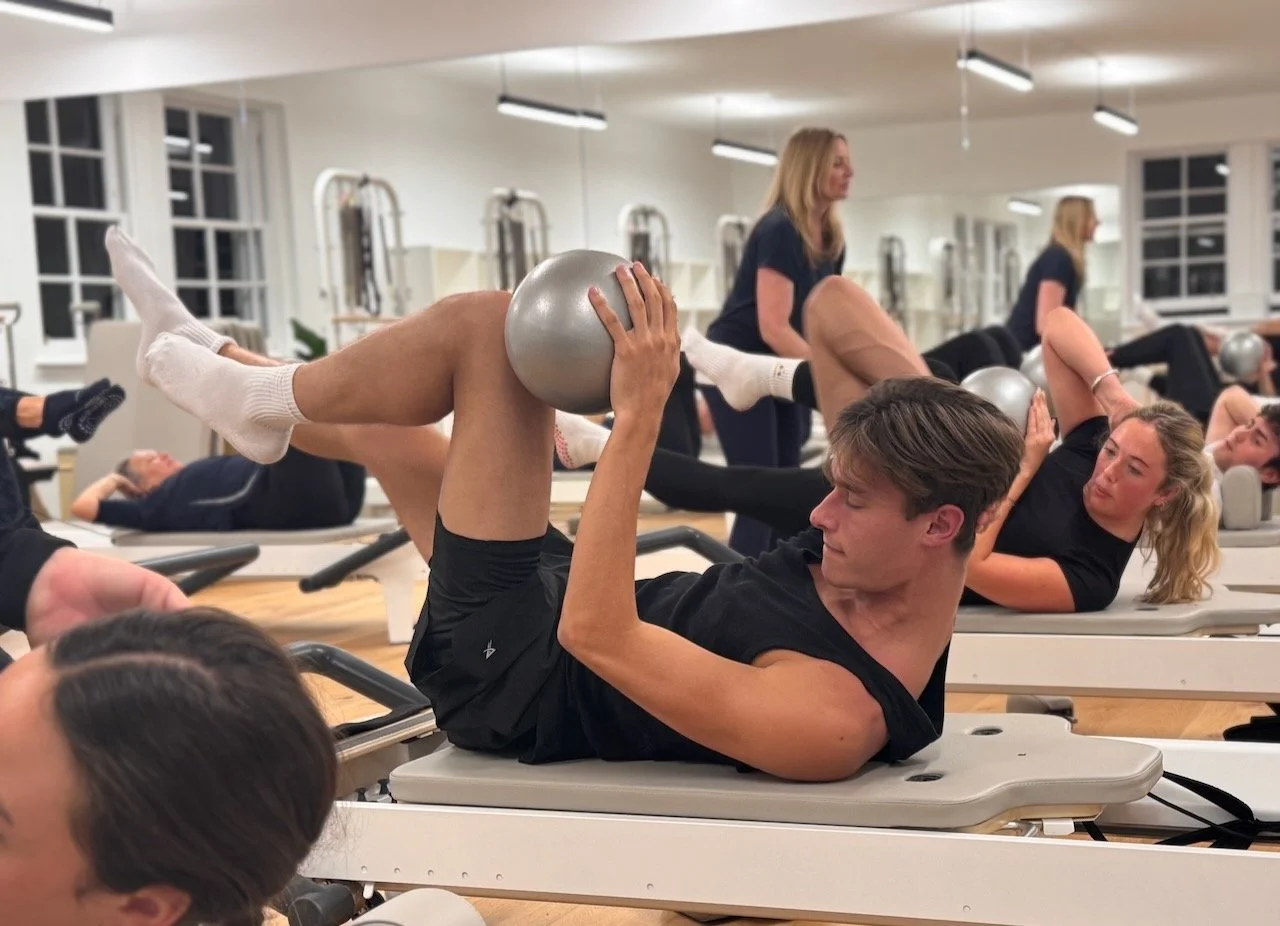
Single leg stretch with oblique work in a group Reformer class at Luma Pilates. The core and rotational strength that cyclists need
Short answer
Yes. Cycling is one of the sports that benefits most directly from Reformer Pilates. The forward position, the repetitive bilateral loading, and the lack of lateral and rotational movement create predictable patterns of tightness and weakness that Pilates addresses specifically. Most cyclists notice the difference in their riding, their comfort in the saddle, and their recovery within a few months of consistent practice.
Edinburgh has a serious cycling community. From the club riders grinding out early morning miles on the Pentland roads to the weekend warriors tackling the Water of Leith path or the coastal route along the Forth, cyclists here tend to be committed, consistent, and hard on their bodies in the particular way that cycling demands. And that's before you count the commuters, who may be logging fewer miles but are doing so on top of a full working day, often on a bike that isn't quite right for them, in clothing that isn't quite right for cycling.
I work with cyclists at Luma regularly. The pattern is consistent: they arrive managing something, a tight lower back, neck and shoulder tension that builds through long rides, a knee that's started to complain, hips that feel locked after hours in the saddle. Sometimes they're injured. More often they're managing something that hasn't quite become an injury yet but is heading that way.
The Reformer addresses the underlying causes of these problems more directly than most things cyclists try. Here's why.
What cycling does to the body
Cycling is a closed, fixed, forward-facing movement pattern. For hours at a time, the body holds the same position: hips flexed, spine rounded forward, shoulders elevated, head forward of the spine. The pedal stroke is bilateral and sagittal, meaning both legs work in the same plane, in the same direction, at the same time.
This produces a set of predictable physical consequences.
The hip flexors shorten. Hours of hip flexion in the saddle keeps the hip flexors in a shortened position. Off the bike, they pull the pelvis into anterior pelvic tilt, increasing the curve in the lower back and loading the lumbar spine. This is one of the most common sources of lower back pain in cyclists.
The thoracic spine stiffens. The rounded forward position compresses the thoracic vertebrae and reduces rotation and extension. Over time, the thoracic spine loses the mobility it's designed to have, which transfers load to the lower back and neck and reduces the body's ability to absorb road vibration efficiently.
The posterior chain weakens relative to the anterior. Cycling is quad-dominant. The glutes are underused relative to their role in the pedal stroke, and the hamstrings work primarily as knee flexors rather than hip extensors. The result is a posterior chain that can't produce the power or provide the joint protection it should.
The lateral stabilisers are underdeveloped. Cycling has no lateral component. The muscles that stabilise the pelvis in the frontal plane, the hip abductors and the lateral hip rotators, don't get trained. This contributes to the knee tracking issues and IT band problems that are common in cyclists.
The neck and shoulder girdle carry chronic tension. Holding the head forward of the spine for hours activates the neck extensors continuously. The upper trapezius and levator scapulae become chronically overloaded. The serratus anterior and lower trapezius, which should be stabilising the shoulder blade, tend to disengage.
What Pilates addresses
Reformer Pilates works the body in three dimensions, across a range of movement patterns that cycling systematically avoids. It addresses the hip flexor shortening, the thoracic stiffness, the posterior chain weakness, the lateral stabiliser deficit, and the shoulder girdle overload that cycling produces, not as a series of isolated fixes, but as an integrated practice.
The spinal articulation built into every Reformer class directly counteracts the compression of long hours in the saddle. The footwork series loads the posterior chain in ways the pedal stroke doesn't reach. The lateral and rotational work develops the stabilisers that cycling ignores. And the eccentric loading throughout the repertoire strengthens the hip flexors and hamstrings in lengthened positions, producing lasting changes in usable range of movement rather than temporary relief from stretching.
The breath work is also relevant. Cyclists tend to breathe shallowly in the forward position, restricting the lateral expansion of the ribcage. The Pilates breath pattern, which expands the ribcage laterally and posteriorly, restores the full respiratory range and has a direct effect on endurance and recovery.
The Reformer advantage
Mat Pilates is valuable, but for cyclists the Reformer offers something more specific. The spring resistance allows for precise loading of the muscles that cycling underuses, at exactly the angles and ranges where they need to be stronger. The moving carriage demands deep spinal stabiliser engagement on every repetition, training the muscles that protect the lower back under exactly the kind of sustained load that cycling imposes.
The range of positions available on the Reformer, lying, seated, kneeling, standing, side-lying, is also significant for cyclists. Moving through positions that aren't available on a bike develops the mobility and the neuromuscular coordination that fixed-position training suppresses.
The adjustable resistance means the work can be calibrated precisely to where each cyclist currently is: loading the glutes at a level that produces genuine adaptation without overloading a system that's already fatigued from training.
Injury prevention
The injuries most common in cyclists, lower back pain, knee pain, IT band syndrome, neck and shoulder tension, all have biomechanical roots that Pilates addresses directly.
Lower back pain in cyclists typically comes from a combination of anterior pelvic tilt from shortened hip flexors, weak deep spinal stabilisers, and reduced thoracic mobility that forces the lumbar spine to compensate for the movement the thoracic spine can no longer provide. The Reformer addresses all three. See our guide to Pilates for lower back pain for more detail.
Knee pain in cyclists, particularly patellofemoral pain, often comes from quad dominance and weak lateral hip stabilisers, which allow the knee to track inward under load. Strengthening the lateral hip rotators and adductors on the Reformer corrects this pattern at the source.
IT band syndrome has a similar root: weak hip abductors and lateral stabilisers allowing the pelvis to drop on the unloaded side, which increases tension through the IT band. The single-leg and lateral work on the Reformer develops exactly the stability that prevents this.
Neck and shoulder tension responds well to the shoulder girdle work built into the Reformer repertoire. Strengthening the serratus anterior and lower trapezius, and reducing the chronic overactivation of the upper trapezius, changes the resting tension pattern in the neck and shoulders over a period of weeks.
Performance gains
The injury prevention benefits are the most common reason cyclists come to Pilates. The performance gains are often what keep them coming back.
Power transfer. A stable, well-aligned pelvis transfers force from the legs to the pedals more efficiently. Weak stabilisers allow energy to leak through micro-movements in the pelvis and lower back. Strengthening the deep spinal stabilisers and lateral hip muscles improves the rigidity of the platform the legs are working from, which translates directly into more effective power transfer.
Endurance. The muscular fatigue that limits cyclists towards the end of long rides is often not in the quads or the cardiovascular system. It's in the postural muscles holding the position. Strengthening the muscles of the thoracic spine, the shoulder girdle, and the deep abdominals delays the postural collapse that increases aerodynamic drag and shifts load onto the lower back in the final hours of a long ride.
Recovery. The low-impact nature of Reformer Pilates means it can be programmed into a training week without adding meaningful fatigue. The mobility work and the nervous system activation from breath-focused practice actively support recovery between hard sessions.
How to fit Pilates into your training
Once a week is enough to address the imbalances cycling creates and maintain the gains over a season. Twice a week produces more meaningful change, particularly in the areas of thoracic mobility and posterior chain strength, and is the frequency at which most cyclists notice the clearest performance transfer.
Pilates works well the day after a hard ride, when the body is in recovery but not yet fully rested. It also works well in the off-season as a structural investment, building the foundations that make the following season's training more effective and more resilient.
It's worth being honest that Pilates is not a quick fix. The imbalances that cycling creates accumulate over years of training, and they require consistent, progressive work to address. Most cyclists start to feel the difference within six to eight weeks. The changes that matter most, the ones that show up in how you ride, how you feel at the end of a long day in the saddle, and how quickly you recover, tend to be fully established by three to four months of consistent practice.
See our guide to how often you should do Pilates for more on frequency and programming.
How progression actually works
Your instructor will talk to you about progression. It's not something that happens without a conversation, and it's never a judgment about your ability or your effort. It is a practical assessment of whether the foundations are solid enough to support what comes next.
The signals that you are ready to progress are usually clear: the foundational exercises feel genuinely supported rather than effortful, your body awareness has developed to the point where you can feel the difference between correct and incorrect alignment, and you are consistently working at the edge of what the current level asks of you.
The signals that you are not yet ready are equally clear: you are still developing the centring and stabiliser activation that the current level requires, the movement still feels like conscious effort rather than integrated habit, or your instructor can see compensatory patterns that more advanced work would reinforce rather than resolve.
Neither set of signals is a problem. They are simply information. The practice works best when it is honest.
Getting started at Luma
All new clients at Luma begin with Reformer Fundamentals, regardless of fitness level or athletic background. It's where you learn how the machine works, how to set it up for your body, and the foundational movement principles that underpin everything that follows. If you have prior Reformer experience, get in touch before booking and we'll advise on the right entry level.
Our introductory offer of three Reformer or Tower classes for £48 is designed for exactly this starting point. Three sessions is enough to move past the unfamiliar and start feeling what the practice does.
If you're managing a specific injury or want a more tailored starting point, a private session allows the work to be built entirely around your history, your current physical state, and your goals on the bike. Private sessions at Luma start at £90 for a 50-minute 1:1.
View our class schedule, browse all classes, or get in touch to talk it through.
Frequently asked questions
Is Pilates good for cyclists? Yes. Cycling creates predictable patterns of tightness, weakness, and imbalance that Reformer Pilates addresses directly. Most cyclists notice improvements in comfort, power, and recovery within a few months of consistent practice.
How often should a cyclist do Pilates? Once a week addresses the imbalances cycling creates and maintains gains over a season. Twice a week produces more meaningful change. Many cyclists reduce frequency during peak training blocks and increase it in the off-season.
Can Pilates help with lower back pain from cycling? Yes. Lower back pain in cyclists typically comes from shortened hip flexors, weak deep spinal stabilisers, and reduced thoracic mobility. Pilates addresses all three directly. If you're managing a specific injury, speak to your GP or physiotherapist before starting and tell your instructor before your first class.
Will Pilates make me a stronger cyclist? The evidence and clinical experience both suggest yes, particularly for power transfer, endurance in the final stages of long rides, and recovery. The gains come from improved stabiliser strength, better postural endurance, and more efficient movement mechanics.
Do I need any Pilates experience to start? No. All new clients at Luma begin with Reformer Fundamentals, which is designed for people who have never used a Reformer before. Nothing is assumed and nothing is rushed.
Written by Lucia Poulter
Lucia is co-founder and lead instructor at Luma Pilates Edinburgh. She holds Comprehensive BASI certification and has 26 years of teaching experience. She teaches Reformer classes at Luma weekly.