How to Know If Your Reformer Pilates Instructor Is Qualified
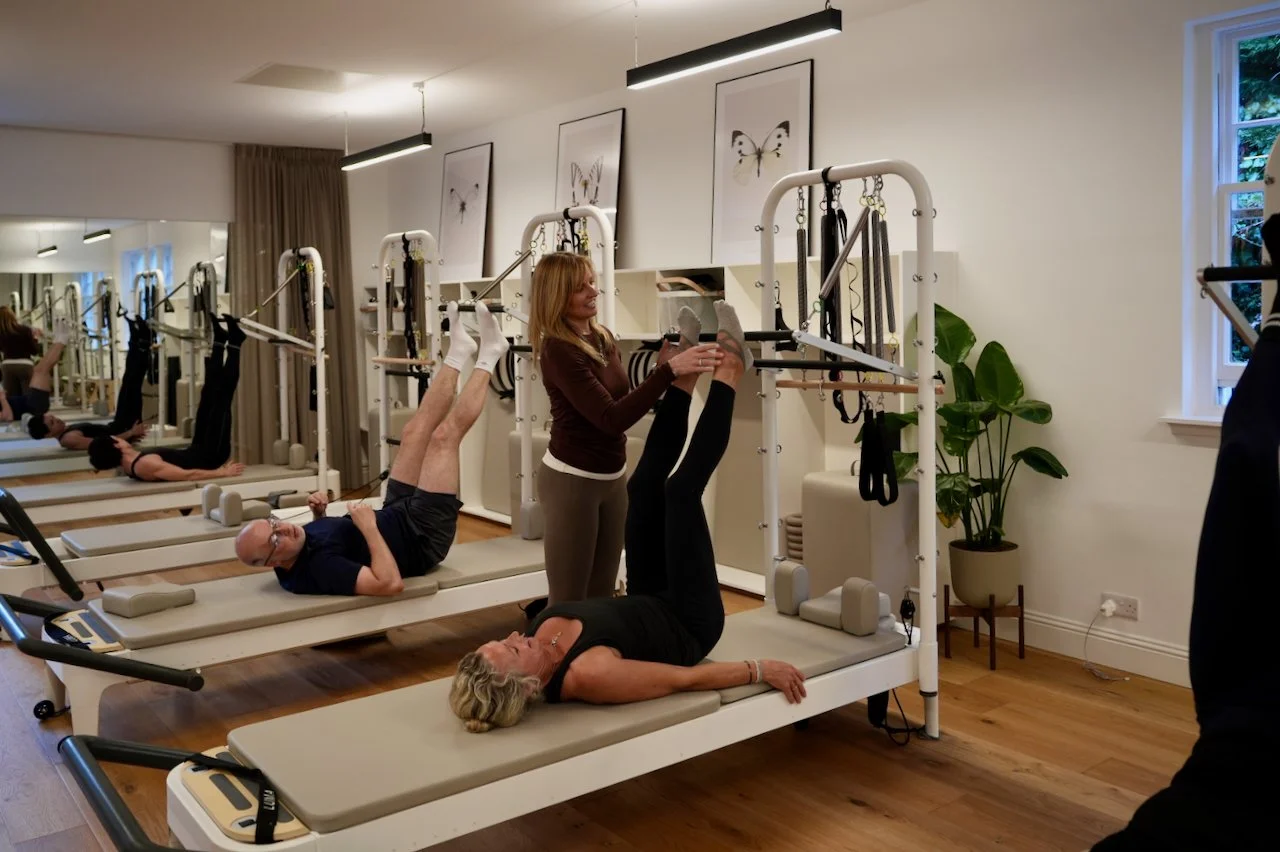
Lucia Poulter cueing a Pelvic Curl on the Tower at Luma Pilates, Edinburgh
How qualified should a Pilates instructor be?
Short answer
A properly qualified Pilates instructor should be able to tell you who trained them, whether their qualification was comprehensive or equipment-specific, how much anatomy, observation and supervised teaching it included, and how they continue their education. For Reformer Pilates clients in Edinburgh, it is worth understanding the difference between comprehensive training from organisations and systems such as BASI Pilates or STOTT PILATES, shorter Reformer-only courses, and physiotherapy-led or clinical Pilates. They are different types of training, and a good instructor should be able to explain clearly where their own qualifications sit.
I have been teaching Pilates for 26 years, and this is one of the questions I wish more people asked before their first class. Not because the answer should put anyone off. Because the answer tells you a great deal about what you are actually walking into.
In this guide
Why Pilates qualifications matter in the UK
Pilates teaching is not a statutorily regulated profession in the UK, which means there is no single legally required qualification that every instructor must hold. That makes it particularly important for clients to understand what an instructor's qualifications actually involved, because training can range from short, equipment-specific courses to comprehensive programmes involving anatomy, observation, practice teaching and formal assessment.
Both people may legitimately describe themselves as a Pilates instructor, while having completed very different amounts and types of training.
This is not a new observation, and calls to change it are growing. In 2026, industry voices began pushing more formally for statutory regulation of Pilates teaching in the UK, citing exactly this gap between the instructor title and the training behind it. Until any such regulation is in place, the responsibility for asking the right questions sits with the client. A reputable studio will welcome those questions, not deflect them.
This is also not a reason to distrust the industry. Most instructors care deeply about doing right by their clients. It is a reason to ask a few direct questions before you commit, in the same way you would with any professional working with your body.
What the different Pilates qualifications actually mean
If you are looking for a highly qualified Reformer Pilates instructor, the name of the qualification matters less than understanding its depth and scope. In the UK, instructors may have trained through comprehensive Pilates education systems such as BASI Pilates or STOTT PILATES, through physiotherapy-associated approaches such as APPI, or through shorter courses focused on a single piece of equipment such as the Reformer. These routes are not equivalent, and they prepare instructors for different scopes of practice.
Comprehensive Pilates education programmes. Organisations and training systems such as BASI Pilates (Body Arts and Science International) and STOTT PILATES, part of Merrithew, run structured, multi-module training across the full Pilates system: mat work and the major pieces of Pilates apparatus, including the Reformer, Cadillac, Chair and Barrels. BASI's current Comprehensive programme, for example, requires 500 student hours across observation, student teaching and self-practice, followed by teaching and practical assessment.
Physiotherapy-associated approaches. APPI (Australian Physiotherapy and Pilates Institute) is a Pilates education system founded by physiotherapists, with strong roots in rehabilitation. The term “clinical Pilates,” meanwhile, is used more broadly and does not refer to one single qualification or governing body. Approaches in this category tend to be taught to, or by, qualified physiotherapists, and tend to emphasise the therapeutic and rehabilitative applications of the method.
Short or equipment-specific courses. It is also possible to complete a course focused solely on the Reformer, sometimes in a matter of days, without the broader anatomy, mat, and multi-apparatus training that a comprehensive programme requires. This can produce a competent instructor within a narrower scope. What a short Reformer-only course cannot offer by itself is the same breadth of training across anatomy, mat work and the wider Pilates apparatus. An instructor may, of course, bring relevant knowledge from other qualifications or professional experience.
None of these categories is inherently “better” in the abstract. What matters is whether the training matches what you need, and whether your instructor can explain honestly which category theirs falls into.
What does “comprehensive” actually mean?
This is the word that does the most work in this article, so it’s worth being specific about it.
A comprehensive Pilates certification covers mat work and the major apparatus as one connected system, rather than treating the Reformer as a standalone piece of equipment. It requires substantial study of anatomy and movement, not just choreography. It includes substantial observation, self-practice and student-teaching hours, with your ability to cue, teach and apply the method ultimately assessed in practice. It ends with a formal assessment, not simply a certificate of attendance.
A short Reformer-only course can teach someone to run a class safely within a defined scope. What a short Reformer-only course cannot offer by itself is the same breadth of training across anatomy, mat work and the wider Pilates apparatus. An instructor may, of course, bring relevant knowledge and adaptability from other qualifications or professional experience. That breadth is what comprehensive training is specifically designed to provide.
My Comprehensive BASI certification included two full modules dedicated specifically to anatomy, alongside the broader mat and apparatus training. That illustrates the difference in breadth between comprehensive training and a course focused specifically on teaching Reformer.
Does a Pilates instructor need to be a physiotherapist?
No, and it is worth being clear about why not, because the two professions are often confused.
“Physiotherapist” is a title protected by law in the UK, and physiotherapists must be registered with the Health and Care Professions Council (HCPC). Pilates instructor is not an equivalent regulated title, which is exactly why the specifics of an individual instructor's training matter so much. Physiotherapy involves diagnosis and treatment of injury and medical conditions. Pilates instruction, even at the most comprehensive level, is not a substitute for that.
What comprehensive Pilates training does provide is a genuinely deep understanding of movement, alignment and how to adapt exercise around common physical limitations. A well-trained instructor should know the boundary of their own scope, and should be comfortable telling you plainly when something you describe is better addressed by a physiotherapist first. If an instructor seems reluctant to draw that line, or implies their training makes them equivalent to a physio, that is worth noticing.
Some clients specifically want a physiotherapy-led or clinical Pilates approach, particularly during active rehabilitation. Others are looking for a comprehensively trained Pilates instructor for general strength, mobility and movement quality. Both are valid. They are simply not the same thing, and it is reasonable to ask which one you are booking.
If you are searching for Pilates in Edinburgh because of an injury or rehabilitation need, it is worth checking whether you actually require a physiotherapist, a physiotherapy-led Pilates service, or an experienced Pilates instructor who can work appropriately within their own scope. These are different services, and a reputable studio should be happy to explain the distinction.
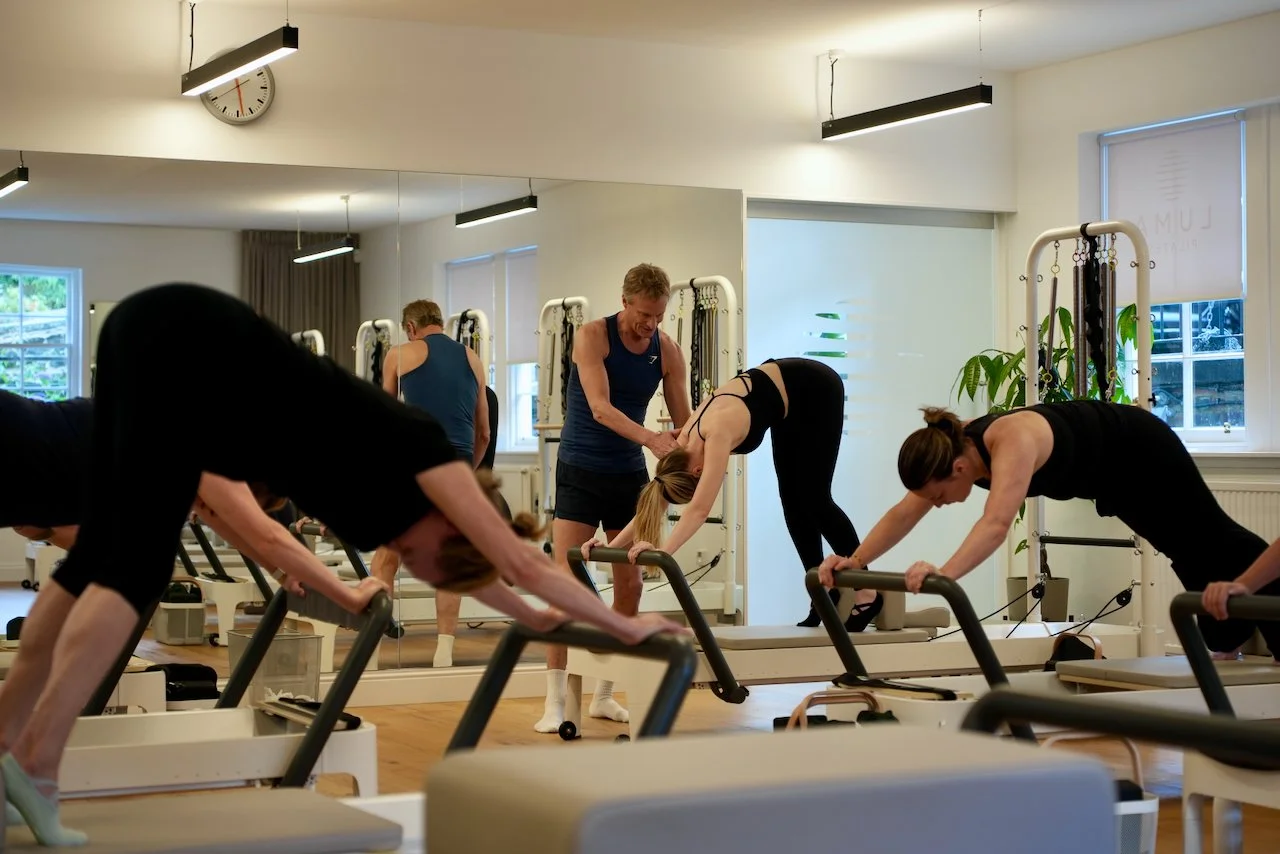
Max Howarth giving hands-on correction in a Reformer class at Luma Pilates, Edinburgh
Five questions to ask before booking a Pilates class
A note from Max, Luma co-founder
I came to Pilates in my mid-fifties with no movement background at all, so I asked Lucia most of these questions myself before I ever set foot on a Reformer. None of them are rude to ask. A good studio will answer them without hesitation.
What Pilates qualification do you hold, and who awarded it? A specific answer, not a vague one, is the first good sign.
Was it comprehensive training or Reformer-only training? This tells you the actual scope of what they studied.
How much anatomy and supervised teaching did it include? Depth here is what allows an instructor to adapt safely to your body, not just run a class.
How long have you been teaching? Experience matters too. Years of teaching expose an instructor to a much wider range of people, movement patterns and individual needs than training alone can provide.
If I have an injury or medical condition, what is within your scope, and when would you refer me to a physiotherapist? This is the most revealing question on the list. The right answer is honest about the boundary, not defensive about it.
If the answers give you confidence, you can see class levels and pricing and book your first session.
Lucia's qualifications and 26 years of experience
I teach Reformer Pilates in Edinburgh and hold Comprehensive BASI certification, with 26 years of teaching experience. When people describe an instructor as “highly qualified,” I think it is more useful to explain exactly what sits behind that phrase than simply use it as a claim. Here is what it means in practice, rather than as a list of credentials:
Comprehensive BASI training covered the Pilates method across mat and the major apparatus, including the Reformer, Cadillac and Chair, rather than training me on the Reformer in isolation. It included substantial anatomy and movement study, observation of experienced teachers, supervised practice teaching, and formal examination before I was certified to teach.
26 years of teaching means I have worked with thousands of different bodies: complete beginners, elite athletes, people recovering from surgery, people managing chronic pain, and people simply trying to move a little better through their forties, fifties and sixties. That volume of experience is its own kind of education. It is where the instinct for what a particular body needs actually comes from.
Ongoing education means my training did not stop on the day I qualified. Alongside my BASI certification I am also Ashtanga Yoga trained, hold a mindfulness certificate, and have completed a CPD in Menopause for Physiotherapists and Movement Practitioners, a course in soft tissue release techniques, the Merrithew/STOTT Zen-GA workshop, Angelie Melzer's Tactile Cueing for the Spine course, and Hypno-Menopause training. Some of that is directly about movement and cueing. Some of it is about understanding what is happening in a client's body and life more broadly. Both matter.
Every instructor at Luma is trained to a standard I would put my own name behind, and every class is capped at a size small enough that hands-on correction is possible, not theoretical. If you are choosing a studio in Edinburgh, I would encourage you to ask the same five questions above of anyone you are considering. It is the right way to choose, and it is exactly what I would want a client to do.
Written by Lucia Poulter
Lucia is lead instructor and co-founder at Luma Pilates, with 26 years of teaching experience and Comprehensive BASI certification. She holds Comprehensive BASI certification and has been teaching for 26 years, with ongoing training that includes tactile cueing, soft tissue release, and specialist work supporting clients through menopause. She believes clients deserve to understand exactly what sits behind the word “qualified,” not just take it on trust.