
Pilates Equipment Explained: What You'll Find at a Luma Class
Short answer
At Luma, every group class is built around the Reformer, a spring-loaded machine that covers an enormous range of movement and works for every level. Integrated into each Reformer is a Tower, extending the repertoire further still. The studio also has a Wunda Chair, a Ladder Barrel, and a full set of props. Together, these tools mean that whatever your body needs, a different stimulus, a specific adaptation, or a deeper exploration of the classical repertoire, we have the equipment to deliver it. Here's what each piece is and what it does.
Most people arrive at their first Pilates class with a rough sense of what a Reformer looks like. The rest of the equipment is less familiar, and the names don't always help. Cadillac, Wunda Chair, Ladder Barrel: Pilates apparatus has a vocabulary of its own that can feel rather opaque before you've seen it in person.
At Luma, every group class is built around the Reformer. The other apparatus in the studio is used in private sessions or when a client needs a specific exercise adapted in a way the Reformer can't offer. This guide covers what each piece is, what it actually does, and what it feels like to use, from the perspective of someone who discovered all of it as a complete beginner in his fifties.
In this guide
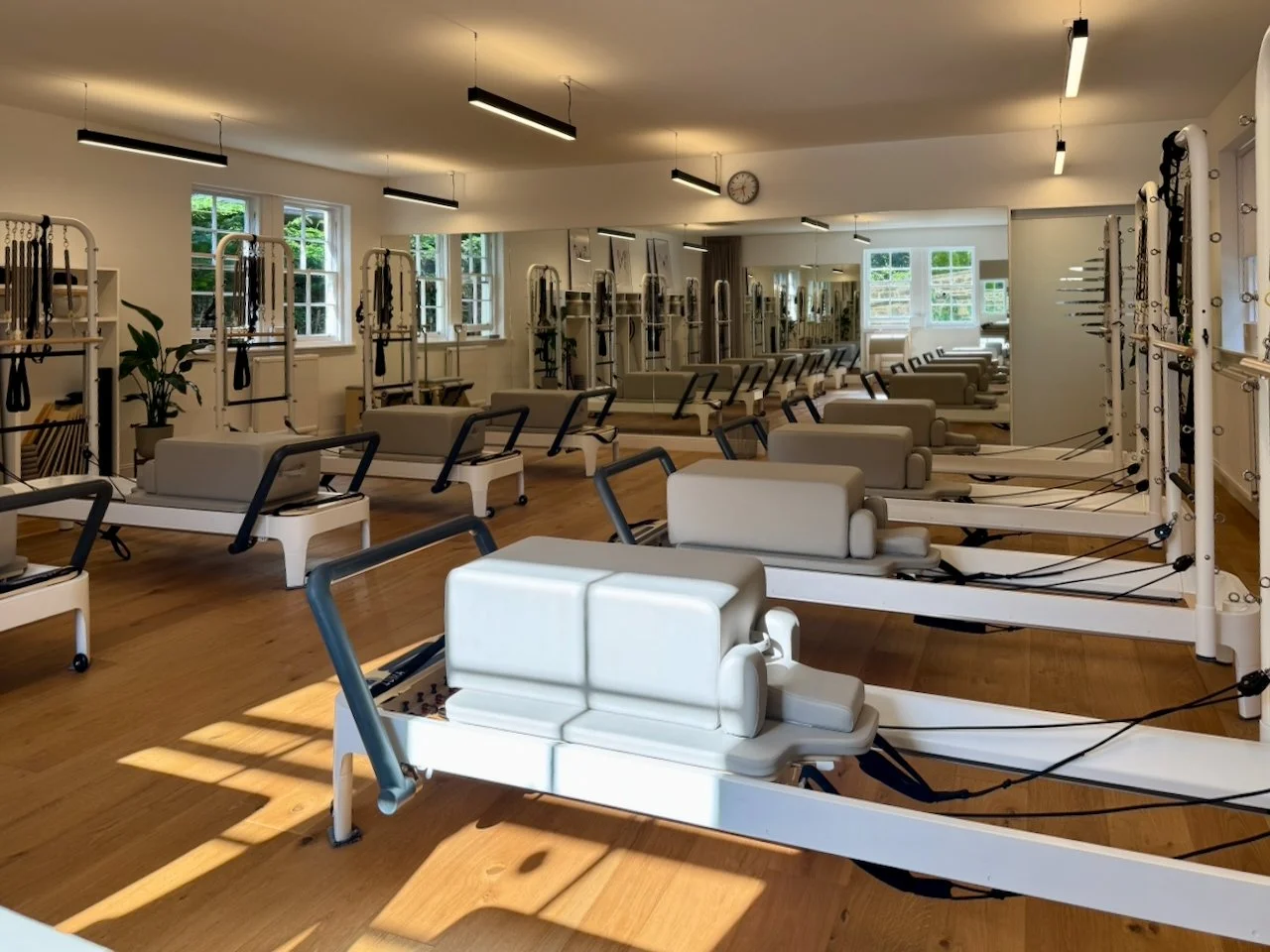
Studio A at Luma Pilates, Edinburgh. 10 Reformers with integrated Towers, long boxes on the carriages
The Reformer
The Reformer is the machine Luma is built around. It is a long, low frame with a sliding carriage, a padded platform that moves back and forth along rails. The carriage is connected to a set of springs that provide resistance, and there is a footbar at one end and a set of ropes and straps at the other.
The springs are the key to what makes the Reformer different from most exercise equipment. They provide resistance in both directions: as you push or pull the carriage away, and as it returns. That two-way resistance is what develops the kind of controlled, balanced strength that makes Pilates feel different from the gym. You are never just pushing. You are also managing the return.
The footbar and the straps allow for an enormous range of exercises in lying, seated, kneeling, and standing positions. The same machine that a beginner uses for basic footwork is used by an advanced client for complex full-body sequences. The springs are adjusted throughout to match the exercise and the client.
At Luma, the Reformers have a platform extension that locks in to create a flat, non-moving surface at one end. This extends the range of exercises available, particularly for box work: exercises performed lying or sitting on the long box positioned on the carriage. It’s useful for clients who need a stable surface, and for exercises that require a longer working length than the standard carriage provides.
The footwork series is usually the first thing a new client encounters. Lying supine with feet on the footbar, pushing the carriage away and controlling its return through different foot positions. It feels deceptively simple. It’s not. Within a few sessions, most clients notice changes in how their legs, glutes, and core feel, not because the movement is complicated, but because it is precise.
The Tower
The Tower is an upright frame attached to one end of the Reformer, fitted with a series of springs, bars, and loops at different heights. It is sometimes described as one end of a Cadillac. The full Cadillac is a freestanding apparatus with a similar spring and bar system but a raised padded table rather than a carriage. At Luma, the Tower gives us much of the same exercise repertoire without the footprint of a full Cadillac.
The Tower springs can be set at different heights and tensions, allowing for a completely different set of movements from the Reformer carriage. Push-through bar work, leg spring sequences, arm spring exercises, and spinal articulation work all use the Tower rather than the carriage. The two systems, Tower and Reformer, complement each other so that a single machine covers an extensive range of the classical Pilates repertoire.
In practice, most clients use the Tower in the context of a Reformer class without necessarily thinking of it as separate apparatus. Your instructor will direct you to the Tower springs or bar at certain points in the class as naturally as any other transition.
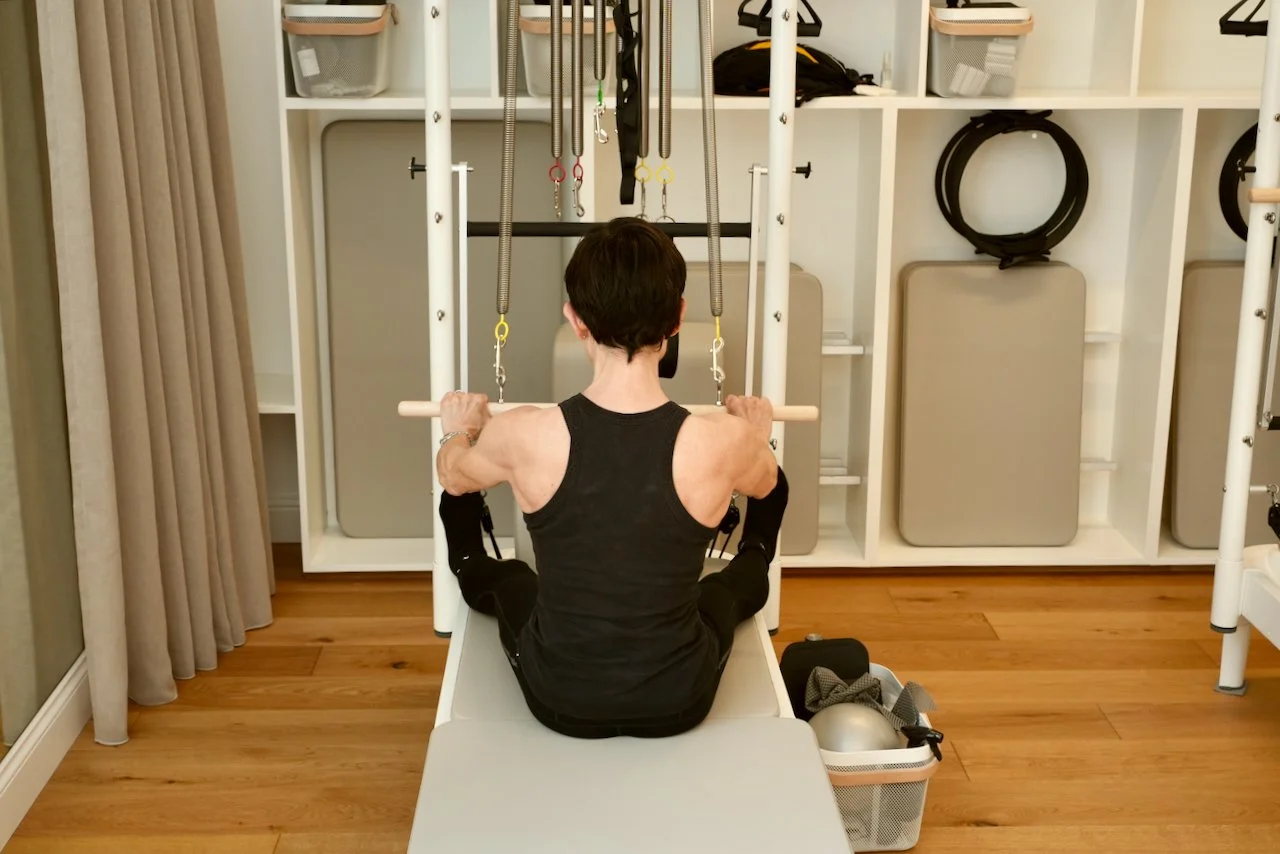
Lat press on the Tower at Luma Pilates, Edinburgh. The bar and spring system that extends the Reformer's repertoire
The Wunda Chair
The Wunda Chair is a compact, box-like apparatus with a spring-loaded pedal. It looks like a small step, which is roughly what it started as. Joseph Pilates reportedly designed an early version that could double as a piece of furniture.
In practice, it is a surprisingly demanding piece of equipment. The pedal can be set to different spring resistances, and exercises are performed pressing it down, holding it, or controlling its return. Because the base of support is small and the springs provide resistance in a different plane from the Reformer, the Chair challenges stability and strength in ways the Reformer does not.
At Luma, the Wunda Chair is used most often in private sessions, and occasionally in group classes as an alternative when a particular exercise needs a different stimulus: for example, seated leg press work or exercises that require a vertical rather than horizontal orientation. If you encounter it in a class, your instructor will guide you through it directly.
The Ladder Barrel
The Ladder Barrel is a curved barrel shape attached to a ladder-like set of rungs. The barrel provides a supportive curved surface for spinal extension and lateral work, and the ladder allows for different positioning depending on the exercise and the client's proportions.
It is particularly useful for spinal articulation, side stretch, and extension exercises that benefit from the support and curve of the barrel surface. For clients with tight thoracic spines, which is most people who work at desks, draping over the barrel in a supported back extension can be revelatory. It reaches parts of the spine that most other apparatus does not.
Like the Wunda Chair, the Ladder Barrel at Luma is used primarily in private sessions and occasionally in group classes when an alternative is needed. It is not intimidating when you encounter it: most exercises on the barrel feel supportive rather than demanding.
Props
Props are the smaller items used alongside the main apparatus to support, challenge, or adapt exercises. At Luma you will encounter several of these in class.
The magic circle (Pilates ring). A flexible ring used between the hands or thighs to add resistance to specific exercises, or between the ankles and knees to cue alignment. It does not look particularly threatening and is considerably more effective than it appears.
Soft balls. Small inflatable balls placed under the pelvis, the spine, or between the knees to support position or add an unstable surface. Particularly useful for clients who need more feedback about neutral pelvis or spinal position.
Weights. Ring weights and wrist or ankle weights are used occasionally to add load to arm and leg exercises where spring resistance is not available or not appropriate.
Blocks. Used to support alignment, particularly under the head or hands for clients with restricted range.
None of these props are compulsory. Your instructor will introduce them when they are useful for your body and the exercise at hand.
The Jumpboard
The Jumpboard is a padded vertical board that attaches at the footbar end of the Reformer, replacing the footbar for specific exercises. Instead of pressing against a fixed bar, you push the carriage away and spring back against the board, creating a low-impact jumping or rebounding motion in a lying position.
At Luma, jumpboard work appears in some classes once or twice a week. It is not a regular feature of every session. When it does appear, the purpose is cardiovascular: to raise the heart rate while maintaining the core engagement and alignment that runs through every other exercise. Because you are lying down and the springs manage the rebound, the load on the knees and hips is significantly lower than running or jumping on a hard surface. The lying position also means the spine stays supported throughout.
One of the things the jumpboard trains consistently is landing mechanics: the way your foot makes contact with the board on each return. Toe, ball, heel in sequence, rather than the flat-footed landing most people default to. It sounds like a small detail. For the knees, it is not.
If you have joint issues that make even low-impact cardio difficult, let your instructor know before class. The jumpboard can be skipped or modified without disrupting the session.
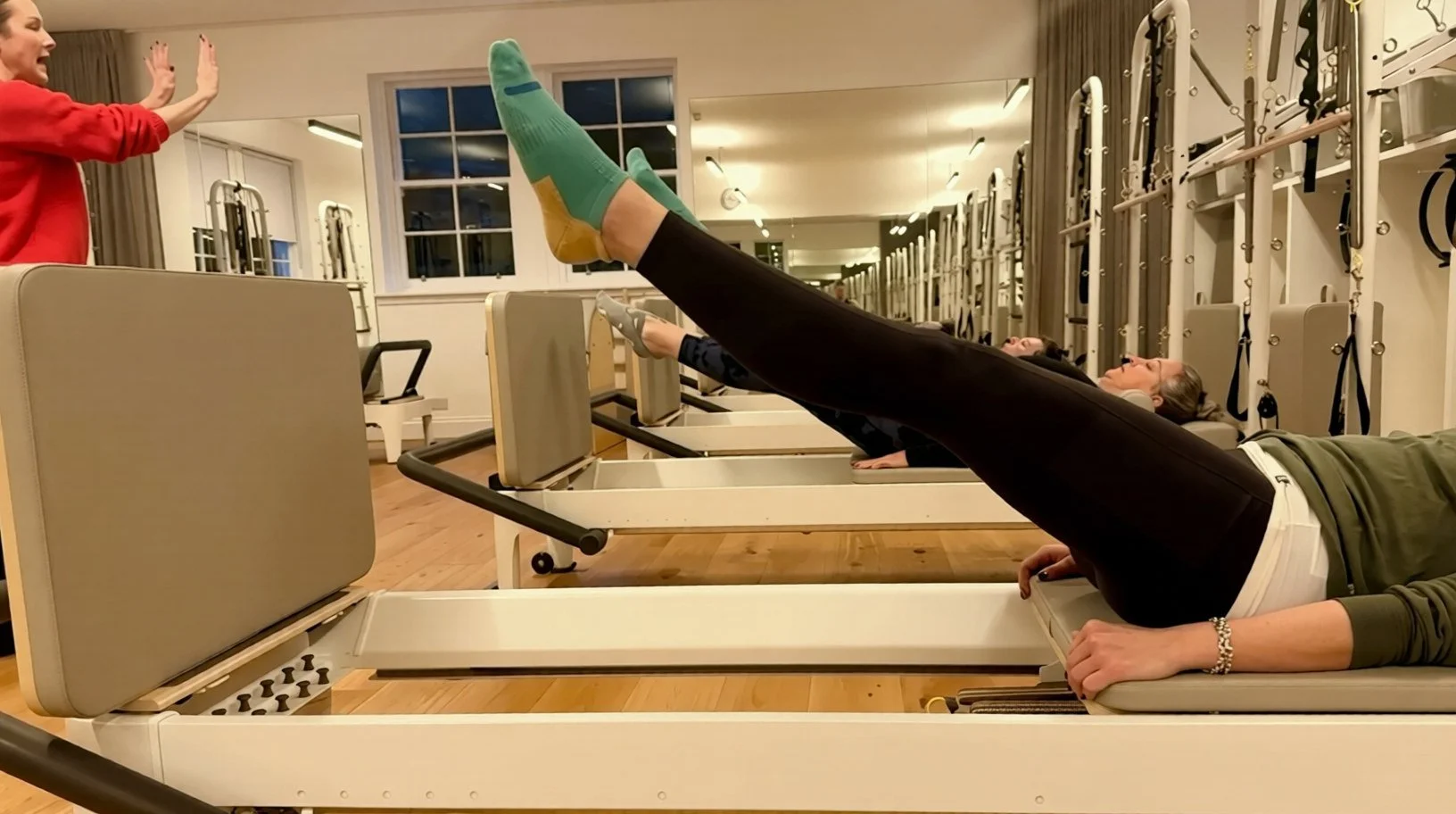
Jumpboard work at Luma Pilates, Edinburgh. Low-impact cardiovascular training on the Reformer
Getting started
If you’re new to Luma and wondering where to begin, the answer is Reformer Fundamentals. Everything else in this guide comes later, and mostly in private sessions. What you need first is a solid understanding of the Reformer: how it works, how to move on it, and what your body is doing. That foundation is what makes everything else possible.
If you'd like to explore the full range of apparatus in more depth, a 1:1 session gives your instructor the space to introduce the Chair, the Barrel, and the Tower in a way that makes sense for your body and your goals.
View our Reformer Pilates classes or get in touch if you would like to talk it through first.
Written by Max Howarth
Max is co-founder of Luma Pilates. He arrived at his first Reformer class in his fifties with no prior experience of Pilates and no particular idea what a Wunda Chair was. He has since taught himself to care deeply about footwork, and considers footwork using the Tower one of the better things that has ever happened to his back.