
Pilates for Men over 50
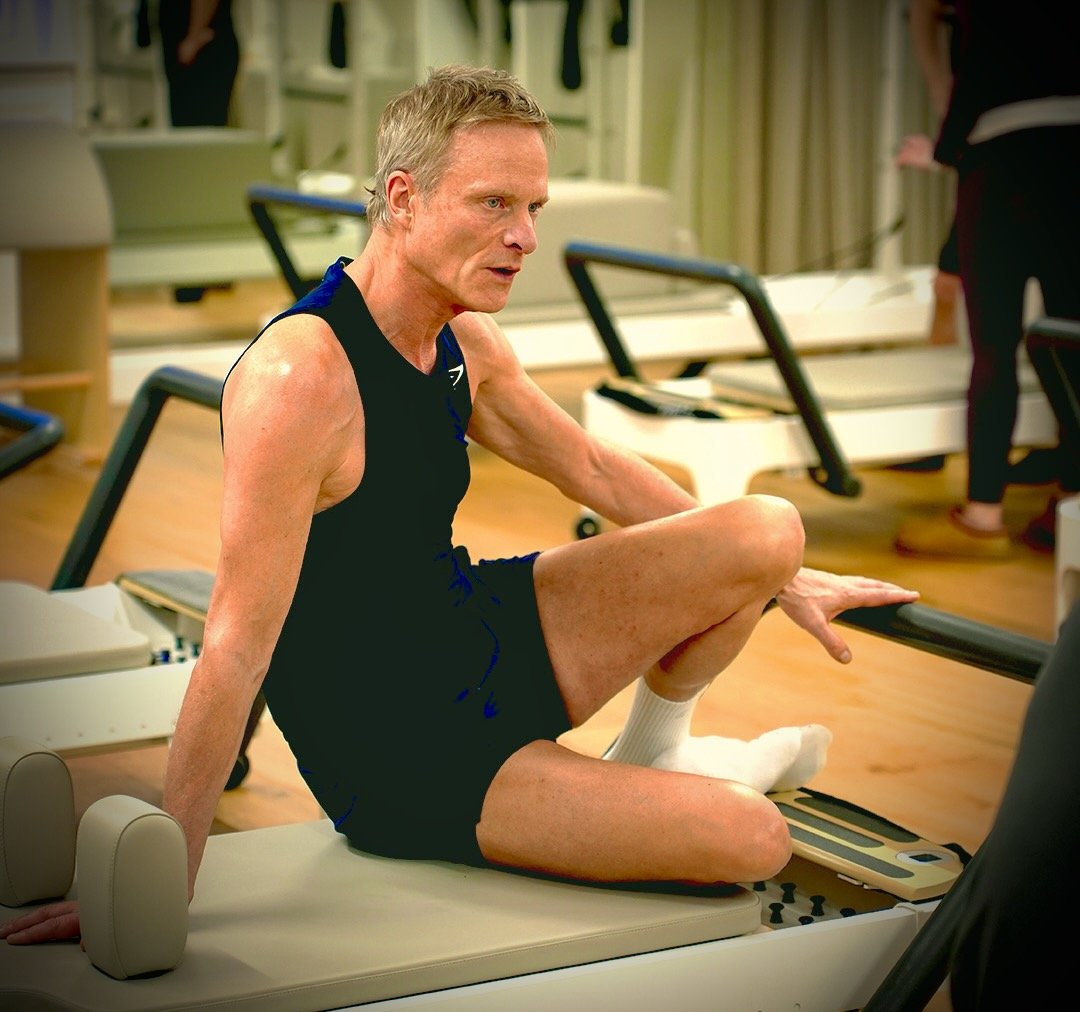
Luma co-founder and instructor Max Howarth. Started at 55. Still shows up every day
Short answer
Reformer Pilates is one of the smartest physical investments a man over 50 can make. It builds the flexibility, joint stability, and movement quality that compound well over the next two decades, and addresses the specific muscular gaps that most men's training leaves behind. The bench press has its place. But it's not going to be what keeps you moving well at 70.
I’m 60. I came to Reformer Pilates in my mid-fifties with no background in it and no strong expectation that it would change much. I was wrong. I move better now than I did at 40, and maybe even younger than that. I recover faster, my lower back is more reliable than it’s been in twenty years, and I have a range of movement in my hips and thoracic spine that I‘d quietly written off as gone.
I also teach five Reformer classes a week at Luma. So I’ve watched this pattern play out in other men too.
We‘ve written a broader guide to why men should try Reformer Pilates if you want the general case first. This guide is specifically for men in their fifties and beyond, and makes a more specific argument: that the physical priorities that made sense in your thirties need revisiting, and that Pilates addresses exactly what comes next.
The long game argument
Most men who have trained consistently through their thirties and forties have built strength in predictable directions. The anterior chain is usually reasonably developed. The posterior chain is often less so. The hip flexors are shortened from years of sitting and sagittal-plane training. The thoracic spine is stiff. The deep spinal stabilisers have been largely ignored.
None of this matters much at 35. At 55, it starts to show up. The lower back that gives out after a long run. The shoulder that does not recover the way it used to. The stiffness that takes longer to shift in the morning. The feeling that the body is less forgiving than it was.
The honest question at this point is not how to train harder. It is what kind of physical investment will still be paying dividends at 70 and 80. The answer is not maximal strength. It is flexibility, joint health, movement quality, and the deep structural strength that supports the body across everything it does.
That is precisely what Reformer Pilates develops.
What the Reformer gives men over 50
Flexibility that lasts. The flexibility gains men over 50 report from consistent Reformer practice are among the most consistently surprising results. Not the temporary kind that comes from a stretching routine, but lasting changes in range of movement that most men in this group had stopped expecting. The Reformer achieves this through eccentric loading, strengthening muscles in lengthened positions, which signals to the nervous system that extended ranges are safe. Years of sitting and bilateral gym training have compressed that range. The Reformer systematically reopens it. See our guide to does Pilates improve flexibility.
Joint stability without excessive load. The deep spinal stabilisers, the deep hip rotators, and the muscles around the shoulder girdle are exactly the muscles that protect joints under load. They are also the muscles that most gym programmes never directly train. Pilates trains them in every class. For men over 50, this is the work that keeps the joints functional and pain-free over the following decades.
Posterior chain strength. Weak or inhibited glutes are one of the most consistent features of men who have trained heavily in the gym and barely at all in the posterior chain. Footwork and leg press sequences on the Reformer load the glutes in ways that squats and deadlifts do not reach. The carryover to lower back health, athletic performance, and general physical function is direct. See our guide to Pilates for lower back pain.
Thoracic mobility. The thoracic spine is designed to rotate and extend. After decades of sitting and forward-focused training, it stops doing either well. The spinal articulation and rotation work built into every Reformer class addresses this directly. For most men over 50, the improvement in thoracic mobility is one of the first things they notice, and one of the most significant for how they move in everyday life.
Movement quality that transfers. The kinetic chain work on the Reformer addresses the body as a connected system. The improvements in hip mobility, spinal stability, and shoulder function do not stay in the studio. They show up in how you move, recover, and feel in everything else you do.
The carryover to sport. I ski. The improvement in my skiing since starting Pilates has been one of the most tangible measures of what the practice does. A stronger core means better control and less fatigue through technical terrain. Stronger, more stable ankles mean more precise edge control and less of the compensatory bracing that used to leave my legs wrecked by day three. And the recovery is genuinely different: I can ski harder, for longer, and not pay the price the following morning in the way I used to. For men over 50 who are still skiing, cycling, running, or playing sport, the Reformer doesn’t just fill gaps in the training. It extends the window in which those things remain genuinely enjoyable.
What about the gym?
I still train in other ways. The Reformer is not an argument against the gym. It is an argument for understanding what the gym does not give you, and filling that gap deliberately.
The gym builds maximal strength efficiently. The Reformer builds the movement quality, flexibility, and stabiliser strength that makes everything else more effective and more sustainable. Most men who add Reformer Pilates to an existing gym programme find their gym performance improves, because the stabiliser weaknesses and movement quality gaps that were quietly limiting them are no longer in the way. See our guide to Reformer Pilates vs gym workouts.
The question worth sitting with is this: in twenty years, what will matter more? The ability to bench press a significant weight, or the ability to move freely, without pain, with a range of motion and a physical resilience that makes daily life and activity genuinely enjoyable? Most men who have thought about it honestly already know the answer.
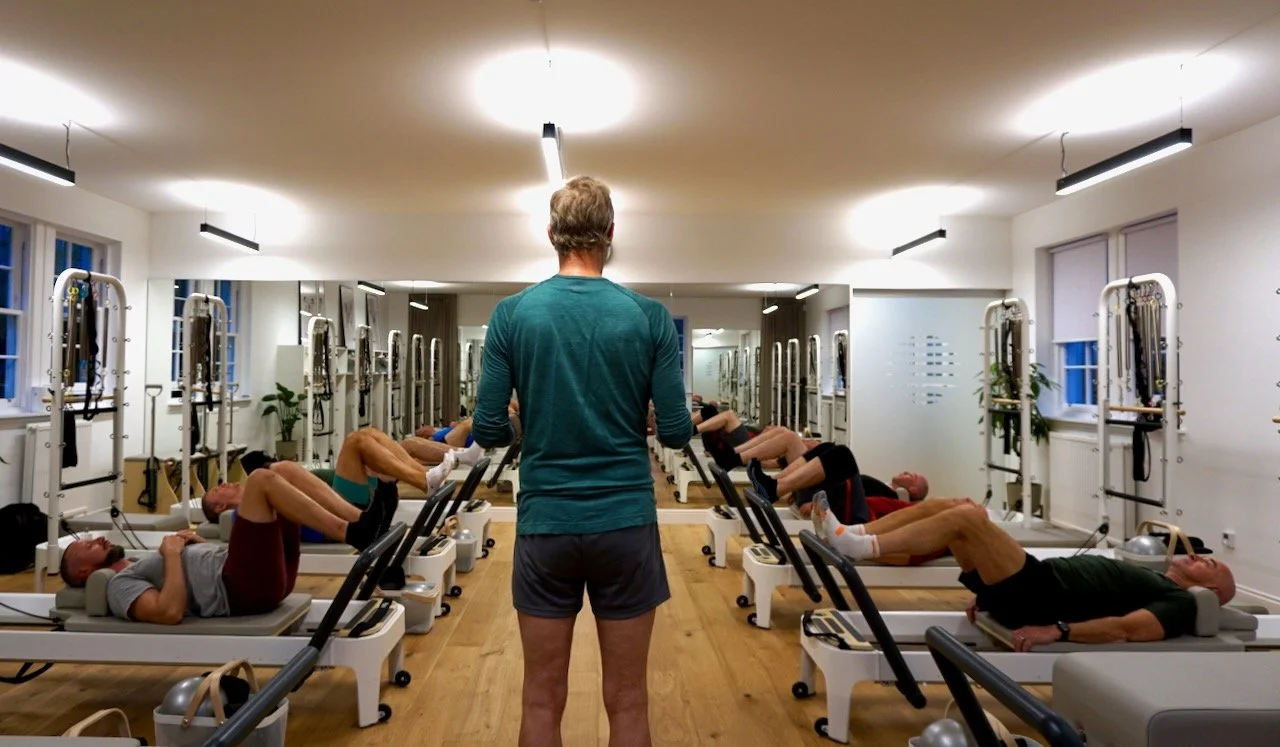
Max teaching a Reformer class at Luma Pilates, Edinburgh. Men doing something most of them never expected to try
Lower back pain and recovery
Lower back pain is one of the most common reasons men over 50 come to Luma. The pattern is almost always the same: years of sitting, a posterior chain that has never been properly trained, hip flexors shortened by decades of desk work, and deep spinal stabilisers that have quietly disengaged. The Reformer addresses all of it, directly and consistently. See our full guide to Pilates for lower back pain.
For men recovering from hip or knee surgery, or managing the aftermath of old sporting injuries, the Reformer's adjustable resistance and controlled movement environment makes it one of the most appropriate forms of exercise available. Speak to your surgeon or physiotherapist first, and then talk to your instructor before your first class. See our guide to Pilates vs physiotherapy for more on how the two work together.
Starting later is not a disadvantage
I started in my mid-fifties. I want to be direct about this because it is the thing men in this age group most often use as a reason not to start.
The Reformer works with wherever your body currently is. The adjustable resistance means you are not competing against a fixed standard. The precision means you are building genuine strength and awareness rather than compensating your way through movements. And the low-impact nature means you can train consistently without the recovery cost of higher-impact exercise.
The men I see benefit most from Pilates at Luma are often in their fifties and sixties. They have the self-knowledge to recognise what their body needs, and the honesty to admit that what they have been doing has gaps. The Reformer fills those gaps in a way that very little else does.
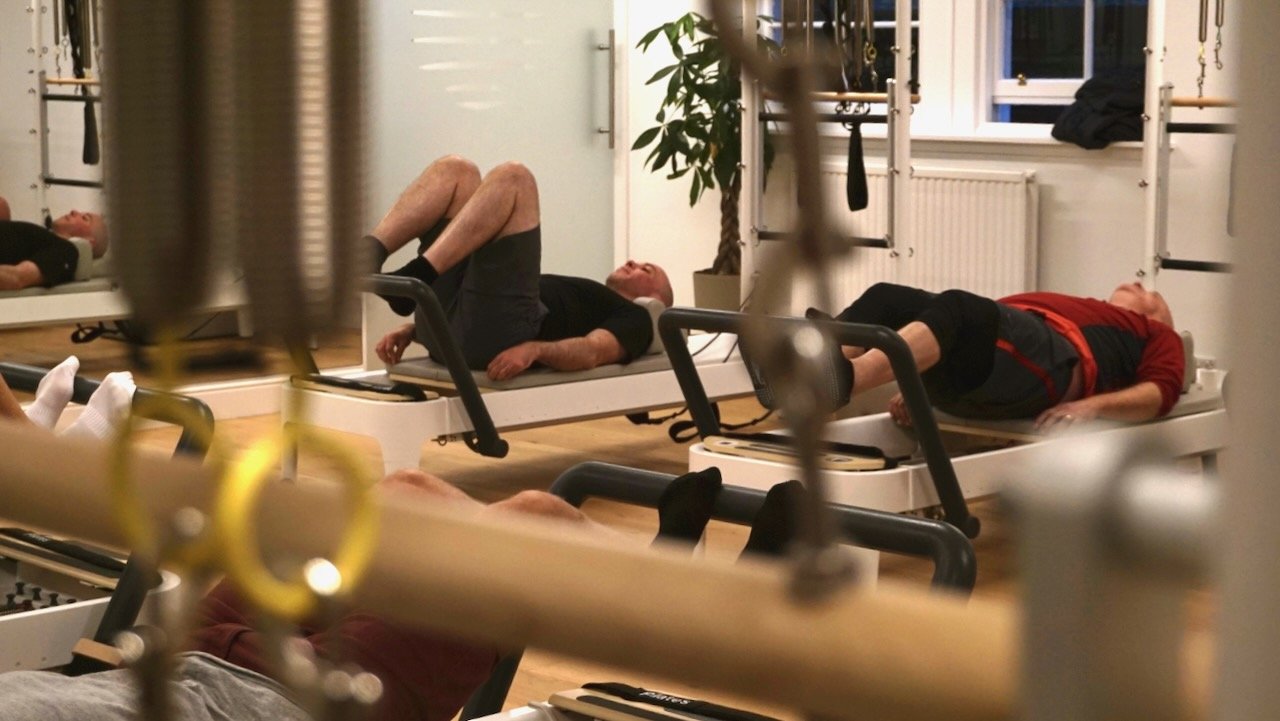
A Reformer class at Luma Pilates, Edinburgh. Men in their forties and fifties doing the work that makes the difference
Where to start
Reformer Fundamentals is the right entry point. It covers how the machine works, how to set it up for your body, and the foundational movement principles that underpin every class at every level. Nothing is assumed and nothing is rushed.
If you would prefer to begin with a private session, a 1:1 gives you your instructor's complete attention to learn the fundamentals at your own pace. Private sessions at Luma start at £90. View all pricing.
Our introductory offer of 3 Reformer or Tower classes for £48 is designed for exactly this starting point. Three sessions is enough to move past the unfamiliar and start experiencing what the practice is genuinely about. View our class schedule, browse all classes, or get in touch if you would like to talk it through first.
Written by Max Howarth
Max is co-founder of Luma Pilates. He came to Reformer Pilates in his mid-fifties with no movement background and now teaches five classes a week at the studio. He is 60. He moves better now than he did more than 20 years ago. His view on whether men over 50 should try Reformer Pilates hasn’t changed since his fourth class.