Lagree vs Reformer Pilates
Short answer
Lagree is a high-intensity conditioning method performed on a Lagree machine, rooted in bodybuilding principles like time under tension. Reformer Pilates is a movement practice rooted in Joseph Pilates's original method, focused on precision, alignment, and whole-body coordination. Both are low-impact. Beyond that, they diverge significantly.
What is the Lagree method?
Lagree was developed in the early 2000s by Sebastien Lagree, a Los Angeles-based trainer who wanted to combine the low-impact qualities of Pilates with the intensity of strength and conditioning work. The method is performed on a machine called the Megaformer, which uses a spring-loaded carriage similar in concept to a Reformer but significantly different in design and function.
Lagree is explicit that it is not Pilates. Sebastien Lagree himself has said the method is rooted in bodybuilding principles, specifically time under tension and progressive overload. Exercises are performed very slowly, for sustained durations, with the goal of producing muscular fatigue. The intensity is real, and so is the cardiovascular demand.
Lagree has grown rapidly as a global franchise model. Studios are typically high-energy environments with upbeat playlists. In Edinburgh, Tallie Lagree is the dedicated Lagree studio, offering classes on the Minformer Pro, a newer iteration of the Megaformer family.
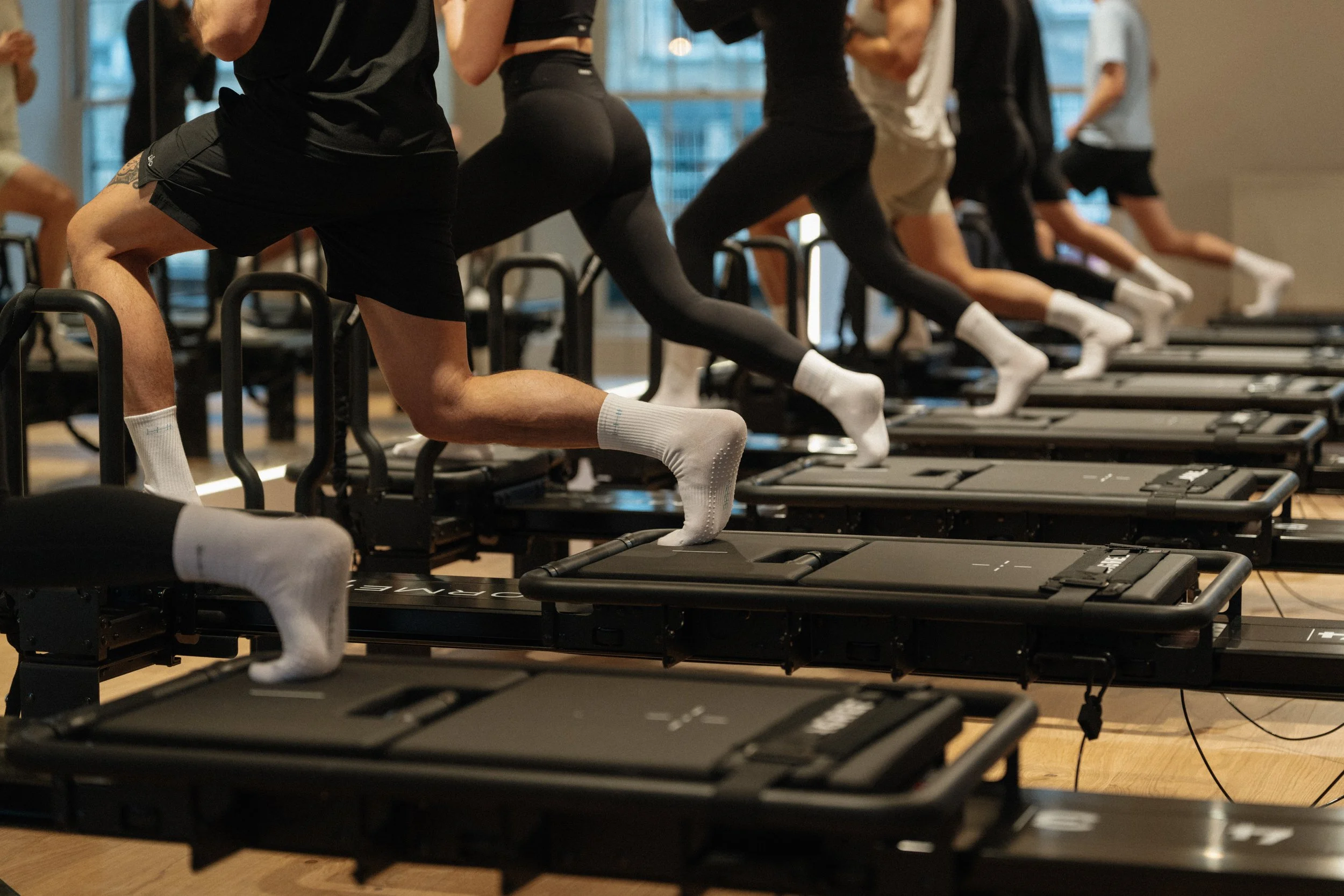
The Minformer Pro at Tallie Lagree. Larger than a Reformer, and designed specifically for the Lagree method
What is Reformer Pilates?
Reformer Pilates is a form of the Pilates method developed by Joseph Pilates in the early twentieth century. The Reformer is a spring-resistance machine that supports controlled movement across a range of exercises targeting the whole body. It is used in rehabilitation, performance training, and general fitness.
The Pilates method is built on a set of principles: concentration, control, centring, flow, precision, and breath. The goal is not muscular fatigue but movement quality, functional strength, and body awareness. Progress comes through developing a deeper relationship with how you move, not just how hard you work.
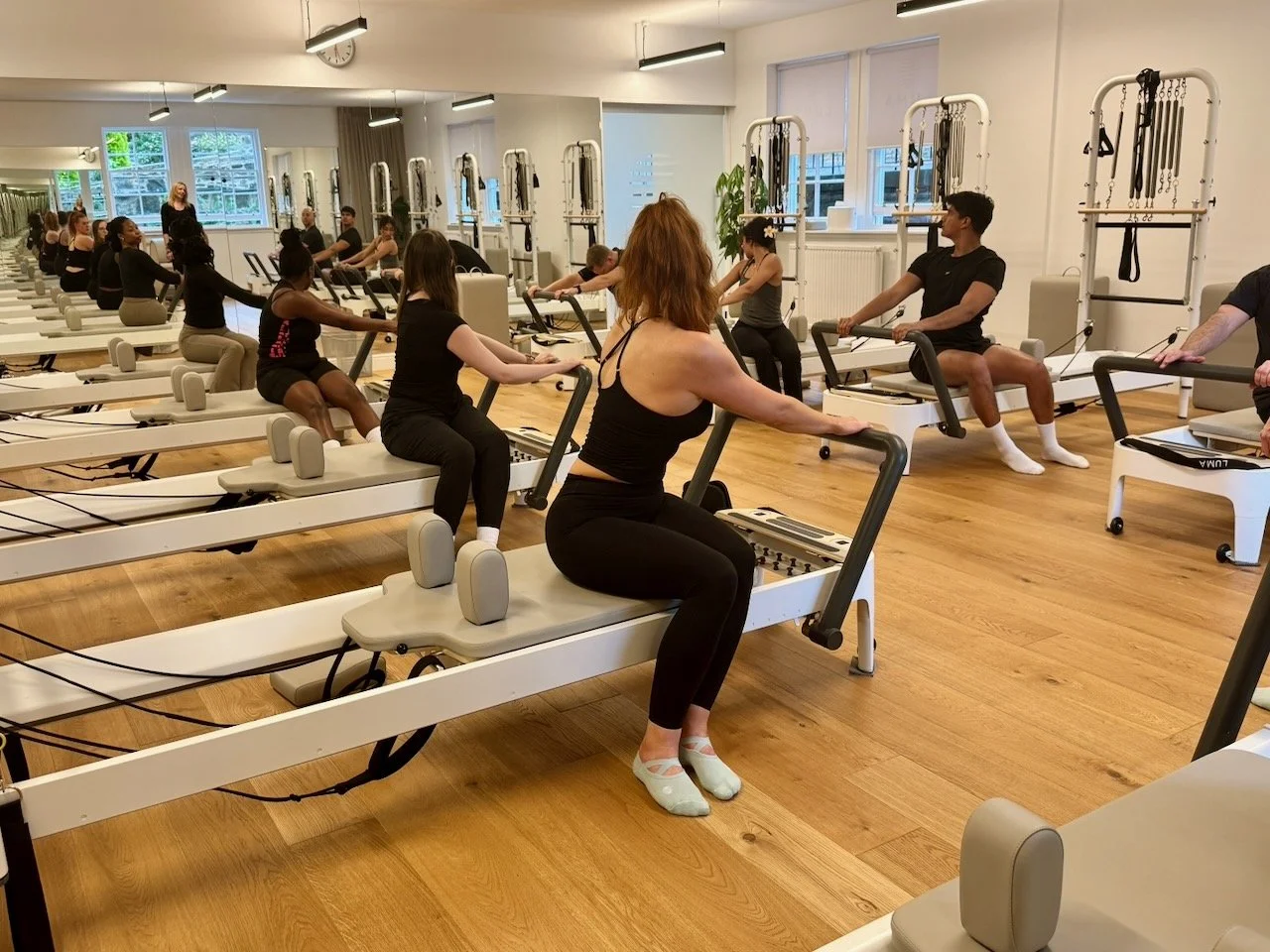
Spinal rotation at the end of a group Reformer class. The kind of mobility that accumulates quietly and shows up everywhere else
Reformer Pilates has been studied extensively, particularly in rehabilitation and musculoskeletal health, which is one reason it is commonly used alongside physiotherapy and in healthcare settings. It is suitable for a broad range of clients including those recovering from injury, managing chronic conditions, or returning to exercise after a significant gap.
At Luma Pilates, Reformer classes are taught in small groups of up to ten, with individual attention in every session. Lucia Poulter, who leads the studio, holds Comprehensive BASI certification.
How the equipment differs
The Reformer and the Megaformer look similar at first glance. Both use a spring-loaded sliding carriage, both have adjustable resistance, and both involve low-impact movement. But the differences become clear when you look more closely.
The Reformer is designed for a wide repertoire of exercises performed in multiple positions, including lying, seated, kneeling, and standing. It includes a footbar, shoulder blocks, a headrest, and a box for seated and prone work. The range of exercises is extensive, and the machine supports both rehabilitation-focused and athletic training.
The Megaformer is larger, with two standing platforms at either end and multiple sets of handles. It is specifically designed for the Lagree method, which involves fewer positions (most exercises are performed kneeling or standing) and a smaller but intensive repertoire. The Megaformer is not designed for the classical Pilates repertoire and would not be used that way.
Philosophy and training approach
This is where the two methods diverge most clearly.
Lagree is intensity-led. The defining principle is time under tension: holding muscles under load for sustained periods to produce fatigue and adaptation. There are no rest periods between exercises. The pace is deliberately slow, but the effort is high. Performing Lagree movements correctly demands a significant amount of body awareness and physical control. It is, as Sebastien Lagree intended, closer to conditioning than to movement practice.
Reformer Pilates is precision-led. The focus is on how you move, not how hard you work. Technical alignment, flexibility, and deliberate breathing technique are central to the method. A well-taught Reformer class will challenge you, but the cues are about alignment, breath, and coordination rather than pushing to failure. The method asks you to develop body awareness alongside strength, and the two build together over time.
Neither approach is better. They are simply different, and they serve different goals.
| Factor | Lagree | Reformer Pilates |
|---|---|---|
| Origin | Sebastien Lagree, early 2000s | Joseph Pilates, early 1900s |
| Primary goal | Muscular endurance and conditioning | Movement quality and functional strength |
| Equipment | Megaformer or Minformer Pro, larger with two platforms | Reformer, with footbar, box and a wider repertoire |
| Positions used | Mostly kneeling and standing, smaller repertoire | Lying, seated, kneeling and standing, extensive repertoire |
| Intensity | High | Variable |
| Cardiovascular demand | Higher | Moderate |
| Session feel | High-energy, continuous tension, no rest | Controlled, alignment and breath-led |
| Focus | Fatigue and adaptation | Precision and control |
| Rehabilitation use | Intensity-led; less commonly used in clinical rehab | Widely used alongside physiotherapy |
| Research base | Limited published research | Extensively studied, especially in musculoskeletal health |
| Beginner friendly | Accessible with good instruction | Highly adaptable to all levels |
Intensity and who each method suits
Lagree tends to suit people who:
Want high-intensity, sweat-producing workouts within a low-impact format
Are comfortable with sustained muscular fatigue
Enjoy the energy of a group fitness class with a strong conditioning focus
Are already reasonably fit and looking to push harder
Reformer Pilates tends to suit people who:
Want to build functional strength alongside flexibility and mobility
Are recovering from injury or managing a chronic condition
Are returning to exercise and need a method that adapts to where they are
Want to improve posture, body awareness, and movement quality
Are looking for a sustainable long-term practice rather than a short-term intensity hit
It’s worth noting that Reformer Pilates is not easy, particularly as you progress through levels. The challenge becomes more nuanced rather than simply more intense, and many clients find this more sustainable and more rewarding over time.
Can you do both?
Yes, and some people do. Because the methods are complementary rather than competing, Lagree can function as conditioning work while Reformer Pilates supports technique, recovery, and movement quality. The overlap in equipment means some movement patterns will feel familiar across both methods, even if the principles behind them differ.
If you’re doing both, it is worth being aware that Lagree produces real muscular fatigue, so programming them on back-to-back days may not be ideal. Many clients who combine the two use Reformer Pilates as the steadier foundation and Lagree as an occasional intensity layer.
Which is right for you?
If you are searching for Lagree in Edinburgh and wondering whether Reformer Pilates might also be worth trying, the honest answer is: it depends on what you’re looking for.
If you want intensity, cardiovascular demand, and a conditioning-focused workout, Tallie Lagree is a well-run studio doing exactly that.
If you want to build strength and mobility in a method that adapts to your body, supports injury recovery, and develops over time, Reformer Pilates is likely a better fit. It is also worth knowing that Reformer Pilates has significantly more research behind it, particularly for anyone managing a specific condition or working with a physiotherapist.
At Luma Pilates, we work with clients across a wide range of ages, backgrounds, and starting points. If you are not sure where to begin, our Reformer Fundamentals class is designed specifically for people who are new to the Reformer, and your instructor will guide you through everything at a pace that suits you.
Get in touch if you’d like to talk through which class might be right for you.
Written by Lucia Poulter
Lucia is the lead instructor and co-founder of Luma Pilates. She holds Comprehensive BASI certification and has been teaching Pilates for 26 years. If you’re weighing up your options in Edinburgh, Lagree is a genuine workout and worth trying if intensity is what you are after. At Luma, the approach is different: smaller classes, more individual attention, and a method that adapts to your body rather than asking your body to keep up with the method. Come and try a class and see how it feels.