What Is Mat Pilates? And Why It Deserves More Credit Than It Gets
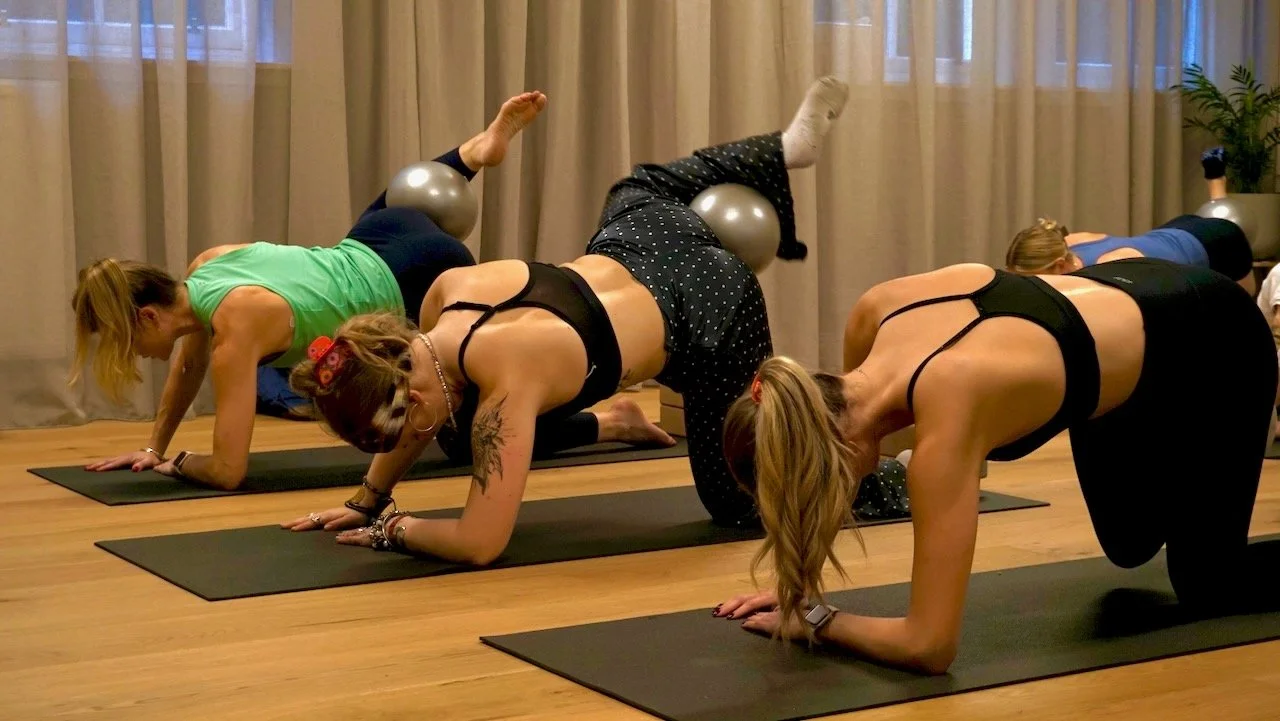
Mat Pilates at Luma Pilates, Edinburgh. The original practice, taught properly
Short answer
Mat Pilates is the original form of the practice, performed on the floor using bodyweight rather than equipment. It develops core strength, spinal mobility, body awareness, and flexibility through a series of precise, controlled exercises. It is suitable for all levels, more physically demanding than most people expect, and one of the most effective movement practices available.
Mat Pilates is where the practice began. Joseph Pilates developed his method on the floor, using nothing but bodyweight and intention, long before the Reformer existed. The exercises he created are still taught today, in studios and living rooms around the world, because they work.
No springs. No carriage. No equipment to assist or resist. Just you, a mat, and a method that has been refined for over a century.
That simplicity is not a limitation. It’s the point.
What Mat Pilates actually is
Mat Pilates is Pilates performed on the floor, using your own bodyweight as the resistance. There is no machine, no springs, no carriage. The exercises are drawn from the original method Joseph Pilates developed in the early twentieth century, and they have remained largely unchanged because they are that well designed.
The practice covers a full range of movement: spinal flexion and extension, rotation, lateral work, hip mobility, and the kind of sustained deep stabiliser engagement that most forms of exercise never reach. All of it is done on the mat, through exercises that can look deceptively simple from the outside and feel considerably less so once you are doing them.
What makes Mat Pilates distinctive is the demand it places on you to generate everything yourself. On the Reformer, the springs provide feedback, assistance, and resistance. On the mat, there is nothing between you and the movement but your own strength and control. That is harder, and more revealing, than most people anticipate.
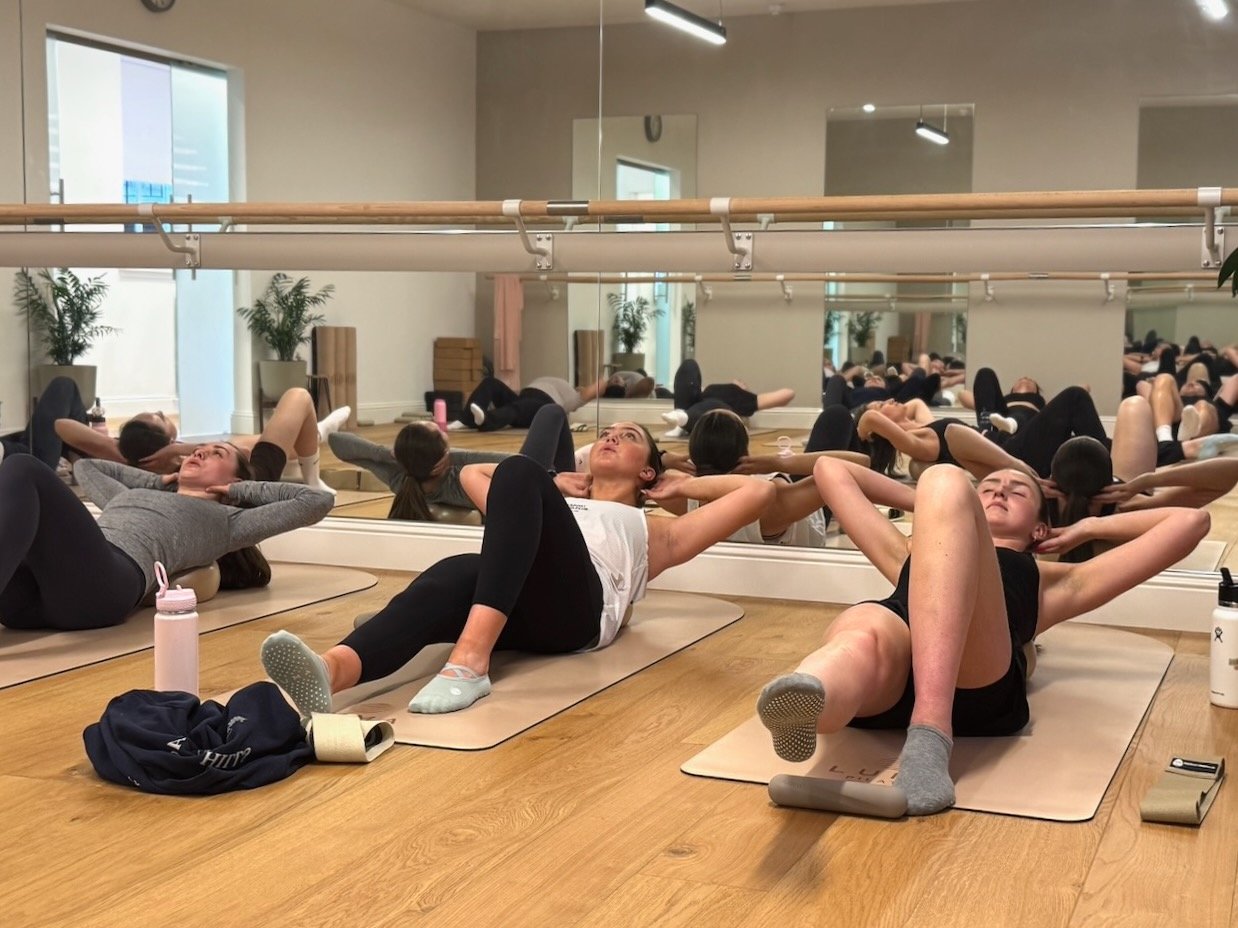
The core exercises in Mat Pilates develop strength and control in ways the Reformer approaches differently
What Mat Pilates does for your body
The physical benefits of Mat Pilates are real, well documented, and often underestimated.
Core strength that actually works
The centring principle at the heart of all Pilates, initiating movement from the deep stabilisers rather than the superficial muscles, is particularly demanding on the mat. Without the machine to manage load and range, every exercise requires the transverse abdominis and multifidus to work continuously. The core strength Mat Pilates builds is the functional, load-bearing kind that transfers to everything else you do.
Spinal mobility
The rolling and articulation exercises that are central to Mat Pilates develop spinal articulation in ways that the Reformer approaches differently. Moving through the spine vertebra by vertebra, in both flexion and extension, maintains the mobility that desk work and daily life progressively erode.
Flexibility and active range of movement
Mat Pilates develops active flexibility: the range of movement you can control under your own muscular power, rather than the passive range you might achieve with assistance. This is the kind of flexibility that persists and transfers to everyday movement.
Postural strength
The shoulder girdle work, thoracic extension, and hip stabiliser exercises that run through every Mat class address the same postural imbalances as Reformer Pilates, from a different angle and without equipment.
Body awareness
Without the tactile feedback of the Reformer, Mat Pilates demands more internal attention. Clients who practise Mat consistently develop a quality of body awareness that shows up in everything they do, on the mat and off it.
What to expect in a class
A Mat Pilates class at Luma runs for 50 minutes. The pace is measured and deliberate. You will move through a sequence of exercises on the floor, guided by your instructor throughout.
Classes are open to all levels. The instructor will offer variations for clients who want to work more deeply or need to modify for injury or discomfort. Nobody is left to figure things out on their own, and nobody is held back from the full expression of an exercise if they are ready for it.
You’ll need grip socks. We sell them at the studio if you don't have a pair. Comfortable, fitted clothing is ideal. Nothing else is required.
Most people leave their first Mat class surprised by how much they felt, particularly in the deep abdominals and the muscles around the shoulder blades, and curious to come back.
Is Mat Pilates suitable for all levels?
Yes. Mat Pilates is one of the most adaptable movement practices available. The foundational exercises can be modified for complete beginners, and the full classical repertoire challenges experienced practitioners who have been practising for years.
At Luma, our Mat classes are open to all levels. Your instructor will observe how you are moving and offer adjustments and progressions in real time. If you have a specific injury, condition, or area of concern, tell your instructor before class. The more they know, the better they can support your practice.
New to Pilates entirely? Mat is a valid and excellent starting point. You do not need to begin on the Reformer. Many of Luma's most dedicated practitioners started on the mat and have never needed to change.
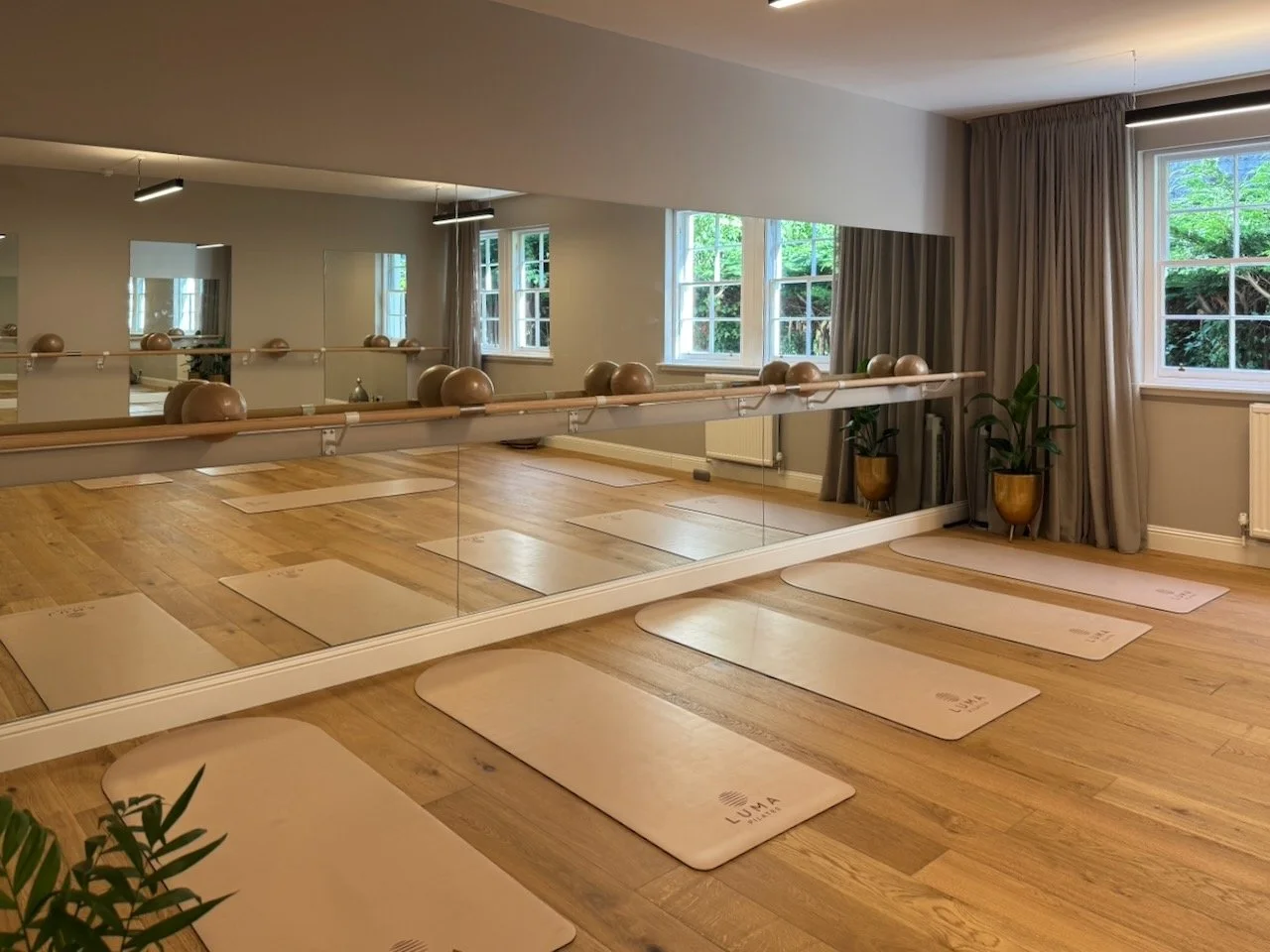
Studio B at Luma Pilates, Edinburgh. Light, space, and room to move. This is where Mat and Barre classes happen
Mat vs Reformer: what's the difference?
Both are Pilates. Both are built on the same principles: centring, neutral spine, precision, breath, and spinal articulation. The body awareness you develop in one transfers directly to the other.
The differences are real but complementary rather than competitive.
The Reformer adds spring resistance, a moving carriage, and a much wider range of exercise possibilities. The machine assists movement in the early stages, which makes it accessible for beginners and useful for rehabilitation. It is particularly effective for posterior chain work, shoulder stability, and progressive loading.
The mat asks you to generate everything from within. No assistance, no resistance beyond your own bodyweight. This makes certain exercises more demanding on the mat than on the Reformer, particularly the rolling sequences and the abdominal work. It also makes the mat completely portable. You can practise anywhere with nothing but floor space.
For many clients, the mat and the Reformer reveal different things about how the body moves. Exercises that feel solid on the Reformer can expose gaps on the mat, and vice versa. Clients who practise both consistently tend to develop faster in each, because the skills reinforce each other.
For a full comparison, see our guide to Reformer Pilates vs Mat Pilates.
The case for Mat Pilates as a standalone practice
Mat Pilates doesn’t need the Reformer to justify itself. It is a complete practice in its own right, with a century of evidence behind it and a full physical curriculum that addresses strength, mobility, flexibility, and body awareness without any equipment at all.
The perception that Mat is the entry-level version of Reformer, something you do before you're ready for the machine, is a misunderstanding of what the practice actually is. Joseph Pilates taught the mat method as the foundation and the standard. The Reformer was designed to supplement it, not replace it.
Many of the most experienced Pilates practitioners in the world regard the mat as the more demanding of the two disciplines. The absence of equipment removes the safety net. Every movement has to come from genuine strength and control, and there is nowhere to hide.
For clients who travel frequently, work from home, or simply want a practice they can sustain anywhere in the world with nothing but a mat, the case for Mat Pilates as a primary practice is straightforward. It is also low impact, requires no equipment investment, and produces results that accumulate with consistent practice just as reliably as any other form of Pilates.
Mat Pilates at Luma
At Luma we offer Mat Pilates classes taught by Catrin Dawson, Alex Sandgren, and Julia Govan, who bring deep experience and a precise, attentive approach to the mat.
Catrin came to Pilates through injury and has practised consistently ever since. Her understanding of how the body adapts and recovers shapes everything about how she teaches. Alex is STOTT trained in Reformer and Mat Pilates and believes movement should be fun as well as effective. A former attorney from the US, she found Pilates as a way to manage a high-stress career, and now brings an athletic, dynamic energy to her classes. Julia brings the same depth of attention to every class she teaches.
Classes are open to all levels, run for 50 minutes, and are kept deliberately small so your instructor can see you throughout and adjust accordingly. Whether you are completely new to Pilates or an experienced practitioner looking to deepen your practice, Mat at Luma is worth trying.
Our introductory offer of 3 Barre or Yoga classes for £30 also covers Mat. View our full class schedule to find when Catrin, Alex and Julia are teaching, or get in touch if you'd like to talk it through first.
Frequently asked questions
Is Mat Pilates good for beginners? Yes. Mat Pilates is suitable for complete beginners. Classes at Luma are open to all levels, and your instructor will offer modifications and progressions throughout. You do not need any prior Pilates experience to start.
Is Mat Pilates harder than Reformer Pilates? In some ways, yes. Without the spring resistance of the Reformer to assist or support movement, Mat Pilates demands more from your own strength and control. Certain exercises are significantly more challenging on the mat. The two practices are different rather than one being harder than the other overall.
Can I do Mat Pilates if I have a bad back? In most cases, yes. Mat Pilates is low impact and builds the deep stabiliser strength that underpins lower back health. Tell your instructor about your history before class and they will adjust accordingly. If your back pain is connected to a specific diagnosis, speak to your GP or physiotherapist before starting.
Do I need any equipment for Mat Pilates? Just grip socks. We sell them at the studio. Mats are provided. Everything else is taken care of.
What is the difference between Mat Pilates and yoga? Both are floor-based practices that develop flexibility, strength, and body awareness, but they approach this differently. Mat Pilates is focused on specific movement principles, spinal alignment, and deep stabiliser activation. Yoga addresses flexibility, breath, and the nervous system through a different framework. Many clients find the two complement each other well.
How often should I do Mat Pilates? Two sessions per week produces the clearest and most consistent results. One session per week is genuinely useful and maintains what you build. For a full breakdown, see our guide to how often you should do Pilates.
Written by Lucia Poulter
Lucia is co-founder and lead instructor at Luma Pilates Edinburgh. She holds Comprehensive BASI certification and has 26 years of teaching experience. Mat Pilates classes at Luma are taught by Catrin Dawson, Alex Sandgren and Julia Govan, all of whom came to the practice with deep personal investment in what it does.