
Pilates for Athletes: Performance, Injury Prevention, and Recovery
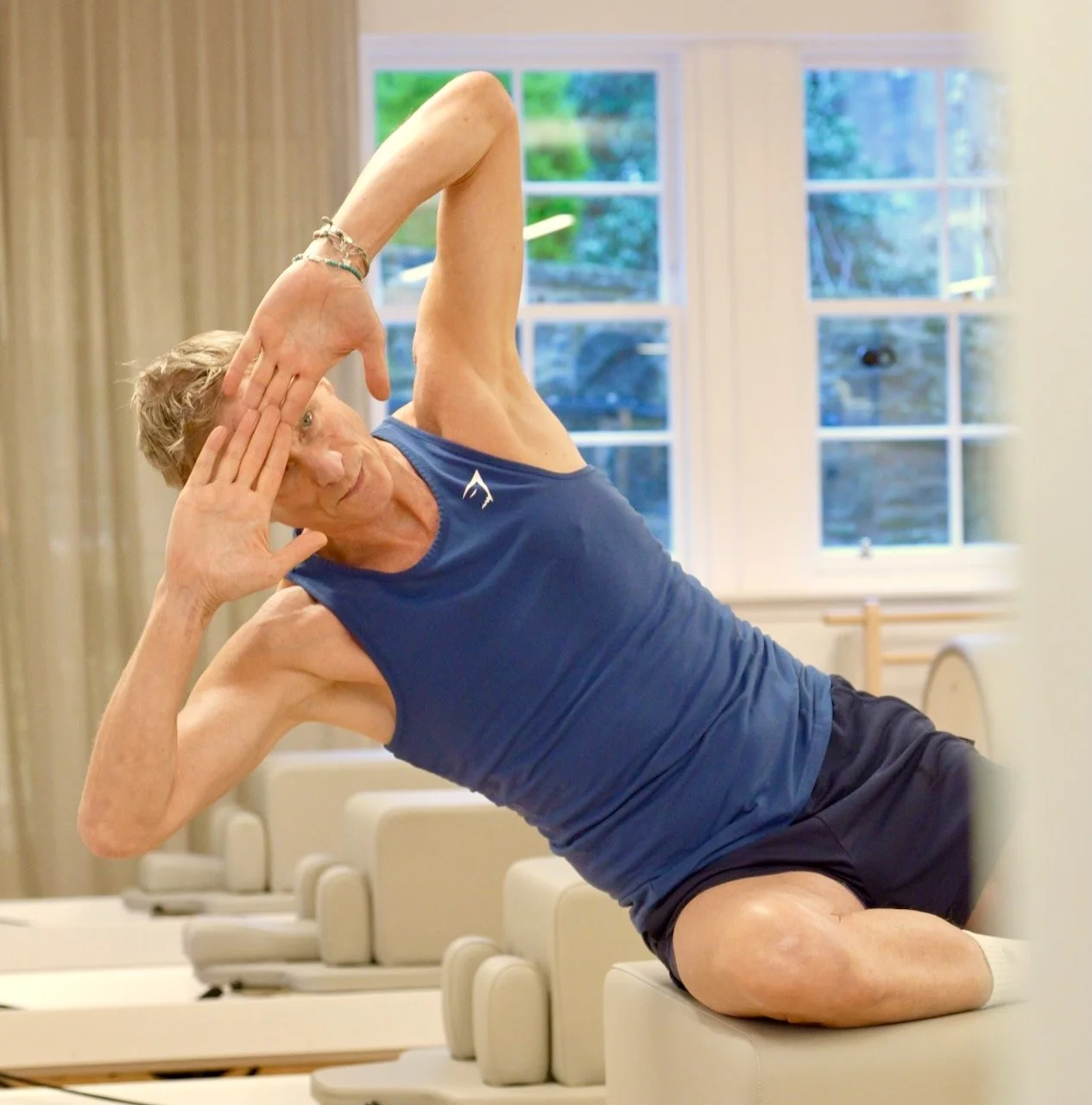
Max Howarth working the obliques in Side Overs on the long box. The lateral strength that most training never reaches
Short answer
Reformer Pilates builds the deep stabiliser strength, mobility, and movement quality that most athletic training misses. It addresses the imbalances and compensations that accumulate from repetitive sport-specific training, reduces injury risk, and tends to improve performance in ways athletes don't expect. It doesn't replace your sport. It makes everything else work better.
We've welcomed athletes of most kinds into Luma: runners, cyclists, skiers, swimmers, rugby players, and footballers. Most arrive curious. Most leave converted.
The conversion usually happens in the first two or three sessions, when they feel muscles they didn't know were weak and move in ways they didn't know they'd been avoiding. The Reformer has a way of finding the gaps in even well-trained bodies, because it works the body in ways that sport-specific training almost never reaches.
This is not a gentle practice. It's a precise one. And for athletes, precision is where most of the gains are.
What Pilates does for athletes
Most athletic training is anterior-dominant, sagittal-plane, and bilateral. That means it loads the front of the body, in a forward-backward direction, with both sides working simultaneously. Running, cycling, swimming, lifting: the pattern is consistent, and the gaps it creates are consistent too.
The posterior chain is underloaded. The lateral stabilisers are underdeveloped. The thoracic spine loses rotation. The hip flexors shorten. The deep spinal stabilisers disengage because the larger movers have compensated for them. None of this matters much in the short term. Over months and years of training, it's where injuries come from.
The Reformer works the body in three dimensions, across a wide range of movement patterns, with the lateral and rotational planes as well as the sagittal. It loads the posterior chain directly. It trains the stabilisers specifically. It develops the thoracic mobility that repetitive sport compresses. And it does all of this through eccentric loading, strengthening muscles as they lengthen, which is the loading pattern most relevant to injury prevention and athletic resilience.
Deep stabiliser strength
The muscles closest to the spine, the multifidus and transverse abdominis, are the foundation of athletic movement. They stabilise the spine under load, transfer force efficiently between the upper and lower body, and protect the joints that take the most punishment in sport.
They're also the muscles that most athletic training ignores. Heavy compound lifts, sport-specific drills, and cardio-based conditioning all rely on these muscles being functional, but rarely train them directly. When they're weak or inhibited, the larger movers compensate, creating the movement inefficiencies and overuse patterns that lead to injury.
Pilates trains the deep stabilisers in every session, from the first class through to the most advanced level. The footwork series alone, which looks deceptively simple, is one of the most effective tools available for developing the kinetic chain integration that underlies athletic performance. Athletes who add Reformer Pilates to their training typically notice the difference in their sport within six to eight weeks.
Injury prevention and alignment
Most sports injuries don't happen in isolation. They're the endpoint of a pattern: a compensation that developed over months, a weakness that was never addressed, an imbalance that accumulated until the load exceeded what the structure could bear.
Pilates makes these patterns visible. The precision of the work, the individual attention from an instructor who can see how you're moving, the variety of positions and loading angles, all of these create conditions in which compensations can't hide. An instructor who knows their work will spot a hip that's rotating, a shoulder that's substituting for a weak serratus, a lower back that's absorbing load the glutes should be handling. Identifying these patterns is the first step to correcting them.
The correction itself happens through the practice. Exercises are modified, load is adjusted, and the body is gradually retrained to move in the patterns that protect it. This is a slower process than most athletes want. It's also more durable than most injury management approaches.
See our guide to Pilates vs physiotherapy for more on how the two approaches work together.
Mobility that transfers
There's a distinction worth making between flexibility and active flexibility. Passive flexibility, the kind you develop through static stretching, gives you range of movement you can demonstrate at rest. Active flexibility gives you range of movement you can use under load, at speed, in the positions your sport demands.
Pilates develops active flexibility through eccentric loading: strengthening muscles in lengthened positions rather than simply stretching them. This signals to the nervous system that extended ranges are safe and accessible, producing lasting changes in usable range of movement rather than temporary improvements in passive flexibility.
For athletes, the practical effects are direct. Runners find their hip flexors and hamstrings stop restricting their stride. Cyclists find their thoracic spine starts rotating again, reducing the neck and shoulder strain that long rides produce. Swimmers find their shoulder mobility and rotator cuff stability improve in ways that directly support their stroke. Skiers find their hip stability and ankle mobility give them more precise edge control and less compensatory fatigue through technical terrain.
See our guides to Pilates for runners and Pilates for cyclists for sport-specific detail.
Sport by sport
Runners. The carryover from Reformer Pilates to running is among the most well documented of any sport. Posterior chain strength, hip stability, pelvic floor function, and single-leg balance all improve directly, and all translate into more efficient, more resilient running. See our full guide to Pilates for runners.
Cyclists. Long hours in a fixed forward position compress the thoracic spine and shorten the hip flexors. The Reformer addresses both directly. Spinal mobility work restores the rotation and extension that cycling suppresses. Hip flexor strengthening in lengthened positions produces lasting change rather than temporary relief from stretching. See our guide to Pilates for cyclists.
Swimmers. Rotator cuff stability and shoulder girdle strength are the limiting factors for most swimmers. The Reformer targets the muscles around the shoulder blade, particularly the serratus anterior and lower trapezius, in ways that directly support stroke mechanics and reduce the shoulder overuse injuries that are almost universal in competitive swimming.
Skiers. Hip stability, single-leg balance, and ankle mobility are what separate confident skiing from effortful skiing. The Reformer develops all three specifically. I've been skiing for years, and the improvement in my skiing since starting Pilates has been one of the most tangible measures of what the practice does. Stronger through the core, more precise through the ankles, and recovering faster at the end of a long day on the mountain.
Rugby and football players. The combination of high-impact collision sport and repetitive sprint and change-of-direction loading creates predictable patterns: weak hip stabilisers, restricted thoracic rotation, anterior pelvic tilt, and lower back vulnerability. The Reformer addresses all of these directly, and the injury-prevention gains for team sport players who train consistently are significant.
How to fit Pilates into your training
The most common question athletes ask is where Pilates fits in a training week that's already full.
The honest answer is that it depends on what you're training for and how hard you're working. A few principles worth knowing:
Reformer Pilates is not recovery work in the conventional sense. It's demanding, and it will use muscles that are also used in sport. Programming it immediately before a hard training session or competition isn't ideal.
It works well the day after a hard session, when the body is in a recovery phase but not yet fully rested. The low-impact nature means it won't add significant fatigue, and the mobility and stabiliser work supports recovery.
Once a week maintains the gains and provides a consistent structural stimulus. Twice a week is where most athletes find meaningful improvement in the patterns Pilates addresses. Three times a week in the off-season, with a reduction during competition phases, is a model that works well for athletes who want to use Pilates as a core part of their preparation.
If you're new to Luma, our introductory offer of three Reformer or Tower classes for £48 is the right starting point. View our class schedule, browse all classes, or get in touch to talk through how Pilates might fit your training.
Written by Max Howarth
Max is co-founder of Luma Pilates. He came to Reformer Pilates in his mid-fifties with no movement background and now teaches five classes a week at the studio. The stiffness he used to treat as inevitable turned out to be optional.
Sonnet 4.6 Low